Industrial Mixers for Chemicals: Complete Guide to Mixing Systems, Types, and Industrial Applications
Industrial mixers for chemicals are essential equipment used to blend, dissolve, disperse, and homogenize materials during chemical manufacturing.
These mixing systems play an important role in producing consistent formulations for industries such as pharmaceuticals, petrochemicals, water treatment, paints and coatings, adhesives, cosmetics, food processing, and specialty chemicals.
Different chemical products require precise mixing conditions to achieve the desired quality and performance. Modern industrial mixers are designed to handle liquids, powders, slurries, and highly viscous materials while maintaining uniformity throughout the production process.
This guide explains how industrial chemical mixers work, the major mixer types, their industrial applications, key components, advantages, and future developments.
Understanding the Concept
An industrial chemical mixer is a machine that combines two or more materials into a uniform mixture. The mixing process helps distribute ingredients evenly, improve chemical reactions, dissolve solids, suspend particles, and maintain product consistency.
Chemical mixing may involve:
- Liquid-to-liquid blending
- Liquid-to-solid mixing
- Powder blending
- Slurry preparation
- Emulsion formation
- Suspension mixing
- Polymer processing
Industrial mixing equipment is designed to meet different production requirements depending on material properties, viscosity, temperature, and batch size.
Key Types or Categories
Agitator Mixers
Agitator mixers are among the most widely used mixing systems in chemical processing.
They typically include:
- Mixing shaft
- Impeller
- Motor
- Gearbox
- Mixing tank
These mixers are suitable for blending low- to medium-viscosity liquids.
High Shear Mixers
High shear mixers create intense mixing forces that rapidly disperse particles and form stable emulsions.
They are commonly used for:
- Paint manufacturing
- Cosmetic formulations
- Pharmaceutical production
- Chemical emulsions
- Polymer processing
Ribbon Blenders
Ribbon blenders mix dry powders and granular materials using specially designed helical ribbons.
Applications include:
- Chemical powders
- Pigments
- Fertilizers
- Industrial additives
- Mineral compounds
Paddle Mixers
Paddle mixers use rotating paddles to gently blend materials without excessive shear.
They are suitable for:
- Fragile materials
- Powder mixtures
- Granular chemicals
- Crystal products
Static Mixers
Static mixers contain fixed internal elements that mix fluids as they flow through a pipeline.
Common applications include:
- Water treatment
- Chemical dosing
- Process pipelines
- Continuous production systems
Planetary Mixers
Planetary mixers combine rotational and orbital movement to handle high-viscosity materials.
These mixers are widely used in:
- Adhesives
- Sealants
- Resins
- Specialty chemicals
- Silicone compounds
Important Subsections
Mixing Tank Design
The mixing tank directly affects overall mixing performance.
Common tank features include:
- Stainless steel construction
- Jacketed walls
- Baffles
- Bottom discharge valves
- Inspection openings
Tank geometry helps improve mixing efficiency.
Impeller Types
Different impellers create different flow patterns.
Examples include:
- Propeller impellers
- Turbine impellers
- Paddle impellers
- Anchor impellers
- Helical impellers
Selecting the correct impeller depends on the material being processed.
Variable Speed Control
Modern industrial mixers often include variable speed drives.
These controls allow operators to adjust mixing speed according to:
- Product viscosity
- Batch size
- Mixing stage
- Material characteristics
Temperature Control
Some chemical reactions require controlled temperatures during mixing.
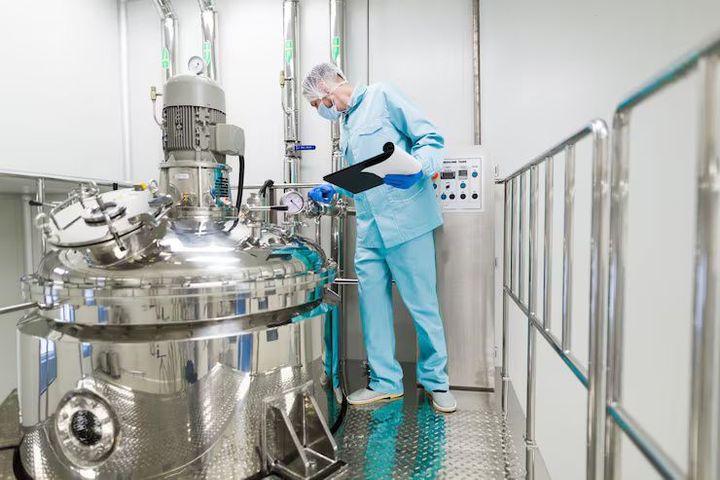
Jacketed mixing vessels help maintain stable heating or cooling conditions throughout production.
How It Works
Industrial chemical mixing follows a structured process.
Step 1: Material Loading
Raw materials are introduced into the mixing vessel.
These may include:
- Liquids
- Powders
- Solvents
- Additives
- Pigments
- Catalysts
Proper loading order improves mixing efficiency.
Step 2: Mixer Activation
The motor rotates the mixing shaft and impeller.
Different impeller designs create various flow patterns depending on the application.
Step 3: Material Circulation
Continuous movement distributes materials throughout the vessel.
This circulation promotes:
- Uniform blending
- Particle suspension
- Dissolution
- Heat transfer
Step 4: Process Monitoring
Operators monitor important production parameters including:
- Mixing speed
- Temperature
- Mixing time
- Viscosity
- Batch consistency
Monitoring helps maintain product quality.
Step 5: Product Discharge
Once mixing is complete, the finished material is discharged for further processing, packaging, or quality inspection.
Benefits and Advantages
Industrial chemical mixers provide numerous production advantages.
Consistent Product Quality
Uniform mixing produces consistent chemical formulations across multiple production batches.
Improved Production Efficiency
Automated mixing systems reduce manual handling and improve manufacturing productivity.
Better Process Control
Modern control systems allow accurate adjustment of speed, temperature, and mixing duration.
Reduced Material Waste
Efficient mixing improves raw material utilization and minimizes product variation.
Wide Material Compatibility
Industrial mixers process various materials including:
- Liquids
- Powders
- Slurries
- Pastes
- High-viscosity compounds
Scalable Production
Mixing systems are available for laboratory research, pilot plants, and large-scale industrial manufacturing.
Real-World Examples or Applications
Industrial chemical mixers are widely used across many industries.
Chemical Manufacturing
Chemical plants use mixers for:
- Industrial solvents
- Cleaning compounds
- Industrial acids
- Chemical additives
- Process chemicals
Paint and Coatings
Mixers disperse pigments and additives to produce uniform paint formulations with consistent color and texture.
Pharmaceutical Manufacturing
Pharmaceutical production uses precision mixing for:
- Liquid medicines
- Creams
- Ointments
- Suspensions
- Topical formulations
Water Treatment
Water treatment facilities use mixing equipment for chemical dosing, pH adjustment, and coagulant preparation.
Cosmetic Manufacturing
Cosmetic manufacturers prepare products such as:
- Lotions
- Creams
- Shampoos
- Gels
- Skin care formulations
Petrochemical Industry
Petrochemical facilities rely on industrial mixers during blending, additive preparation, and specialty chemical production.
Important Factors to Understand
Several considerations influence mixer selection.
Material Properties
Factors include:
- Density
- Viscosity
- Particle size
- Abrasiveness
- Chemical compatibility
Understanding these properties improves equipment selection.
Mixing Time
Different formulations require different mixing durations depending on product characteristics.
Cleaning Requirements
Industries with strict quality standards often require equipment designed for efficient cleaning between production batches.
Production Capacity
Mixer size should match expected production volume while allowing future expansion.
Energy Efficiency
Modern industrial mixers increasingly use energy-efficient motors and intelligent drive systems to reduce power consumption.
Future Trends and Industry Insights
Industrial mixing technology continues evolving with automation and digital manufacturing.
Smart Mixing Systems
Modern mixers use sensors to monitor:
- Speed
- Temperature
- Torque
- Viscosity
- Production consistency
Real-time monitoring improves process control.
Artificial Intelligence
Artificial intelligence helps optimize mixing parameters by analyzing production data and identifying opportunities for improved efficiency.
Industrial Automation
Automated production lines integrate mixers with pumps, storage tanks, filling equipment, and quality monitoring systems.
Internet of Things Integration
Connected equipment enables remote monitoring, predictive maintenance, and production analysis through industrial networks.
Sustainable Manufacturing
Manufacturers continue developing energy-efficient mixing equipment designed to reduce environmental impact while maintaining high production performance.
Conclusion
Industrial mixers for chemicals are essential components of modern manufacturing. They support accurate blending, improved product consistency, efficient production, and reliable process control across industries including chemicals, pharmaceuticals, water treatment, cosmetics, petrochemicals, and paints.
Choosing the appropriate mixing system depends on material characteristics, production capacity, process requirements, and desired product quality. Technologies such as high shear mixers, agitator systems, ribbon blenders, paddle mixers, and planetary mixers provide solutions for a wide range of industrial applications.
As manufacturing technology advances, intelligent automation, artificial intelligence, connected monitoring systems, and energy-efficient designs will continue improving chemical mixing operations, supporting safer, more efficient, and higher-quality industrial production.