Industrial Systems Engineering: AI, Automation & Digital Engineering Guide
Industrial systems engineering is a multidisciplinary approach to designing and improving complex production and operational environments. It brings together mechanical engineering, electrical systems, software, industrial automation, data analytics, artificial intelligence, and process management.
Traditional engineering often focuses on an individual machine, component, or process. Systems engineering looks at how many elements interact as one larger system. In a modern factory, this can include production equipment, sensors, programmable logic controllers, robots, industrial networks, databases, operators, quality systems, and energy management.
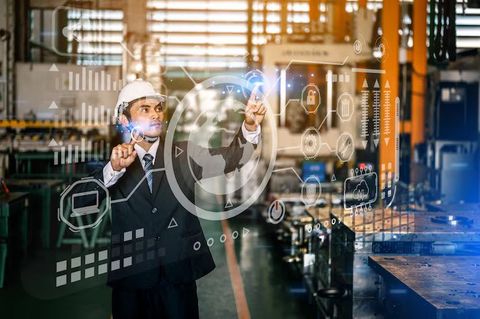
The growth of Industry 4.0 has made this approach increasingly important. Digital engineering allows engineers to create digital models, analyze operational data, test scenarios, and identify potential problems before changes are introduced to physical equipment.
Artificial intelligence adds another layer. AI and machine learning can analyze large volumes of industrial data, identify patterns, support predictive maintenance, and assist with quality monitoring. A 2026 NIST roadmap identifies industrial big-data analytics, digital twins, robotics, autonomous systems, sustainable manufacturing, generative AI, and explainable AI among important areas of smart manufacturing development.
Why Industrial Systems Engineering Matters Today
Modern industrial environments are becoming more connected and data-driven. A production line may contain hundreds or thousands of sensors generating information about temperature, vibration, pressure, speed, energy consumption, and equipment status.
Industrial systems engineering provides a structured way to manage this complexity.
It can help organizations address problems such as:
- Unplanned equipment downtime
- Production bottlenecks
- Quality variation
- Inefficient energy usage
- Poor communication between machines
- Disconnected industrial data
- Cybersecurity risks
- Difficulties integrating older equipment with newer technologies
- Limited visibility across production processes
AI automation can support decision-making by identifying patterns that may be difficult to detect manually. For example, machine-learning models can examine vibration and temperature data to identify conditions associated with equipment degradation.
Digital twins can also represent physical assets or processes digitally. Engineers can use these models to study possible operating conditions and evaluate changes before applying them to physical systems.
The field affects many industries, including manufacturing, automotive production, aerospace, pharmaceuticals, energy, logistics, electronics, food processing, and infrastructure.
A 2025 NIST manufacturing publication highlighted applications such as predictive maintenance and generative design while also identifying data quality and availability as important implementation challenges.
How AI, Automation, and Digital Engineering Work Together
These technologies perform different but connected roles.
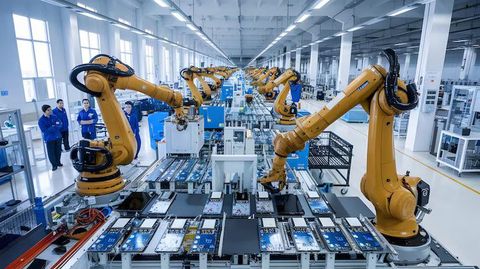
Industrial automation controls physical processes. PLCs, robots, sensors, drives, and control systems can execute repetitive operations with defined rules.
Artificial intelligence analyzes information and supports decisions. Machine learning can detect patterns, classify images, forecast equipment conditions, and identify unusual behavior.
Digital engineering creates connected digital representations of products, processes, equipment, and systems. It supports modeling, simulation, testing, and lifecycle management.
Together, they can create a more connected industrial environment.
For example, a smart production system could collect vibration information from a motor, transfer that data through an industrial network, analyze it with an AI model, and provide an alert when the pattern differs from expected operating conditions.
The engineering challenge is not simply adding AI to existing equipment. The complete system needs appropriate data, reliable communication, cybersecurity controls, human oversight, and clearly defined operational requirements.
Recent Developments in Industrial Systems Engineering
Several developments during 2025 and 2026 have influenced industrial engineering.
In July 2026, NIST published its Roadmap on Artificial Intelligence and Machine Learning for Smart Manufacturing. It identifies digital twins, robotics, autonomous systems, industrial data analytics, generative AI, foundation models, explainable AI, and reliability-related methods as areas of continuing development.
Industrial cybersecurity has also received greater attention. IEC published IEC PAS 62443-2-2:2025 in March 2025, providing guidance for industrial automation and control system security protection schemes.
Another development is IEC PAS 62443-1-6:2025, published in December 2025, which addresses applying the IEC 62443 cybersecurity series to Industrial Internet of Things environments.
The broader direction is toward systems that combine physical equipment, connected sensors, software, AI models, digital twins, and cybersecurity controls rather than treating each technology as an isolated component.
Selected Technology Areas
| Technology | Main Industrial Role |
|---|---|
| AI and Machine Learning | Data analysis and prediction |
| Industrial Robotics | Automated physical operations |
| Digital Twins | Modeling and simulation |
| IoT Sensors | Real-time data collection |
| PLC Automation | Machine and process control |
| Edge Computing | Local data processing |
| Cloud Platforms | Large-scale data management |
| Industrial Cybersecurity | Protection of connected systems |
Laws, Regulations, and Engineering Policies
Industrial systems engineering can be affected by several layers of regulation. Requirements vary according to the country, industry, equipment, data, and intended application.
In the European Union, the EU AI Act is particularly relevant to organizations developing or deploying certain AI systems. The Act entered into force in August 2024, with different requirements becoming applicable over several dates. The majority of its rules began applying on 2 August 2026, while certain high-risk provisions have later application dates.
For high-risk AI systems embedded in regulated physical products covered by Annex I, including certain machinery, the current implementation timeline extends to 2 August 2028 following the 2026 regulatory changes.
The EU Machinery Regulation (EU) 2023/1230 is also important for machinery placed on the EU market. Its general application date is 20 January 2027. It establishes requirements concerning machinery safety and related products.
Cybersecurity is another important policy area. The IEC 62443 family provides internationally recognized frameworks for industrial automation and control system cybersecurity. IEC 62443-2-1:2024, for example, addresses security-program requirements for industrial automation and control system asset owners.
Organizations should therefore evaluate applicable national legislation, machinery requirements, workplace safety rules, cybersecurity frameworks, privacy obligations, and sector-specific regulations before implementing advanced industrial technologies.
Tools and Resources for Industrial Systems Engineering
Engineers and students can use several categories of tools to understand and develop industrial systems.
System modeling tools can represent components, relationships, requirements, and system behavior.
Simulation platforms can help evaluate production processes, mechanical behavior, control logic, and operating scenarios before physical implementation.
Digital twin platforms can connect digital models with information from physical equipment and sensors.
Industrial data analytics tools can organize production information and support trend analysis, anomaly detection, and predictive models.
Automation development environments can be used for PLC programming, HMI development, robotics programming, and industrial control configuration.
AI and machine-learning frameworks can support classification, forecasting, computer vision, anomaly detection, and optimization.
Cybersecurity assessment tools can help identify vulnerabilities, monitor industrial networks, and evaluate security controls.
Useful learning resources include:
- Systems engineering textbooks and technical courses
- Industrial automation documentation
- Engineering simulation tutorials
- Digital twin learning materials
- Industrial cybersecurity frameworks
- AI and machine-learning documentation
- Government manufacturing research publications
- Engineering standards and technical specifications
A practical learning path usually begins with systems thinking and industrial fundamentals before moving into automation, data analytics, AI, digital twins, and cybersecurity.
Frequently Asked Questions
What is industrial systems engineering?
Industrial systems engineering is the practice of analyzing and designing interconnected industrial systems. It considers equipment, software, people, processes, data, control systems, and their interactions.
How is AI used in industrial engineering?
AI can analyze industrial data for applications such as predictive maintenance, quality inspection, anomaly detection, process optimization, forecasting, and decision support. Its usefulness depends heavily on data quality, system design, validation, and human oversight.
What is the role of digital twins?
A digital twin is a digital representation of a physical asset, process, or system. Depending on its design, it can support monitoring, simulation, analysis, testing, and lifecycle management.
Why is industrial cybersecurity important?
Connected machines and control systems can introduce cybersecurity risks. Protecting industrial systems helps maintain system integrity, availability, confidentiality where applicable, and safe operation.
Will automation replace all human involvement?
Automation changes how people interact with industrial systems, but many applications still require human planning, supervision, engineering judgment, maintenance, safety management, and exception handling. The level of human involvement depends on the system and its risk profile.
Conclusion
Industrial systems engineering is evolving from traditional process optimization toward an integrated discipline combining automation, artificial intelligence, digital engineering, data analytics, robotics, and cybersecurity.