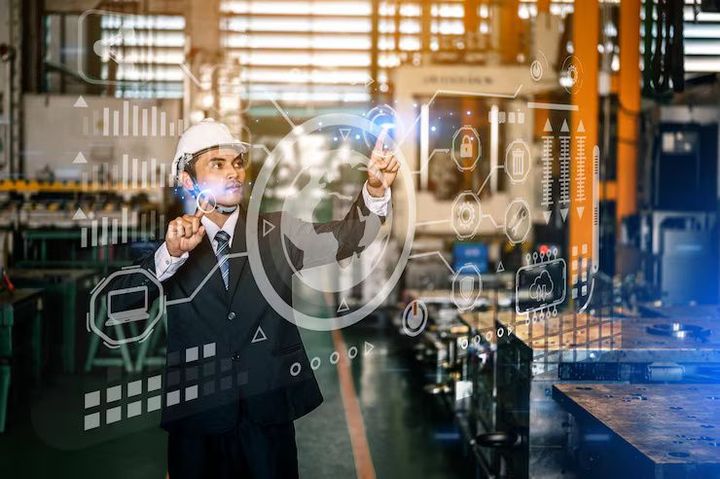
Manufacturing Excellence Guide: From Factory Floor to Global Industries
Manufacturing excellence is the continuous effort to make industrial production more efficient, consistent, safe, flexible, and environmentally responsible. It covers much more than machines on a factory floor. It includes production planning, industrial automation, quality control, supply chain management, workforce skills, maintenance, energy management, and the use of data.
The idea exists because manufacturing environments must handle many challenges at the same time. A factory may need to maintain consistent product quality while managing raw materials, production schedules, equipment performance, energy consumption, workplace safety, and changing customer requirements.
A modern manufacturing system therefore connects several activities into one coordinated process. Raw materials enter the production system, machines transform them, quality checks verify the output, and digital records help managers understand how the process is performing.
Manufacturing excellence does not mean that every factory needs the newest technology. A practical approach starts by understanding the production process and identifying where delays, defects, waste, downtime, or unnecessary resource use occur.
Common elements include:
- Production planning and process optimization
- Industrial machinery and automation
- Quality management systems
- Preventive and predictive maintenance
- Inventory and supply chain planning
- Energy and resource management
- Worker training and workplace safety
- Manufacturing data analysis
- Continuous improvement programs
Why Manufacturing Excellence Matters Today
Manufacturing has become increasingly connected to global supply chains. A disruption in one region can affect production schedules in another. This makes resilience, inventory planning, supplier diversification, and production flexibility increasingly important.
Manufacturing excellence also affects businesses of different sizes. Large industrial plants may use advanced robotics, industrial Internet of Things systems, and automated inspection. Smaller manufacturers may gain substantial improvements from better production scheduling, preventive maintenance, standardized procedures, and basic data tracking.
Quality is another major reason the concept matters. In industries such as automotive, electronics, aerospace, pharmaceuticals, medical devices, food processing, and industrial equipment, inconsistent production can create significant technical and regulatory challenges.
Modern manufacturing also increasingly focuses on sustainability. Efficient machinery, energy monitoring, material optimization, waste reduction, and circular production methods can help manufacturers use resources more responsibly.
The following areas are particularly important:
| Area | Main Objective | Typical Improvement Focus |
|---|---|---|
| Production | Consistent output | Workflow and scheduling |
| Quality | Reliable products | Inspection and process control |
| Maintenance | Equipment availability | Preventive and predictive methods |
| Automation | Repeatable operations | Robotics and control systems |
| Energy | Efficient resource use | Monitoring and optimization |
| Supply Chain | Reliable material flow | Planning and inventory visibility |
| Workforce | Strong operational capability | Training and digital skills |
For manufacturers entering international markets, these capabilities can also support compliance with technical specifications, quality expectations, documentation requirements, and supply-chain standards.
Recent Manufacturing Trends and Updates
Manufacturing developments during 2025 and 2026 show a stronger focus on technology, domestic production capacity, advanced industries, and integration with global value chains.
In India, the government reported in February 2026 that manufacturing GVA grew by 7.72% in the first quarter and 9.13% in the second quarter of FY 2025–26. The same update highlighted the growing contribution of medium- and high-technology industries to manufacturing value added.
A significant policy development has been the continued implementation of Production Linked Incentive programs across 14 sectors. By 31 December 2025, the programs had recorded more than ₹2.16 lakh crore in cumulative investment and more than ₹20.41 lakh crore in production or sales, according to government data released in March 2026.
The manufacturing landscape also received a new technology and measurement perspective in June 2026. India released a revised Index of Industrial Production series with a 2022–23 base year. For May 2026, industrial production recorded 5.1% year-on-year growth, while manufacturing recorded 5.5% growth.
Another important development occurred in February 2026, when the Ministry of Steel announced 85 projects involving ₹11,887 crore of committed investment under the specialty steel PLI 1.2 program. The projects represented planned downstream steel and alloy-making capacity.
In July 2026, India also approved a Mobile Phone Manufacturing Scheme with a ₹62,500 crore budgetary outlay for FY 2026–27 through FY 2030–31. The program focuses on increasing domestic value addition, strengthening supply chains, and expanding mobile-phone manufacturing capabilities.
These developments reflect several broader manufacturing trends:
- Greater use of industrial automation and robotics
- Expansion of electronics and semiconductor ecosystems
- Increasing use of manufacturing analytics
- Stronger focus on domestic supply chains
- Growth of advanced materials and specialty manufacturing
- Greater attention to energy efficiency and sustainability
- Integration of artificial intelligence into selected industrial processes
Artificial intelligence is also becoming relevant to manufacturing analytics, quality inspection, maintenance forecasting, and production planning. However, its usefulness depends on reliable data, suitable infrastructure, trained personnel, and clear operational objectives.
Laws, Policies, and Manufacturing Frameworks in India
Manufacturing in India operates within a broad regulatory environment covering factories, labor, environmental protection, product quality, taxation, industrial safety, and sector-specific requirements.
The National Manufacturing Mission announced in the Union Budget 2025–26 provides a policy framework focused on areas including ease of doing business, a future-ready workforce, stronger MSMEs, technology availability, and product quality.
The Economic Survey 2025–26 describes the National Mission on Manufacturing as a long-term framework for strengthening India's manufacturing capabilities and global value-chain participation.
The Production Linked Incentive framework is another important policy mechanism. It covers 14 strategic sectors, including electronics, pharmaceuticals, automobiles and components, advanced chemistry cell batteries, solar PV modules, telecommunications equipment, textiles, specialty steel, food processing, and selected other industries.
Manufacturers must also consider applicable environmental and workplace requirements. Depending on the industry and facility, these can involve pollution control, hazardous material handling, waste management, occupational safety, electrical safety, fire protection, and factory-related regulations.
For companies working across international markets, additional technical requirements may apply depending on the destination country and product category. Quality management frameworks, product standards, documentation systems, and conformity requirements can therefore become important parts of manufacturing planning.
Regulations change over time, so manufacturers should verify the latest requirements with the relevant government authority or qualified regulatory professional before making compliance decisions.
Tools and Resources for Manufacturing Improvement
Manufacturing improvement can begin with simple analytical tools and gradually develop into advanced digital systems.
Useful resources include:
- Production planning worksheets for tracking output and schedules
- Overall Equipment Effectiveness calculators for equipment performance analysis
- Pareto analysis templates for identifying major sources of defects
- Root-cause analysis worksheets for investigating production problems
- Preventive maintenance schedules for critical equipment
- Inventory planning spreadsheets for material requirements
- Energy monitoring dashboards for tracking industrial consumption
- Quality-control checklists for production inspections
- Process mapping templates for identifying workflow delays
- Statistical process control tools for monitoring process variation
- Digital dashboards for production and quality data
- Computerized maintenance management systems for equipment records
- Manufacturing execution systems for production visibility
- Industrial IoT platforms for connected equipment monitoring
A useful starting point is to establish a small number of measurable indicators. Examples include production output, defect rate, downtime, equipment availability, energy consumption per unit, production lead time, and on-time completion.
The objective is not to collect every possible metric. The objective is to collect information that helps decision-makers understand production performance and identify practical improvements.
Frequently Asked Questions
What does manufacturing excellence mean?
Manufacturing excellence is a structured approach to improving production quality, efficiency, reliability, safety, flexibility, and resource use. It combines people, processes, equipment, technology, and measurement.
Why is automation important in modern manufacturing?
Automation can improve repeatability, reduce manual handling in appropriate processes, support consistent production, and provide useful operational data. Its value depends on the process and how well the technology is implemented.
How does artificial intelligence affect manufacturing?
Artificial intelligence can support applications such as visual inspection, predictive maintenance, production forecasting, anomaly detection, and process analysis. It works best when manufacturers have reliable data and clearly defined operational objectives.
What are the main challenges in achieving manufacturing excellence?
Common challenges include equipment downtime, inconsistent quality, inefficient workflows, supply-chain disruption, skills gaps, outdated processes, limited data visibility, and difficulties integrating new technologies with existing systems.
How can a factory begin improving manufacturing performance?
A practical starting point is to map the production process, identify major bottlenecks, establish measurable performance indicators, analyze root causes, and implement improvements in stages. Regular measurement helps determine whether changes are producing the intended results.
Conclusion
Manufacturing excellence is an ongoing process rather than a single technology or production method. It connects efficient processes, reliable equipment, quality management, skilled workers, digital information, and responsible resource use.