Learn Industrial 3D Scanners Basics for Engineering and Design Applications
Industrial 3D scanners are advanced devices used to capture the shape, size, and surface details of physical objects and convert them into digital 3D models. These scanners work by using technologies such as laser triangulation, structured light, or photogrammetry to gather precise spatial data.
Industrial 3D scanners provide fast, accurate, and repeatable measurements, addressing the limitations of traditional tools like calipers or coordinate measuring machines (CMMs). They are essential for complex geometries where precision and efficiency are critical.
Industries such as automotive, aerospace, healthcare, and manufacturing use 3D scanning to create digital replicas of objects. These digital models help engineers analyze parts, detect defects, and enhance product development cycles.
Why Industrial 3D Scanners Matter Today
Industrial 3D scanners have become vital as industries adopt digital transformation and automation. They help professionals capture precise data efficiently, ensuring consistency in production and design.
Key Benefits
- Improved Accuracy: High-resolution scanning for precise measurements
- Time Efficiency: Faster data collection compared to manual methods
- Quality Control: Detects defects and deviations in production
- Reverse Engineering: Recreates legacy parts without original designs
- Digital Documentation: Creates permanent records for analysis and storage
These scanners support engineers, quality inspectors, product designers, and researchers, solving problems like design inconsistencies, manufacturing defects, and inspection inefficiencies.
Recent Updates and Trends (2024–2025)
Industrial 3D scanning technology has seen notable advancements in the past year.
Key Trends
- AI and Machine Learning Integration: Automatically detect defects and optimize scan data
- Portable and Handheld Devices: Enable on-site inspections in factories and field environments
- Cloud-Based Data Processing: Store and analyze large 3D datasets remotely
- Higher Scanning Speeds: Faster capture without compromising accuracy
- Digital Twin Adoption: 3D scanning increasingly used to create digital twins for system monitoring
These trends reflect a move toward smarter, connected industrial ecosystems that enhance productivity and reduce downtime.
Regulations and Policies Affecting Industrial 3D Scanners
Industrial 3D scanning must comply with standards and regulations to ensure safety, accuracy, and data reliability.
Key Regulatory Considerations
- Quality Standards: Compliance with ISO standards such as ISO 10360
- Data Protection: Follow cybersecurity and data privacy guidelines
- Industry-Specific Regulations: Aerospace and medical sectors require strict validation
- Government Initiatives: Programs like Make in India encourage advanced manufacturing adoption
- Workplace Safety Norms: Safety protocols for laser-based scanners
These rules maintain trust in industrial processes while promoting innovation.
Tools and Resources for Industrial 3D Scanning
Industrial 3D scanning workflows rely on specialized software, hardware, and platforms for processing and analysis.
Common Tools
- 3D Scanning Software: Converts raw scan data into usable models
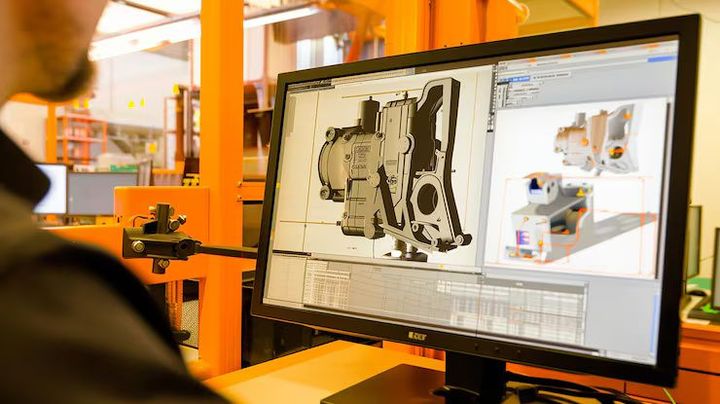
- CAD Software: Integrates scanned data into design workflows
- Inspection Software: Compares scanned models with original designs
- Cloud Platforms: Store and share large datasets
- Simulation Tools: Analyze scanned models for stress and performance
3D Scanning Technology Comparison Table
| Technology Type | Accuracy Level | Speed | Best Use Case |
|---|---|---|---|
| Laser Scanning | High | Medium | Precision engineering parts |
| Structured Light | Very High | Fast | Quality inspection and design |
| Photogrammetry | Moderate | Slower | Large objects and environments |
Industrial 3D Scanning Workflow
- Object preparation and positioning
- Data capture using a 3D scanner
- Processing scan data into a digital model
- Analyzing and comparing results
- Exporting data for design or inspection
This structured workflow ensures consistent and reliable results.
Frequently Asked Questions (FAQs)
What industries use industrial 3D scanners?
Automotive, aerospace, healthcare, construction, and manufacturing widely use 3D scanners for design, inspection, and analysis.
How accurate are industrial 3D scanners?
Accuracy depends on technology, but many scanners achieve precision within microns, suitable for high-precision tasks.
Can 3D scanners replace traditional measurement tools?
They complement traditional tools. For complex shapes and large datasets, 3D scanners are more efficient.
What is reverse engineering in 3D scanning?
Reverse engineering creates digital models from physical objects, often when original design files are unavailable.
Are industrial 3D scanners difficult to use?
Modern scanners are user-friendly, but proper training ensures accurate results.
Conclusion
Industrial 3D scanners are transforming how industries measure, analyze, and optimize physical objects. By providing precise, fast, and repeatable measurements, they enhance quality control, design processes, and production workflows.
With advancements like AI integration, cloud connectivity, and portable devices, 3D scanning is becoming more accessible and powerful. Supportive regulations and increasing industry adoption make these tools essential in modern manufacturing and engineering. Understanding their capabilities, applications, and trends enables organizations to make informed decisions and stay at the forefront of technological progress.