Motor Winding Machine Guide: Types, Working and Uses Explained
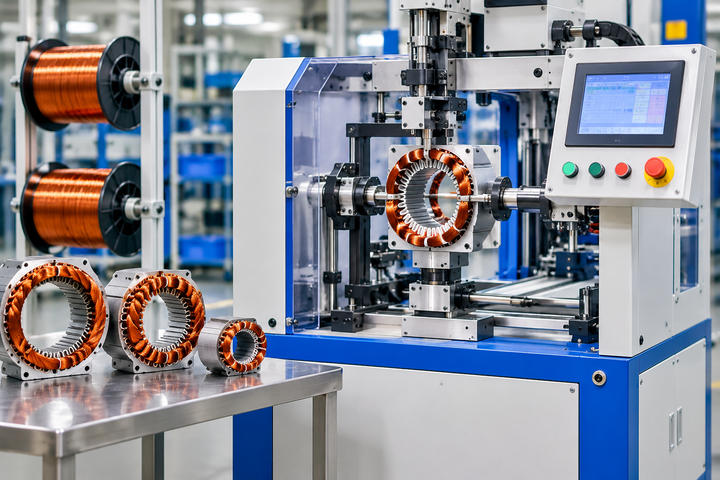
A motor winding machine is specialized industrial equipment used to wind insulated copper or aluminum wire into coils for electric motors and other electromagnetic devices.
It controls wire placement, winding tension, coil turns, and positioning to produce consistent motor windings. These machines range from manually operated equipment to fully automated systems used in large-scale motor manufacturing.
Motor winding technology supports the production of stators, rotors, armatures, and other electrical components. Understanding its machine types, operating principles, components, and industrial applications helps explain how electric motor manufacturing achieves accuracy and repeatability.
Quick Facts About Motor Winding Machines
The following table summarizes the essential characteristics of motor winding equipment.
Feature | Details |
|---|---|
Equipment Name | Motor Winding Machine |
Alternative Name | Electric Motor Coil Winding Machine |
Primary Function | Winding insulated conductors into electrical coils |
Main Materials | Enamel-coated copper and aluminum wire |
Main Workpieces | Stators, rotors, armatures, and coil formers |
Common Machine Types | Flyer, needle, linear, and rotary winding machines |
Operating Modes | Manual, semi-automatic, and fully automatic |
Main Components | Spindle, wire guide, tensioner, controller, and winding fixture |
Control Technologies | PLC, CNC, servo motors, and electronic controllers |
Main Industries | Automotive, electrical equipment, appliances, and industrial machinery |
Key Process Parameters | Wire tension, winding speed, turn count, and coil arrangement |
What Is a Motor Winding Machine?
A motor winding machine is a manufacturing device designed to place insulated electrical wire into specific coil patterns. These coils are installed in the stator or rotor of an electric motor and create the electromagnetic fields required for motor operation.
The machine controls the movement of the wire and the component being wound. Depending on its design, it may rotate a spindle, move a winding needle, guide a flyer around a core, or coordinate multiple mechanical axes.
Motor winding machines are used in manufacturing facilities to produce consistent coils for different motor designs. They can handle various conductor diameters, coil geometries, winding patterns, and production requirements.
For example, an electric motor stator contains multiple coils arranged within slots in its laminated steel core. A winding machine positions insulated copper wire into these slots according to a predefined winding configuration.
The accuracy of this process affects electrical resistance, insulation integrity, winding distribution, and the overall performance of the finished motor.
Why Motor Winding Machines Are Important in Motor Manufacturing
Electric motors depend on correctly arranged electrical windings to generate the magnetic fields needed for energy conversion. The winding process must maintain the required number of turns, conductor positioning, and electrical connections.
Manual winding can be suitable for certain repair activities and low-volume production. However, complex motor designs require consistent wire placement and repeatable manufacturing processes.
Motor winding machines address these requirements through controlled mechanical movements and adjustable operating parameters.
Their importance can be understood through several manufacturing functions:
Winding consistency: Maintains repeatable coil arrangements across production batches.
Wire tension control: Helps prevent excessive stretching, wire breakage, and loose winding.
Turn accuracy: Controls the number of conductor turns required for a specific coil.
Production efficiency: Reduces repetitive manual winding activities.
Material utilization: Supports organized wire placement and reduces unnecessary conductor waste.
Manufacturing flexibility: Allows suitable machines to accommodate different coil configurations and motor designs.
Process repeatability: Stores and reproduces winding programs in programmable equipment.
The choice of winding equipment depends on motor construction, conductor characteristics, production volume, and the required winding geometry.
How Does a Motor Winding Machine Work?
A motor winding machine operates by feeding insulated wire from a supply spool and guiding it around a designated component or winding fixture. The machine coordinates wire movement, rotation, positioning, and tension to create the required coil arrangement.
The exact sequence varies between flyer, needle, and other winding technologies, but the general operating process follows several stages.
1. Workpiece Preparation
The stator, rotor, armature, bobbin, or winding former is positioned in the machine fixture.
The workpiece must be correctly aligned so that the wire can follow the required winding path without damaging the component or its insulation.
2. Wire Feeding
Insulated copper or aluminum wire is supplied from a spool through a feeding mechanism.
The wire passes through guides and tension-control components before reaching the winding head.
3. Wire Tension Regulation
A tensioning system maintains controlled resistance as the wire moves through the machine.
Proper tension helps maintain consistent coil placement while reducing the risk of conductor stretching, insulation damage, or loose turns.
4. Coil Formation
The winding mechanism moves the wire around the workpiece or winding fixture.
Depending on the machine design, this movement may be produced by a rotating flyer, reciprocating needle, rotating spindle, or coordinated mechanical axes.
5. Turn Counting and Positioning
The machine tracks the number of turns and controls the wire position according to the programmed winding pattern.
Automatic equipment may use electronic counters, servo motors, sensors, and programmable controllers to coordinate these operations.
6. Wire Cutting and Termination
After the required winding is completed, the wire is cut and prepared for the next manufacturing operation.
Some machines also perform automatic wire gripping, lead positioning, or termination-related operations.
7. Winding Inspection
The completed coil is inspected for winding arrangement, conductor damage, turn accuracy, and other process requirements.
Depending on the production system, additional electrical testing may be performed after winding or during subsequent motor assembly.
The following table summarizes the general winding workflow.
Manufacturing Stage | Machine Operation | Expected Result |
|---|---|---|
Preparation | Positions the workpiece | Correct component alignment |
Feeding | Supplies insulated wire | Continuous conductor delivery |
Tension Control | Regulates wire resistance | Consistent wire handling |
Winding | Forms the required coil | Organized conductor arrangement |
Counting | Tracks winding turns | Required turn quantity |
Cutting | Separates completed winding | Prepared coil leads |
Inspection | Checks winding quality | Verified winding condition |
Main Types of Motor Winding Machines
Motor winding machines are classified according to their winding mechanism, workpiece design, and automation level. The most suitable configuration depends on the accessibility of the winding area and the geometry of the required coil.
1. Flyer Winding Machine
A flyer winding machine uses a rotating arm or flyer to guide wire around a coil former, stator pole, or other winding component.
As the flyer rotates, it distributes the conductor around the designated winding area. The workpiece may remain stationary or move through an indexing mechanism, depending on the machine configuration.
Flyer winding is commonly used for externally accessible winding areas and coil geometries that can be reached through rotary wire movement.
Main characteristics:
Uses a rotating flyer to distribute wire.
Suitable for many bobbin and pole-winding applications.
Can support single or multiple winding stations.
Available in programmable automatic configurations.
Typical applications: Motor coils, transformer coils, hub motor stators, and electrical components.
2. Needle Winding Machine
A needle winding machine uses a guided needle or nozzle to carry insulated wire into specific winding slots.
The needle moves through or near the winding area while the workpiece is positioned or indexed to create the required coil pattern.
This technology is particularly useful when winding spaces are difficult to access using a conventional rotating flyer.
Main characteristics:
Uses a reciprocating wire-guiding needle.
Supports internal and external stator winding configurations.
Can produce concentrated and certain distributed winding arrangements.
Allows precise wire routing through restricted spaces.
Typical applications: BLDC motor stators, electric vehicle motor components, industrial motors, and specialized electrical machines.
3. Linear Winding Machine
A linear winding machine uses controlled linear movement to position the wire along a winding path.
The winding head, workpiece, or both may move along programmed axes to produce specific coil geometries. Depending on the configuration, linear winding technology can support specialized stator and coil manufacturing processes.
Main characteristics:
Uses coordinated linear movement.
Supports programmable wire positioning.
Can accommodate specialized winding geometries.
May be integrated with automated handling equipment.
Typical applications: Specialized stator assemblies, segmented motor components, and customized electromagnetic coils.
4. Rotary Winding Machine
A rotary winding machine uses controlled rotational movement of the workpiece or winding mechanism to distribute wire around a component.
The machine coordinates rotation with wire feeding and positioning to produce the required coil arrangement.
The exact mechanism varies by design, and rotary motion may also be incorporated into flyer and other winding technologies.
Main characteristics:
Uses rotational movement during coil formation.
Supports repeatable winding patterns.
Can be integrated with automatic indexing.
Suitable for specific cylindrical and rotational coil geometries.
Typical applications: Motor armatures, rotor components, cylindrical coils, and specialized electrical assemblies.
5. Stator Winding Machine
A stator winding machine is specifically designed to place conductors into the slots or winding positions of a motor stator.
Its configuration depends on whether the stator has internal or external slots, the available winding space, and the required coil arrangement.
Needle and flyer mechanisms are commonly used for different stator geometries.
Main characteristics:
Designed around stator dimensions and slot arrangements.
Supports different coil configurations.
May include automatic core indexing.
Can integrate with coil insertion and connection processes.
Typical applications: Induction motors, BLDC motors, permanent-magnet motors, and industrial motor stators.
6. Rotor and Armature Winding Machine
Rotor and armature winding machines are designed to produce coils on rotating motor components.
In wound-rotor induction motors and certain synchronous machines, conductors are arranged within rotor slots according to the required electrical design.
Armature winding machines are also used for DC motor and generator components that contain wound armatures.
Main characteristics:
Designed for specific rotor or armature geometries.
Supports controlled coil placement and turn counting.
Can accommodate specialized winding patterns.
May include dedicated fixtures and indexing mechanisms.
Typical applications: DC motors, wound-rotor induction motors, generators, and specialized rotating electrical equipment.
Motor Winding Machine Type Comparison
The following comparison highlights the differences between common winding mechanisms and application-specific machines.
Machine Type | Winding Mechanism | Main Application | Key Characteristic |
|---|---|---|---|
Flyer Winding | Rotating wire guide | Coil and pole winding | Rotary wire distribution |
Needle Winding | Reciprocating wire guide | Stator winding | Access to restricted winding spaces |
Linear Winding | Controlled linear movement | Specialized coils | Programmable linear positioning |
Rotary Winding | Rotational movement | Cylindrical and rotating components | Coordinated rotation |
Stator Winding | Stator-specific winding arrangement | Motor stators | Designed around stator slots |
Rotor and Armature Winding | Component-specific winding | Rotors and armatures | Specialized rotating-part geometry |
These categories are not entirely separate. For example, a stator winding machine may use either flyer or needle winding technology.
Manual vs Semi-Automatic vs Fully Automatic Motor Winding Machines
Another way to classify motor winding equipment is according to its automation level. This classification describes how much of the winding process is controlled by the machine rather than the operator.
Manual Motor Winding Machine
A manual winding machine relies primarily on operator-controlled movement and adjustment.
The operator guides the conductor, controls winding movement, and monitors the number of turns. These machines are commonly used where production quantities are limited or winding configurations require frequent manual adjustments.
Advantages:
Simple operating arrangement.
Suitable for repair and prototype activities.
Direct operator control over winding operations.
Flexible for certain specialized winding tasks.
Semi-Automatic Motor Winding Machine
A semi-automatic machine combines motor-driven winding mechanisms with operator-controlled preparation or handling.
The equipment may automatically rotate the spindle and count turns while the operator positions components, manages wire connections, or performs loading and unloading.
Advantages:
Reduces repetitive manual winding.
Provides controlled spindle movement.
Supports more consistent turn counting.
Suitable for small and medium production operations.
Fully Automatic Motor Winding Machine
A fully automatic winding machine uses programmable controls, motors, sensors, and automated mechanisms to perform multiple winding operations.
Depending on its configuration, it may automatically feed wire, control tension, index the workpiece, count turns, cut wire, and manage different winding programs.
Advantages:
Supports repeatable production processes.
Reduces manual intervention.
Enables coordinated multi-axis movement.
Can integrate with larger motor manufacturing lines.
Main Components of a Motor Winding Machine
A motor winding machine combines mechanical, electrical, and control components to guide wire accurately and maintain the required winding pattern.
The following table explains the main components and their functions.
Component | Primary Function | Importance |
|---|---|---|
Wire Supply Spool | Holds insulated conductor | Provides continuous wire material |
Wire Tensioner | Regulates wire tension | Helps maintain consistent winding |
Wire Guide | Directs wire toward the winding area | Controls conductor placement |
Winding Head | Performs the winding movement | Forms the required coil |
Spindle | Rotates the workpiece or winding mechanism | Provides rotational movement |
Workpiece Fixture | Holds the stator, rotor, or former | Maintains component alignment |
Servo Motor | Controls mechanical positioning | Supports precise movement |
PLC or CNC Controller | Manages machine operations | Coordinates programmed sequences |
Turn Counter | Tracks winding turns | Maintains required coil quantities |
Cutting Mechanism | Separates completed wire | Prepares the winding for subsequent operations |
Safety Enclosure | Protects the operating area | Reduces exposure to moving components |
The number and arrangement of components vary according to machine type, automation level, and production requirements.
Materials and Requirements for Motor Winding
The winding process requires suitable conductor materials, insulation systems, and mechanical components. These materials must match the electrical and thermal requirements of the motor design.
Insulated Copper Wire
Copper wire is widely used in motor winding because of its electrical conductivity and suitability for manufacturing different coil configurations.
Motor winding commonly uses enamel-coated copper conductors. The enamel insulation separates adjacent turns and helps prevent unwanted electrical contact.
Aluminum Wire
Aluminum conductors are also used in selected motor designs. Their electrical and mechanical properties differ from copper, so conductor dimensions and winding parameters must be designed accordingly.
Stator and Rotor Cores
Motor cores are commonly constructed from laminated electrical steel. The slots and geometric arrangement of the core determine how the winding must be positioned.
Insulation Materials
Electrical insulation materials protect conductors from contact with the motor core and other conductive components.
Depending on the motor design, these may include slot liners, insulation papers, phase separators, and other insulating materials.
Winding Fixtures and Tooling
Fixtures hold the workpiece in the correct position during winding. Specialized tooling may be required for different stator sizes, rotor configurations, and coil geometries.
Applications of Motor Winding Machines Across Industries
Motor winding machines are used across industries that manufacture electric motors and electromagnetic components. Their applications depend on the motor design, production requirements, and type of winding configuration.
1. Automotive and Electric Vehicle Manufacturing
Automotive manufacturing uses motor winding equipment for traction motors, auxiliary motors, electric steering systems, pumps, and other electrically driven components.
Electric vehicle production includes different motor architectures, such as permanent-magnet synchronous motors and induction motors. Their winding requirements influence the selection of needle, flyer, and specialized stator winding technologies.
2. Industrial Motor Manufacturing
Industrial motor manufacturers use winding machines to produce stators, rotors, and armatures for equipment used in factories and processing facilities.
Common applications include motors for:
Industrial pumps.
Air compressors.
Conveyor systems.
Machine tools.
Industrial fans.
Material handling equipment.
3. Home Appliance Manufacturing
Household appliances contain different types of electric motors that require accurately manufactured windings.
Motor winding equipment is used in the production of components for washing machines, refrigerators, air conditioners, vacuum cleaners, and other electrically operated appliances.
4. Generator and Alternator Manufacturing
Generators and alternators use electromagnetic windings to convert mechanical energy into electrical energy.
Specialized winding equipment produces stator and rotor coils according to the electrical design of the machine.
The winding arrangement, conductor characteristics, and insulation system must meet the generator's operating requirements.
5. Electrical Equipment Manufacturing
Motor winding machines also support the production of electromagnetic coils used in other electrical equipment.
Applications include certain transformer coils, electromagnetic actuators, solenoid assemblies, and specialized electrical components.
6. Pump and Compressor Manufacturing
Electric motors used in industrial and commercial pumping systems require winding assemblies suited to their operating conditions.
Motor winding equipment helps produce the coils used in pump motors, submersible motors, and compressor drive systems.
7. Renewable Energy Equipment
Wind turbines and other renewable energy installations use generators containing specialized electrical windings.
Motor and generator winding equipment supports the production of stator and rotor assemblies used in these energy conversion systems.
Benefits and Advantages of Motor Winding Machines
Motor winding machines provide several manufacturing advantages when correctly matched with the motor design and production environment.
Consistent coil formation: Programmable winding movements help maintain repeatable conductor arrangements across multiple components.
Controlled wire tension: Tension regulation reduces the risk of loose coils, excessive stretching, and conductor damage.
Improved production efficiency: Automated winding reduces repetitive manual activities and supports continuous manufacturing operations.
Accurate turn counting: Electronic counters and programmable controls help maintain the required number of turns.
Reduced material waste: Controlled wire feeding and cutting can reduce unnecessary conductor consumption.
Flexible production configurations: Programmable equipment can accommodate different winding patterns when the machine has the required mechanical and control capabilities.
Integration with manufacturing lines: Advanced machines can connect with automated loading, inspection, coil insertion, and motor assembly equipment.
Common Motor Winding Machine Challenges and Solutions
Winding quality depends on mechanical accuracy, conductor condition, machine configuration, and process control. The following table describes common manufacturing challenges and suitable corrective approaches.
Common Challenge | Potential Cause | Recommended Solution |
|---|---|---|
Uneven Coil Distribution | Incorrect wire guide positioning | Check guide alignment and winding program |
Wire Breakage | Excessive tension or damaged conductor | Verify tension settings and wire condition |
Insulation Damage | Sharp tooling or excessive mechanical contact | Inspect guides, fixtures, and winding paths |
Incorrect Turn Count | Counter or program configuration error | Verify winding parameters |
Loose Windings | Insufficient or inconsistent tension | Adjust the tension-control system |
Machine Vibration | Mechanical imbalance or loose mounting | Inspect machine structure and rotating components |
Inconsistent Production | Incorrect indexing or positioning | Check servo alignment and workpiece fixtures |
Excessive Wire Waste | Poor cutting or feeding coordination | Review wire feeding and cutting operations |
These problems should be investigated through documented maintenance and process-control procedures. Adjustments to machine parameters should follow the equipment manufacturer's instructions and the approved production specification.
How to Choose a Motor Winding Machine
Selecting a motor winding machine requires an understanding of the motor construction, winding geometry, conductor material, and manufacturing requirements.
A machine designed for bobbin coils may not be suitable for a stator with narrow internal slots. Similarly, a winding process intended for small appliance motors may differ substantially from one used for large industrial motor components.
The following selection criteria help evaluate equipment suitability.
Selection Factor | What to Evaluate | Why It Matters |
|---|---|---|
Motor Type | AC, DC, BLDC, or synchronous motor | Determines winding configuration |
Workpiece Design | Stator, rotor, armature, or bobbin | Defines machine architecture |
Winding Method | Flyer, needle, or other mechanism | Determines wire routing capability |
Wire Characteristics | Conductor material and diameter | Affects feeding and tension requirements |
Coil Geometry | Turns, pitch, and winding pattern | Determines positioning requirements |
Production Volume | Prototype, batch, or continuous production | Influences automation requirements |
Automation Level | Manual, semi-automatic, or automatic | Defines operator involvement |
Control System | PLC, CNC, and servo configuration | Determines programming capabilities |
Tooling Requirements | Fixtures, guides, and winding heads | Affects component compatibility |
Quality Requirements | Turn accuracy and insulation integrity | Defines process verification needs |
Integration | Loading, testing, and assembly equipment | Supports production-line coordination |
Before selecting equipment, manufacturers should evaluate the actual stator or rotor drawings, winding specifications, conductor dimensions, and required production sequence.
A production trial using representative workpieces can help confirm whether the machine achieves the required winding pattern and process consistency.
Motor Winding Machine vs Coil Winding Machine
Motor winding machines and coil winding machines are closely related, but the terms do not always describe identical equipment.
A coil winding machine is a broader category of manufacturing equipment used to produce electromagnetic coils. These coils may be used in motors, transformers, inductors, relays, and other electrical devices.
A motor winding machine is specifically configured for the winding requirements of electric motor components.
Comparison Factor | Motor Winding Machine | General Coil Winding Machine |
|---|---|---|
Primary Application | Electric motor manufacturing | Various electromagnetic components |
Main Workpieces | Stators, rotors, and armatures | Bobbins, formers, and coil cores |
Winding Configuration | Motor-specific winding patterns | Application-dependent coil patterns |
Wire Placement | Often involves slots or motor poles | Depends on coil former geometry |
Machine Tooling | Motor-specific fixtures and guides | Coil-specific fixtures and guides |
Common Industries | Automotive and industrial motor manufacturing | Electrical and electronic manufacturing |
A motor winding machine can therefore be considered a specialized type of coil winding equipment.
Limitations of Motor Winding Machines
Although motor winding machines support accurate and repeatable manufacturing, they have limitations that should be considered during production planning.
Application-specific tooling: Different motor geometries may require dedicated winding heads, fixtures, and wire guides.
Initial setup complexity: Advanced equipment requires appropriate programming, calibration, and mechanical configuration.
Conductor limitations: Wire diameter, insulation type, and material properties affect winding compatibility.
Maintenance requirements: Mechanical drives, tensioners, sensors, and wire guides require periodic inspection.
Operator training: Personnel must understand machine operation, winding programs, and quality requirements.
Production flexibility: A machine optimized for one winding configuration may require substantial retooling for another design.
Quality dependency: Automated winding does not guarantee a defect-free motor. Insulation damage, incorrect connections, and other manufacturing issues still require inspection and testing.
Selecting equipment without considering these limitations can lead to inconsistent winding results and unnecessary production interruptions.
Motor Winding Machine Safety and Industry Standards
Motor winding equipment contains moving mechanical parts, electrical systems, rotating components, and wire-handling mechanisms. Proper machine design and operating procedures are necessary to protect operators and maintain production reliability.
Several recognized standards are relevant to machinery design and electrical equipment.
ISO 12100: Safety of Machinery – General Principles for Design – Risk Assessment and Risk Reduction
ISO 12100 provides a framework for identifying machinery hazards, assessing risks, and applying appropriate risk-reduction measures.
IEC 60204-1: Safety of Machinery – Electrical Equipment of Machines
IEC 60204-1 addresses electrical equipment used in machinery, including electrical control systems, protective measures, and related machine electrical requirements.
IEC 60034 Series: Rotating Electrical Machines
The IEC 60034 series addresses rotating electrical machines. Its various parts cover subjects such as ratings, performance, efficiency, and other motor-related requirements. It is relevant to the electrical machines being manufactured rather than a general specification for winding machine construction.
Important Safety Practices
Motor winding operations should incorporate appropriate protective measures, including:
Guards around rotating and moving mechanisms.
Accessible emergency-stop controls.
Suitable electrical protection and grounding.
Safe wire spool handling procedures.
Appropriate protection against unexpected machine movement.
Documented maintenance and isolation procedures.
Operator training for normal operation and fault conditions.
Machine-specific safety requirements should be evaluated by qualified personnel before equipment is installed or operated.
Motor Winding Machine Maintenance Best Practices
Regular maintenance helps preserve mechanical accuracy, reduce unplanned interruptions, and maintain consistent winding quality.
Inspect Wire Guides and Tensioners
Check wire guides, rollers, tensioning devices, and contact surfaces for wear or damage. Damaged components can affect wire movement and insulation condition.
Check Mechanical Alignment
Inspect spindle alignment, winding fixtures, indexing mechanisms, and moving axes. Mechanical misalignment can create inconsistent coil placement.
Monitor Servo and Drive Systems
Check servo motors, drive connections, and motion-control components according to the manufacturer's maintenance instructions.
Verify Turn Counters and Programs
Confirm that electronic counters, winding programs, and machine positioning settings match the approved production specifications.
Inspect Electrical Connections
Check electrical panels, connectors, sensors, and control wiring for visible damage or abnormal operating conditions.
Maintain Machine Cleanliness
Remove accumulated wire fragments, dust, and manufacturing debris using approved cleaning procedures. Keep moving mechanisms and work areas clear.
Review Winding Quality
Inspect completed coils for turn arrangement, wire damage, and other relevant defects. Electrical testing should follow the motor design and manufacturing quality requirements.
Future Trends in Motor Winding Machine Technology
Motor winding technology continues to develop alongside electric vehicle manufacturing, industrial automation, and advanced electrical machine designs.
Several developments are influencing modern winding equipment.
Advanced Servo-Controlled Winding
Servo-driven motion systems provide coordinated control of winding heads, workpiece indexing, and wire positioning. Improved motion coordination supports complex winding patterns and repeatable production processes.
Electronic Wire Tension Control
Traditional passive tensioning methods are increasingly complemented by electronic and actively controlled systems. These technologies can adjust tension during different stages of the winding cycle.
Multi-Axis Automation
Modern machines can coordinate several mechanical axes to control wire guides, winding heads, and component positioning. This supports more complex coil arrangements and automated production sequences.
Electric Vehicle Motor Manufacturing
The development of electric vehicle traction motors is creating demand for specialized winding processes. Hairpin winding, for example, uses preformed rectangular copper conductors inserted into stator slots and subsequently connected through joining operations.
This manufacturing approach differs from conventional round-wire winding and requires specialized forming, insertion, and connection equipment.
Integrated Manufacturing and Inspection
Winding machines can increasingly be integrated with automated loading, wire preparation, inspection, and production data systems.
Such integration supports better process traceability and coordination between winding and subsequent motor manufacturing stages.
Frequently Asked Questions About Motor Winding Machines
1. What is a motor winding machine used for?
A motor winding machine is used to produce electrical coils by winding insulated copper or aluminum wire around a designated component. It is commonly used for manufacturing motor stators, rotors, and armatures.
2. What are the main types of motor winding machines?
Common types include flyer winding machines, needle winding machines, linear winding machines, rotary winding machines, stator winding machines, and rotor or armature winding machines. They differ according to their winding mechanisms and workpiece requirements.
3. What materials are used in motor winding?
Motor winding primarily uses insulated copper or aluminum conductors. The winding assembly may also require electrical insulation materials, laminated electrical steel cores, slot liners, and specialized fixtures.
4. How does an automatic motor winding machine work?
An automatic motor winding machine feeds insulated wire through a controlled guiding and tensioning system. It coordinates wire movement, workpiece positioning, and turn counting to produce the required coil configuration.
5. What is the difference between flyer and needle winding machines?
A flyer winding machine uses a rotating arm to distribute wire around a winding component. A needle winding machine uses a guided needle or nozzle to carry wire through or near specific winding slots, making it useful for restricted winding spaces.
6. What is the difference between manual and automatic motor winding?
Manual winding requires greater operator involvement in wire placement, movement, and turn counting. Automatic winding uses programmed controls and mechanical systems to perform multiple operations with reduced manual intervention.
7. Which industries use motor winding machines?
Motor winding machines are used in automotive manufacturing, electric vehicle production, industrial machinery, home appliances, generator manufacturing, pump production, compressor manufacturing, and renewable energy equipment.
8. What factors affect motor winding quality?
Winding quality depends on wire tension, conductor condition, turn count, coil positioning, insulation integrity, and mechanical alignment. Machine calibration and correct program configuration also influence the final winding result.
9. Can one motor winding machine manufacture different motor types?
Some programmable winding machines can accommodate multiple motor designs when their workpiece dimensions, winding mechanisms, wire specifications, and tooling requirements are compatible. However, different stator and rotor configurations may require dedicated fixtures or additional tooling.
10. What maintenance does a motor winding machine require?
Regular maintenance includes inspecting wire guides, tensioners, mechanical alignment, servo drives, electrical connections, and control systems. Completed windings should also be inspected to identify process-related defects.
Conclusion
Motor winding machines are specialized manufacturing systems used to produce the electrical coils required in electric motors and related electromagnetic equipment. Their designs range from manual winding units to advanced automatic machines that use servo motors, programmable controllers, and electronic tension regulation. Flyer, needle, linear, stator, and rotor winding configurations address different manufacturing requirements. Selecting suitable equipment depends on motor construction, winding geometry, conductor specifications, production volume, and quality expectations. As electric vehicle manufacturing and industrial automation continue to develop, motor winding technology is also advancing through improved motion control, specialized conductor processing, and integrated production systems.