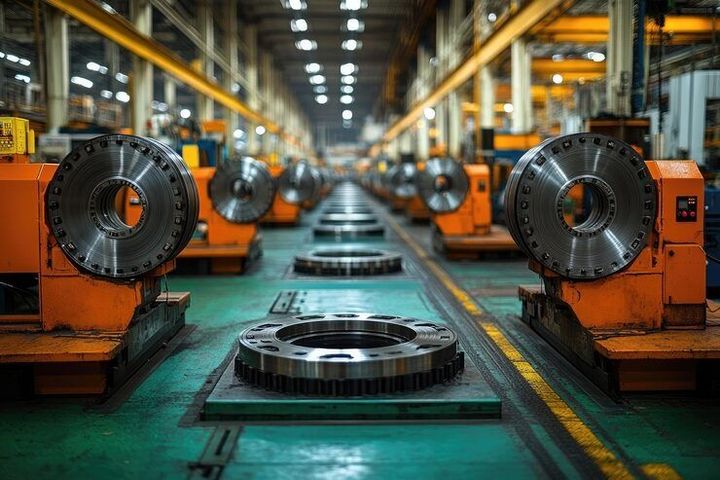
Plate Rolling Machines Guide : Types, Working Principle, Applications, and Industry Insights
Plate rolling machines are industrial equipment designed to bend flat metal plates into curved shapes such as cylinders, cones, and arcs. These machines are widely used wherever strong and accurately shaped metal components are required. Industries rely on them to manufacture pressure vessels, storage tanks, pipes, wind towers, ship components, heavy machinery parts, and structural metal products.
The need for plate rolling machines emerged as industrial manufacturing expanded and required consistent metal forming techniques. Manual bending methods often produced uneven shapes and required significant physical effort. Modern rolling machines address these challenges by applying controlled pressure through multiple rollers, allowing metal plates to be formed with greater accuracy and repeatability.
Today's manufacturing sector focuses on precision, efficiency, and material optimization. Plate rolling technology supports these goals by enabling manufacturers to process steel, aluminum, stainless steel, copper, and other metals into desired shapes while maintaining dimensional accuracy.
Industries continue adopting advanced plate rolling systems because they improve production consistency, reduce material waste, and support automated manufacturing environments. As industrial automation and smart manufacturing continue evolving, plate rolling machines remain an important part of modern metal fabrication.
Importance
Plate rolling machines play a significant role across numerous industrial sectors. Their ability to produce uniform curved metal components makes them essential for projects that require structural strength and precision.
Some of the major reasons these machines remain important include:
- Improved manufacturing accuracy
- Better production consistency
- Reduced material deformation
- Support for heavy-duty fabrication
- Capability to process various metal thicknesses
- Increased production efficiency
- Enhanced workplace productivity
These machines impact several industries, including:
| Industry | Common Applications |
|---|---|
| Construction | Steel structures, bridges, support frames |
| Oil and Gas | Storage tanks, pressure vessels, pipelines |
| Shipbuilding | Hull sections, cylindrical structures |
| Aerospace | Lightweight structural components |
| Energy | Wind towers, power generation equipment |
| Automotive | Heavy vehicle components and frames |
| Manufacturing | Industrial equipment and machinery |
Plate rolling technology also helps manufacturers meet growing demands for customized metal components. Modern production facilities frequently require different diameters, thicknesses, and materials. Plate rolling machines provide the flexibility needed for these changing production requirements.
From an engineering perspective, accurate rolling improves product quality while minimizing rework. This contributes to better resource utilization and smoother production planning.
High-value manufacturing industries also appreciate plate rolling because it supports precision fabrication for complex industrial assemblies, making it relevant for sectors associated with industrial machinery, metal fabrication, manufacturing technology, engineering equipment, CNC manufacturing, heavy machinery, industrial automation, and precision engineering.
Types of Plate Rolling Machines
Different manufacturing applications require different rolling technologies. The most common types include:
Two-Roll Plate Rolling Machines
These machines use two primary rollers and are generally suitable for thinner metal sheets. They are commonly used in automated production environments where speed and consistency are priorities.
Advantages include:
- Faster operation
- High production efficiency
- Consistent rolling quality
- Suitable for continuous manufacturing
Three-Roll Plate Rolling Machines
Three-roll machines remain one of the most widely used options in industrial fabrication. They include two lower rollers and one upper roller that applies pressure to bend the plate.
They are suitable for:
- Medium-thickness metal plates
- General fabrication work
- Cylindrical components
- Industrial workshops
Four-Roll Plate Rolling Machines
Four-roll systems provide greater control during bending operations. They allow improved positioning of the workpiece and often require fewer handling steps.
Common benefits include:
- Higher rolling precision
- Better repeatability
- Easier operation
- Improved productivity
- Reduced setup time
Variable Geometry Plate Rolling Machines
These advanced machines adjust roller positions depending on the material and desired curvature. They are often selected for demanding industrial applications involving thick or high-strength materials.
Working Principle
The working principle of a plate rolling machine is based on controlled plastic deformation.
Initially, the flat metal plate is positioned between the rollers. As the rollers rotate, they grip the plate while controlled pressure gradually bends the material. Multiple passes may be required depending on the required diameter and material thickness.
The process generally includes:
- Plate positioning
- Roller adjustment
- Controlled feeding
- Progressive bending
- Diameter verification
- Final shaping
Several factors influence the rolling result:
- Plate thickness
- Material strength
- Roller diameter
- Applied pressure
- Rolling speed
- Desired final radius
Modern machines frequently include digital controls that help operators maintain consistent forming parameters throughout production.
Applications
Plate rolling machines support numerous industrial manufacturing processes.
Common applications include:
- Pressure vessel manufacturing
- Steel storage tanks
- Industrial silos
- Pipeline sections
- Wind turbine towers
- Boiler components
- Shipbuilding structures
- Heat exchanger shells
- Industrial chimneys
- Heavy machinery fabrication
Infrastructure projects also depend on rolled steel sections for bridges, transportation systems, and architectural structures.
Renewable energy has become another important application area. Wind energy projects require large cylindrical tower sections that depend on accurate plate rolling technology.
Industrial fabrication workshops also use these machines to manufacture customized components according to engineering specifications.
Recent Updates
The plate rolling machine industry has experienced several notable developments during the past year.
Throughout 2025 and early 2026, manufacturers increasingly adopted digital monitoring systems that improve production accuracy and equipment performance. Smart control systems now allow operators to monitor rolling parameters more efficiently.
Several trends are shaping the industry:
| Recent Trend | Industry Impact |
|---|---|
| Automation integration | Improved production consistency |
| Digital control systems | Higher operational accuracy |
| Energy-efficient equipment | Lower energy consumption |
| Smart monitoring | Better preventive maintenance |
| CNC integration | Improved repeatability |
| Advanced material processing | Greater flexibility for manufacturers |
Artificial intelligence is also beginning to support predictive maintenance by identifying equipment conditions before unexpected downtime occurs.
Manufacturers continue improving machine designs to process stronger steel grades while maintaining precision. Lightweight alloys and specialized metals are also becoming more common across aerospace and renewable energy industries.
Another growing trend involves integration with Industry 4.0 manufacturing environments where production data can be monitored and analyzed in real time for better decision-making.
Laws and Policies
Plate rolling machine operations are influenced by workplace safety regulations, industrial standards, and manufacturing quality frameworks. Although specific requirements differ between countries, several common regulatory areas apply.
Important regulatory considerations include:
- Workplace safety compliance
- Machine guarding requirements
- Operator training standards
- Electrical safety regulations
- Occupational health practices
- Environmental compliance
- Industrial quality management systems
Many countries encourage manufacturers to follow internationally recognized quality management standards for production consistency.
Environmental regulations are also becoming increasingly important. Manufacturing facilities are expected to improve energy efficiency, reduce industrial emissions where applicable, and manage metal waste responsibly.
Government initiatives supporting advanced manufacturing, industrial automation, and smart factories have also encouraged adoption of modern production equipment in several regions.
Organizations operating plate rolling equipment typically establish internal maintenance schedules, safety inspections, and operator competency programs to ensure safe and efficient production.
Tools and Resources
Various resources help manufacturers, engineers, students, and fabrication professionals understand and improve plate rolling operations.
Useful resources include:
- Metal thickness calculators
- Material weight calculators
- Bending radius calculators
- Engineering design templates
- CAD drawing software
- CAM programming tools
- CNC simulation software
- Production planning templates
- Preventive maintenance checklists
- Industrial safety guidelines
- Manufacturing training materials
- Engineering calculation references
Digital monitoring dashboards also assist production teams in tracking machine performance, maintenance schedules, and production efficiency.
Learning resources such as technical manuals, engineering textbooks, industrial training programs, and manufacturing publications continue supporting workforce development across the metal fabrication sector.
Industry Insights
The future of plate rolling technology is closely connected with digital manufacturing and industrial automation.
Several long-term developments are expected to influence the industry:
- Greater adoption of smart factories
- Improved machine automation
- Higher precision manufacturing
- Increased use of advanced alloys
- Better predictive maintenance systems
- More energy-efficient production methods
- Expanded integration with digital engineering platforms
Manufacturers increasingly prioritize equipment capable of handling multiple material types while maintaining consistent quality. This flexibility supports changing production demands across infrastructure, transportation, renewable energy, and heavy engineering sectors.
As industrial production continues modernizing, plate rolling machines are expected to remain essential for efficient metal fabrication worldwide.
Frequently Asked Questions
What is a plate rolling machine?
A plate rolling machine is industrial equipment used to bend flat metal plates into curved shapes such as cylinders, cones, and arcs for manufacturing and construction applications.
Which industries commonly use plate rolling machines?
They are widely used in construction, shipbuilding, energy, oil and gas, heavy engineering, manufacturing, automotive, and infrastructure industries.
What materials can plate rolling machines process?
Most machines can process carbon steel, stainless steel, aluminum, copper, alloy steel, and several other industrial metals depending on machine capacity.
What is the difference between three-roll and four-roll machines?
Three-roll machines are suitable for many general fabrication tasks, while four-roll machines provide greater accuracy, easier plate positioning, and improved production efficiency.
Why are automated plate rolling machines becoming more common?
Automation improves production consistency, enhances precision, reduces manual adjustments, supports digital manufacturing, and helps manufacturers monitor equipment performance more effectively.
Conclusion
Plate rolling machines are a fundamental part of modern metal fabrication, enabling manufacturers to produce accurate curved metal components for a wide range of industrial applications. Their ability to process different materials, improve production consistency, and support complex engineering projects makes them valuable across construction, energy, transportation, shipbuilding, and manufacturing industries.