Wearable AI Note Taker: How It Works & Key Insights
Wearable AI note takers are emerging as a new category of productivity technology designed to capture conversations, meetings, lectures, interviews, and spoken ideas automatically.
Unlike traditional note-taking methods, these devices combine voice recording, artificial intelligence, and speech recognition to transform spoken information into organized notes.
As workplaces become increasingly mobile and collaborative, professionals often need a way to remember important discussions without constantly writing notes. Wearable AI note takers address this challenge by recording conversations and generating summaries, action items, and searchable transcripts automatically.
From business meetings and educational settings to healthcare and field operations, wearable AI note takers are finding applications across multiple industries.
Quick Facts About Wearable AI Note Takers
| Feature | Description |
|---|---|
| Primary Function | Record and organize spoken information |
| Core Technology | AI transcription and summarization |
| Common Form Factors | Pin, pendant, clip, wristband, earbuds |
| Input Source | Voice conversations |
| Output Format | Transcripts, summaries, action items |
| Connectivity | Bluetooth, Wi-Fi, mobile apps |
| Typical Users | Professionals, students, researchers |
| Main Benefit | Hands-free note capture |
What Is a Wearable AI Note Taker?
A wearable AI note taker is a compact device that records conversations and uses artificial intelligence to convert speech into structured notes. Many devices can be worn as a pin, pendant, clip, wristband, or earbuds, allowing users to capture information without holding a phone or notebook.
The primary goal is to help users focus on conversations rather than manually documenting every detail.
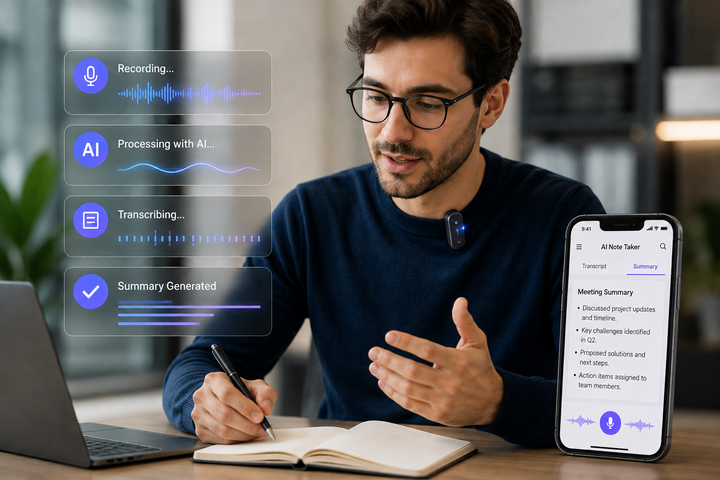
For example, during a client meeting, the device can record the discussion and later generate a summary that highlights key decisions, tasks, and follow-up points.
Understanding the Core Concept
Traditional note-taking requires attention to both listening and writing. This often leads to missed details.
Wearable AI note takers attempt to solve this problem by automating documentation. The user participates in the conversation while the device captures and processes information in the background. After recording, artificial intelligence converts spoken content into organized information that can be reviewed later.
How Wearable AI Note Takers Work
Step 1: Audio Capture
Built-in microphones record conversations and spoken information.
Step 2: Audio Processing
The recorded audio is prepared for speech recognition.
Step 3: Speech-to-Text Conversion
AI transcription systems convert spoken words into written text.
Step 4: Speaker Identification
Many systems identify different speakers within a conversation.
Step 5: AI Analysis
Artificial intelligence analyzes the transcript to identify key topics, decisions, and action items.
Step 6: Summary Generation
The system creates concise summaries and organized notes.
Wearable AI Note-Taking Workflow
| Stage | Function |
|---|---|
| Recording | Capture audio |
| Processing | Prepare audio data |
| Transcription | Convert speech to text |
| Speaker Recognition | Identify participants |
| Analysis | Extract insights |
| Summarization | Generate notes |
| Storage | Save transcripts and summaries |
Wearable AI Note Taker Architecture
Understanding the technology architecture helps explain how these devices operate.
Microphone System
High-quality microphones capture voices and conversations.
Processing Unit
Handles recording management and device functions.
Storage System
Stores audio recordings before synchronization.
Connectivity Module
Supports Bluetooth, Wi-Fi, or mobile connections.
AI Processing Platform
Converts audio into transcripts and summaries.
Companion Application
Allows users to access recordings, transcripts, and notes.
Main Types of Wearable AI Note Takers
Pin-Style Devices
Small devices attached to clothing using clips or magnetic fasteners.
Pendant Devices
Wearable devices that hang around the neck.
Wrist-Worn Devices
Integrated into wristbands or wearable accessories.
Earbud-Based Devices
AI-enabled earbuds that capture conversations and generate notes. Recent products combine earbud functionality with recording, transcription, and AI-generated summaries.
Multi-Wear Devices
Devices that support multiple wearing methods, such as clips, wristbands, and necklaces.
Key Technologies Behind Wearable AI Note Takers
Speech Recognition
Converts spoken language into text.
Natural Language Processing
Helps AI understand the meaning and context of conversations.
Speaker Diarization
Identifies who said what during discussions.
AI Summarization
Creates concise summaries from longer conversations.
Cloud Computing
Processes large amounts of audio and transcript data.
Machine Learning
Continuously improves transcription accuracy and language understanding.
Feature Comparison
| Feature | Purpose |
|---|---|
| Audio Recording | Capture conversations |
| Transcription | Convert speech to text |
| Summaries | Create condensed notes |
| Action Items | Identify tasks |
| Speaker Labels | Differentiate speakers |
| Search Functions | Locate information quickly |
| Export Options | Share notes and transcripts |
| Multi-Language Support | Process different languages |
Benefits and Advantages
Improved Focus
Users can concentrate on conversations instead of taking notes.
Better Information Retention
Important details are preserved automatically.
Time Savings
Automated summaries reduce manual documentation work.
Improved Organization
Notes are searchable and structured.
Enhanced Collaboration
Meeting participants can review the same information.
Mobility
Wearable devices support note-taking away from desks and laptops.
Real-World Applications
Business Meetings
Captures discussions, decisions, and action items.
Education
Records lectures and classroom discussions.
Healthcare Documentation
Assists professionals in capturing consultation details.
Journalism
Helps record interviews and conversations.
Research Activities
Supports data collection during interviews and observations.
Field Operations
Useful for professionals who work away from traditional office environments.
Industry Applications
| Industry | Common Use |
|---|---|
| Business | Meeting documentation |
| Education | Lecture notes |
| Healthcare | Conversation records |
| Journalism | Interview capture |
| Research | Data collection |
| Consulting | Client discussions |
| Legal | Meeting summaries |
| Field Operations | Mobile documentation |
Privacy and Security Considerations
Privacy is one of the most important topics associated with wearable AI note takers.
User Consent
Many jurisdictions require participants to be informed when conversations are recorded.
Data Storage
Recordings may be stored locally, in cloud systems, or both.
Encryption
Many devices use encrypted storage and transmission methods.
Access Controls
Authentication mechanisms help protect sensitive information.
Environmental Considerations
Reduced Paper Usage
Digital note-taking reduces reliance on paper notebooks.
Rechargeable Battery Systems
Most wearable AI note takers use rechargeable batteries.
Compact Hardware Design
Smaller devices generally require fewer materials than larger computing equipment.
Long-Term Digital Storage
Information can be retained electronically rather than through printed documentation.
Common Challenges and Solutions
| Challenge | Practical Solution |
|---|---|
| Background Noise | Use noise-filtering technology |
| Recording Permissions | Follow local regulations |
| Battery Limitations | Charge regularly |
| Storage Constraints | Sync recordings frequently |
| Transcription Errors | Review generated notes |
| Connectivity Issues | Maintain reliable device pairing |
Maintenance Schedule
| Maintenance Task | Frequency |
|---|---|
| Recharge Battery | As Needed |
| Clean Device Exterior | Weekly |
| Check Microphones | Monthly |
| Update Application | Regularly |
| Review Storage Usage | Monthly |
| Inspect Attachments | Monthly |
Best Practices
- Inform participants when recording conversations.
- Review AI-generated notes for accuracy.
- Keep device firmware updated.
- Use clear speech when possible.
- Organize transcripts into categories.
- Maintain regular charging habits.
Expert Insights
Technology analysts view wearable AI note takers as an extension of the broader AI productivity ecosystem. The growing focus is shifting from simple recording toward intelligent knowledge management, where devices not only capture information but also organize, summarize, and surface insights automatically.
Key Facts About Wearable AI Note Takers
- Many devices support automatic transcription and AI-generated summaries.
- Some wearable models can be worn as clips, pins, pendants, or wristbands.
- Modern devices increasingly support multi-language transcription.
- AI systems can generate action items and meeting summaries from conversations.
- Earbud-based note-taking devices are becoming a new category within wearable AI technology.
Future Trends and Industry Insights
Smarter Summarization
AI models are becoming better at understanding context and extracting insights.
Improved Language Support
Future systems are expected to support more languages and dialects.
Enhanced Privacy Controls
Manufacturers continue improving user-controlled privacy features.
Better Battery Performance
Advances in battery technology may support longer recording times.
Deeper Workflow Integration
Future devices may integrate more closely with productivity platforms, calendars, and task management systems.
Frequently Asked Questions
What is a wearable AI note taker?
A device that records conversations and uses AI to generate transcripts and summaries.
How does it work?
It captures audio, converts speech into text, and uses AI to create organized notes.
Who uses wearable AI note takers?
Professionals, students, researchers, journalists, and field workers.
Can they identify different speakers?
Many devices include speaker recognition features.
Are notes generated automatically?
Most AI note-taking systems can automatically generate summaries and action items.
Do wearable AI note takers require internet access?
Some functions work locally, while advanced AI processing often uses cloud resources.
Are recordings searchable?
Many systems provide searchable transcripts.
Can they support multiple languages?
Many modern devices support multiple language options.
What are the main benefits?
Improved focus, time savings, and better documentation.
Are privacy considerations important?
Yes. Users should follow applicable recording and consent requirements.
Conclusion
Wearable AI note takers represent a growing category of productivity technology that combines voice recording, artificial intelligence, and automated knowledge organization. By transforming conversations into searchable transcripts, summaries, and action items, these devices help users focus on communication rather than manual note-taking.
As AI, speech recognition, and wearable technology continue to advance, wearable AI note takers are expected to become more accurate, intelligent, and integrated into daily professional workflows. Their ability to capture and organize information efficiently makes them a valuable tool for modern knowledge-driven environments.