Battery Dry Electrode Processing: From Powder to Electrode
Battery manufacturing has traditionally relied on electrode production methods that use liquid solvents to distribute active materials and binders before coating them onto current collectors.
Battery Dry Electrode Processing provides an alternative manufacturing approach in which electrode materials are processed with little or no conventional liquid solvent.
Dry electrode technology is attracting attention for lithium-ion battery manufacturing because it can change how electrode materials are mixed, formed, coated, dried, and integrated into cell production. The process can also influence manufacturing equipment, plant layout, energy requirements, and electrode design.
Understanding the pathway from dry powder to finished electrode helps explain why dry processing is being investigated for next-generation battery manufacturing.
What Is Battery Dry Electrode Processing?
Battery Dry Electrode Processing is a manufacturing approach for producing battery electrodes without the conventional wet-slurry coating process.
A typical dry electrode formulation contains:
- Active cathode or anode material
- Conductive additives
- Polymer binder
- Current collector
Instead of dispersing these components into a liquid solvent, the materials are blended in dry form and processed into a coherent electrode layer.
The resulting dry electrode film can then be transferred or laminated onto a metal current collector before subsequent battery manufacturing steps.
Why Dry Electrode Processing Matters
Conventional wet electrode production typically requires slurry preparation, coating, solvent evaporation, solvent recovery, and drying.
Dry processing can change this sequence by reducing or eliminating the conventional solvent-handling and drying stages.
Potential advantages include:
- Reduced solvent use
- Less drying infrastructure
- Lower solvent recovery requirements
- Potentially shorter processing lines
- Higher electrode thickness possibilities
- Greater flexibility in electrode formulation
- Potentially lower manufacturing energy requirements
The actual benefits depend on the electrode chemistry, process design, production scale, and equipment configuration.
How Battery Dry Electrode Processing Works
Although different manufacturers use different approaches, the overall process can be described through several stages.
1. Raw Material Preparation
Active materials, conductive additives, and binders are prepared according to the electrode formulation.
Particle size, moisture content, morphology, and material consistency can influence the subsequent processing stages.
Cathode and anode formulations are typically processed separately.
2. Dry Mixing
The materials are combined without creating a conventional liquid slurry.
Mixing equipment must distribute the active material, conductive additives, and binder uniformly throughout the formulation.
The mixing conditions can influence the structure and performance of the final electrode.
3. Binder Activation and Fibrillation
In many dry-electrode approaches, mechanical forces cause the polymer binder to form a network of fibrils.
This network can hold active particles and conductive additives together.
Binder fibrillation is particularly important because the electrode needs sufficient mechanical integrity without relying on a liquid medium.
4. Dry Powder or Composite Formation
The processed powder can be transformed into a more cohesive electrode material.
Depending on the technology, mechanical compaction, shear, rolling, or other techniques can create a self-supporting composite.
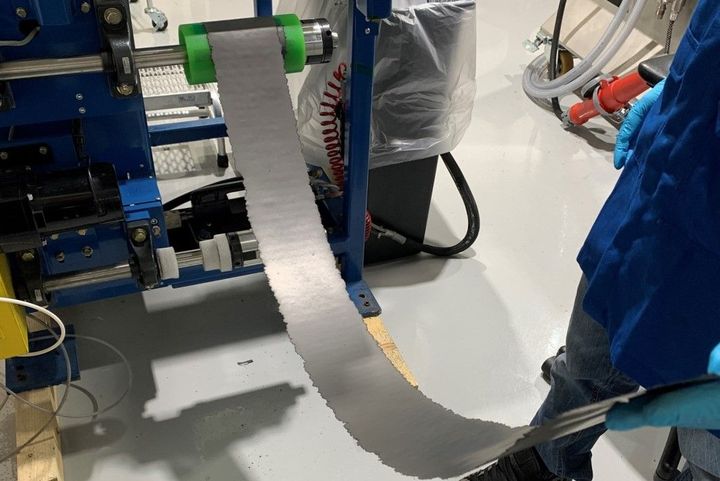
5. Film Formation
The dry composite is formed into a controlled electrode film.
Important characteristics include:
- Thickness
- Density
- Porosity
- Mechanical strength
- Material distribution
- Surface uniformity
The desired properties depend on the battery chemistry and cell design.
6. Lamination to the Current Collector
The electrode film can be transferred onto a current collector such as aluminum foil for cathodes or copper foil for anodes.
Lamination can use pressure, heat, or other controlled processes depending on the manufacturing technology.
7. Calendering
Calendering applies controlled pressure to the electrode to achieve the required thickness, density, and porosity.
The calendering conditions can significantly influence electrode structure and electrochemical behavior.
8. Slitting and Final Electrode Preparation
The coated or laminated electrode can be slit into appropriate widths and prepared for subsequent cell assembly.
The final electrode may then undergo inspection and quality-control processes.
Key Technologies Used in Dry Electrode Processing
Dry Powder Mixing
High-performance mixers distribute active materials, conductive additives, and binder throughout the formulation.
Uniform mixing is important for achieving consistent electrode properties.
High-Shear Processing
Mechanical shear can help activate the binder and create the network needed to hold the electrode structure together.
Dry Film Formation
Specialized equipment converts the processed material into a controlled electrode film.
Lamination Systems
Lamination attaches the dry electrode film to the current collector.
Calendering Equipment
Calendering controls electrode thickness and density through precisely controlled mechanical pressure.
Precision Measurement Systems
Sensors and inspection equipment can monitor:
- Electrode thickness
- Surface uniformity
- Density
- Width
- Defects
- Material distribution
Battery Dry Electrode Processing vs. Wet Electrode Processing
| Feature | Dry Electrode Processing | Wet Electrode Processing |
|---|---|---|
| Electrode formulation | Dry powder-based | Liquid slurry |
| Conventional solvent | Little or none | Typically required |
| Drying stage | Reduced or eliminated | Required |
| Solvent recovery | Reduced requirement | Often required |
| Film formation | Mechanical processing | Wet coating and drying |
| Equipment configuration | Dry processing line | Slurry and coating line |
| Energy demand | Potentially lower | Can be higher due to drying |
| Process challenges | Powder handling and film formation | Slurry control and drying |
Dry processing does not simply remove the drying stage; it introduces different engineering challenges involving powder mixing, binder activation, film formation, adhesion, and uniformity.
Cathode and Anode Dry Electrode Processing
Dry Cathode Processing
Cathodes typically contain active materials such as lithium-containing compounds, conductive additives, and polymer binders.
The formulation must provide good electronic conductivity, mechanical integrity, and appropriate electrochemical performance.
Dry Anode Processing
Anodes can use materials such as graphite, silicon-containing materials, conductive additives, and binders.
Dry processing may require different formulation and mechanical conditions because anode materials have different physical and electrochemical characteristics.
Factors Affecting Dry Electrode Quality
Particle Size
Particle-size distribution influences packing, mixing, film formation, and electrode structure.
Binder Content
Too little binder can reduce mechanical integrity, while excessive binder can affect electrode conductivity and active-material utilization.
Mixing Conditions
Mixing speed, time, sequence, and mechanical energy can affect material distribution and binder activation.
Moisture
Battery electrode materials can be sensitive to moisture. Controlled material handling and environmental conditions are therefore important.
Electrode Density
Density affects volumetric energy density and can influence ion transport.
Porosity
The electrode needs an appropriate pore structure to allow electrolyte penetration and ion movement.
Calendering Pressure
Excessive or insufficient compression can affect electrode performance and mechanical properties.
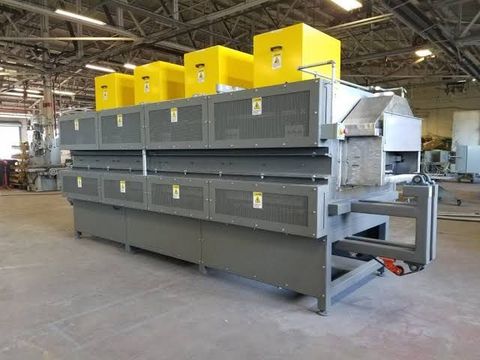
Equipment Used in Battery Dry Electrode Processing
A production line can include several specialized systems.
- Material feeding systems
- Dry powder mixers
- High-shear processing equipment
- Film-forming equipment
- Roll-to-roll processing systems
- Lamination equipment
- Calendering machines
- Slitting equipment
- Thickness measurement systems
- Surface inspection systems
- Environmental control systems
The exact equipment arrangement depends on the dry electrode technology and battery format.
Benefits of Battery Dry Electrode Processing
Reduced Solvent Handling
Dry processing can reduce dependence on conventional liquid solvents used in wet electrode manufacturing.
Reduced Drying Requirements
Because the process does not rely on a wet slurry, the conventional long drying stage can be reduced or eliminated.
Potential Energy Savings
Removing or reducing solvent evaporation can lower the energy requirements associated with electrode drying.
Higher Electrode Loading Potential
Some dry processing approaches can support thicker electrodes, which may contribute to higher active-material loading per unit area.
Manufacturing Footprint
Eliminating large drying and solvent-recovery systems can potentially simplify certain aspects of manufacturing infrastructure.
Challenges of Dry Electrode Processing
Powder Handling
Fine battery powders require controlled handling to maintain consistency and minimize contamination.
Binder Distribution
Achieving uniform binder distribution without a liquid medium can be technically challenging.
Film Formation
Creating a mechanically stable and uniform film requires carefully controlled processing conditions.
Adhesion
The electrode must maintain strong adhesion to the current collector throughout manufacturing and cell operation.
Scale-Up
A process that performs well at laboratory or pilot scale may require significant engineering development for high-volume manufacturing.
Material Compatibility
Different active materials and binders can behave differently during dry mixing, fibrillation, compaction, and calendering.
Best Practices for Dry Electrode Manufacturing
- Control raw-material particle size and moisture.
- Maintain consistent material ratios during dry mixing.
- Optimize binder content for mechanical strength and conductivity.
- Control mechanical energy during mixing and fibrillation.
- Monitor electrode thickness and density continuously.
- Optimize lamination conditions for strong current-collector adhesion.
- Use controlled calendering pressure.
- Inspect electrode surfaces for defects and non-uniformity.
- Maintain controlled environmental conditions.
- Validate process performance at production-relevant scale.
Applications of Battery Dry Electrode Processing
Electric Vehicle Batteries
Dry electrode technology is being explored for high-volume lithium-ion battery manufacturing for electric mobility.
Energy Storage Systems
Large-format batteries used for stationary energy storage can potentially use dry electrode manufacturing approaches.
Consumer Electronics
Compact lithium-ion cells for electronics are another potential application area.
High-Energy-Density Cells
Dry processing can be relevant to electrode designs where high active-material loading and controlled electrode structure are important.
Frequently Asked Questions
What is Battery Dry Electrode Processing?
Battery Dry Electrode Processing is a method of manufacturing battery electrodes using dry active materials, conductive additives, and binders rather than preparing a conventional liquid slurry.
How does dry electrode manufacturing differ from wet coating?
Wet electrode manufacturing disperses electrode materials in a liquid solvent before coating and drying. Dry processing forms the electrode from dry materials and can reduce or eliminate the conventional solvent-drying stage.
What is binder fibrillation?
Binder fibrillation is a mechanical process in which polymer binder material forms a network of fine fibers that helps hold electrode particles together.
What equipment is used for dry electrode processing?
Equipment can include dry mixers, high-shear processors, film-forming systems, laminators, calenders, slitting machines, material feeders, and precision inspection systems.
What are the main challenges of dry electrode manufacturing?
Important challenges include powder handling, uniform binder distribution, film formation, current-collector adhesion, electrode uniformity, and scaling the process for high-volume production.
Conclusion
Battery Dry Electrode Processing represents an alternative approach to conventional wet electrode manufacturing by forming electrode structures from dry materials rather than relying on a liquid slurry and subsequent solvent evaporation.
The process can involve dry mixing, binder fibrillation, composite formation, film formation, lamination, calendering, and final electrode preparation. Each stage requires careful control of material properties and processing conditions.
Dry electrode technology has potential applications across electric vehicle batteries, energy storage systems, consumer electronics, and other lithium-ion battery markets. However, successful implementation requires careful optimization of materials, equipment, process parameters, quality control, and manufacturing scale.
As battery manufacturers investigate higher-performance and more efficient production methods, dry electrode processing remains an important technology area for next-generation battery manufacturing.