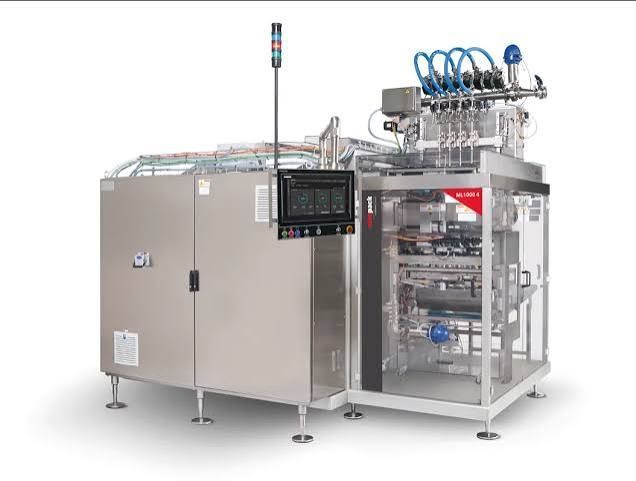
High-Speed Sachet Machines: From Film to Finished Pack
Modern packaging operations require equipment that can handle large production volumes while maintaining consistent filling, sealing, and package quality.
High-Speed Sachet Machines automate the conversion of flexible packaging film into individual sachets, from film feeding and forming to product dosing, sealing, cutting, and inspection.
These machines are used for powders, liquids, granules, gels, pastes, and other products that can be packaged in small single-use portions. Multi-lane configurations can produce several sachets simultaneously, making them suitable for high-throughput packaging environments.
What Are High-Speed Sachet Machines?
High-Speed Sachet Machines are automated packaging systems designed to produce individual sachets at high production rates.
The machines typically integrate several operations into one continuous process:
- Film unwinding
- Film forming
- Product dosing
- Heat sealing
- Sachet cutting
- Date or batch coding
- Inspection
- Discharge
Depending on the machine configuration, sachets can be produced in different shapes, sizes, and seal patterns.
From Film to Finished Pack
The packaging process begins with a roll of flexible film and ends with individually separated sachets.
1. Film Loading
Packaging film is mounted onto an unwinding system.
The film may consist of laminated or coated materials selected according to the product, barrier requirements, sealing characteristics, and packaging environment.
2. Film Unwinding
The machine feeds the film into the packaging line at a controlled speed.
Tension-control systems help maintain consistent film movement and alignment throughout the process.
3. Film Forming
The film passes through forming components that create the required sachet structure.
Depending on the machine design, the film may be folded or guided into multiple lanes before filling begins.
4. Product Dosing
A dosing system introduces a measured quantity of product into each sachet.
Different products require different dosing technologies.
Common systems include:
- Auger fillers for powders
- Volumetric cups for granules
- Piston fillers for liquids
- Pump fillers for liquids and viscous products
- Servo-driven dosing systems
5. Sealing
The packaging material is sealed around the product.
Heat-sealing systems apply controlled temperature, pressure, and dwell time to create the required seal.
6. Cutting
After sealing, individual sachets are separated from the continuous web.
Cutting systems can produce standard straight cuts, perforated formats, or specialized sachet configurations depending on the machine.
7. Coding
Production information can be printed onto the sachet.
Typical information can include:
- Batch identification
- Production codes
- Date information
- Product identification
- Traceability information
8. Inspection and Discharge
Sensors or vision systems can check selected packaging characteristics before finished sachets are discharged.
The completed sachets then move to collection, secondary packaging, or downstream handling equipment.
Major Types of High-Speed Sachet Machines
Different machine configurations are designed for specific product categories and package formats.
| Machine Type | Typical Product | Main Feature |
|---|---|---|
| Liquid sachet machine | Liquids | Pump or piston dosing |
| Powder sachet machine | Powders | Auger or volumetric dosing |
| Granule sachet machine | Granules | Cup or weigh-based dosing |
| Gel sachet machine | Gels | Piston or pump filling |
| Multi-lane sachet machine | Various products | Multiple sachets per cycle |
| Stick sachet machine | Powders and liquids | Narrow single-serve format |
| Form-fill-seal sachet machine | Various products | Integrated packaging cycle |
Multi-Lane Sachet Packaging
One of the defining characteristics of high-speed sachet packaging is multi-lane operation.
Instead of producing one sachet at a time, the machine can form several packaging lanes and fill them simultaneously.
The number of lanes depends on:
- Machine architecture
- Sachet dimensions
- Product characteristics
- Filling technology
- Film width
- Required production rate
Multi-lane systems can increase output while maintaining a compact production footprint.
Liquid Sachet Filling Machines
Liquid products require controlled dosing to maintain consistent fill volumes.
Pump and piston filling systems can be selected according to viscosity, flow characteristics, particle content, and required dosing accuracy.
Applications can include:
- Beverages
- Condiments
- Personal care formulations
- Pharmaceutical liquids
- Cleaning formulations
- Liquid concentrates
The filling system should also minimize dripping and product contamination around the sealing area.
Powder Sachet Packaging Machines
Powder products present different challenges because they can generate dust, bridge in hoppers, or vary in bulk density.
Auger fillers are commonly used to provide controlled powder dosing.
Important considerations include:
- Powder flowability
- Bulk density
- Particle size
- Dust generation
- Fill weight
- Product consistency
Machine design should prevent product particles from interfering with the sealing area.
Granule Sachet Machines
Granular products can include particles such as food ingredients, seeds, detergents, and other dry materials.
Volumetric cup systems or other dosing technologies can measure the required quantity before the product enters the sachet.
The choice depends on particle characteristics and the required filling precision.
Sachet Form-Fill-Seal Technology
Form-fill-seal technology integrates packaging formation, product filling, and sealing within a continuous machine cycle.
A typical sequence is:
- Film feeding
- Film forming
- Product dosing
- Vertical or horizontal sealing
- Cutting
- Discharge
This integrated arrangement reduces manual handling and supports continuous packaging production.
Key Components
High-Speed Sachet Machines contain several coordinated systems.
Film Handling System
Controls film unwinding, tension, alignment, and feeding.
Filling System
Measures and transfers the product into each sachet.
Sealing System
Creates longitudinal and transverse seals using controlled heating and pressure.
Cutting System
Separates individual sachets from the packaging web.
Servo Drive System
Controls machine motion and synchronization.
Sensor System
Detects film position, product presence, registration marks, and other process conditions.
Control System
Coordinates machine operations through programmable controls and a human-machine interface.
Automation and Servo Control
Modern machines increasingly use servo motors to control critical movements.
Servo technology can provide precise synchronization between:
- Film feeding
- Filling
- Sealing
- Cutting
- Registration
- Lane operation
Electronic control can also make it easier to adjust machine parameters for different sachet formats.
Packaging Speed and Output
The actual production rate of a sachet machine depends on more than the machine's nominal operating speed.
Important factors include:
- Number of lanes
- Sachet dimensions
- Product characteristics
- Filling method
- Film properties
- Seal requirements
- Machine configuration
- Changeover frequency
- Operator intervention
A multi-lane system can produce significantly more sachets per cycle than a single-lane configuration, but the practical output depends on the complete packaging process.
Sachet Machine Comparison
| Factor | Single-Lane | Multi-Lane |
|---|---|---|
| Production capacity | Lower | Higher |
| Machine complexity | Lower | Higher |
| Format flexibility | Often high | Depends on configuration |
| Footprint efficiency | Moderate | High output per footprint |
| Changeover | Generally simpler | Can require more coordination |
| Suitable applications | Smaller production runs | High-volume production |
How to Select High-Speed Sachet Machines
Product Characteristics
Identify whether the product is a liquid, powder, granule, gel, paste, or another material.
The product's viscosity, density, particle size, flowability, and temperature can affect the filling system.
Sachet Dimensions
Determine the required sachet width, length, volume, and shape.
Production Requirements
Consider required output, number of lanes, operating schedule, and expected production variation.
Filling Accuracy
The dosing system should match the required fill-volume or fill-weight tolerance.
Film Compatibility
The packaging machine should be compatible with the selected film structure and sealing characteristics.
Sealing Requirements
Seal temperature, pressure, dwell time, and seal width should be appropriate for the packaging material and product.
Automation
Servo drives, sensors, automatic registration, recipe management, and digital controls can improve process consistency.
Quality Control
Consistent sachet production requires monitoring throughout the packaging cycle.
Important quality checks can include:
- Fill quantity
- Seal integrity
- Sachet dimensions
- Film registration
- Cut position
- Print quality
- Product contamination
- Package appearance
Automated vision systems can inspect selected packaging characteristics without requiring manual examination of every sachet.
Maintenance Best Practices
Clean the Filling System
Product residue can affect dosing accuracy and may interfere with subsequent production runs.
Inspect Sealing Components
Worn sealing surfaces can affect seal consistency.
Check Film Alignment
Incorrect film tracking can lead to uneven sachets, poor registration, or cutting errors.
Inspect Cutting Components
Cutting tools should be maintained to produce clean and consistent separation.
Monitor Sensors
Film-position, registration, and product-detection sensors should remain clean and correctly aligned.
Review Servo Performance
Unexpected movement or synchronization changes can indicate mechanical or control-system issues that require investigation.
Applications of High-Speed Sachet Machines
High-Speed Sachet Machines are used across numerous packaging sectors.
Food and Beverage
Common applications include sauces, seasonings, instant beverage products, sweeteners, and single-use ingredients.
Pharmaceutical Packaging
Small-dose products and selected pharmaceutical formulations can be packaged in individual sachets where the packaging format is appropriate.
Personal Care
Creams, gels, lotions, shampoos, and other formulations can use single-use sachet formats.
Household Products
Cleaning powders, liquids, concentrates, and other household formulations can be packaged in small portions.
Agricultural Products
Selected granular and powdered agricultural formulations can use sachet packaging for controlled portions.
Frequently Asked Questions
What are High-Speed Sachet Machines?
High-Speed Sachet Machines are automated packaging systems that form sachets from flexible film, fill them with a measured product quantity, seal the packages, and separate them into individual units.
What products can sachet machines package?
Sachet machines can package powders, liquids, granules, gels, pastes, and other products when the machine's filling and sealing systems are designed for those materials.
How do multi-lane sachet machines increase output?
Multi-lane machines produce multiple sachets during the same machine cycle. This allows several filling and sealing operations to occur simultaneously.
What determines sachet machine speed?
Production speed depends on lane count, sachet dimensions, filling technology, product characteristics, film properties, sealing requirements, and machine configuration.
What is a form-fill-seal sachet machine?
A form-fill-seal sachet machine integrates film forming, product filling, sealing, and cutting into a continuous automated packaging process.
Conclusion
High-Speed Sachet Machines transform flexible packaging film into individually filled and sealed packs through a coordinated sequence of film handling, forming, dosing, sealing, cutting, coding, and inspection.
The appropriate machine configuration depends heavily on the product and packaging format. Powders may require auger dosing, liquids may need pumps or piston fillers, while granular products can use volumetric or other specialized dosing systems.
Multi-lane architectures, servo controls, digital sensors, automated registration, and inspection technologies have expanded the capabilities of modern sachet packaging equipment. These technologies can support consistent operation while allowing manufacturers to handle different product types and packaging formats.
When selecting a machine, manufacturers should evaluate product characteristics, sachet dimensions, film compatibility, filling accuracy, sealing requirements, production volume, automation, and maintenance requirements together. A properly matched system can provide a controlled path from packaging film to a consistent finished sachet.