Robotic Case Packing Systems: From Products to Packed Cases
Modern packaging operations increasingly use automation to move products from primary packaging lines into organized shipping cases.
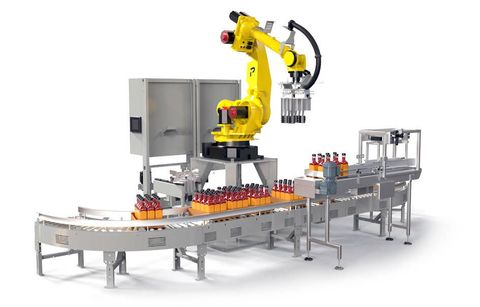
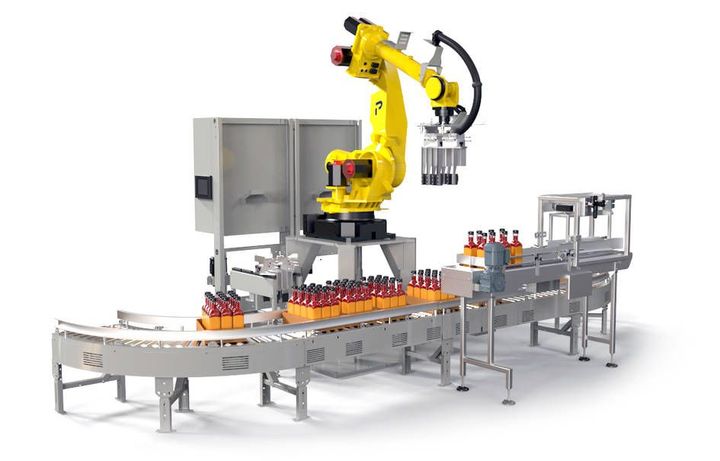
Robotic Case Packing Systems combine robotic arms, grippers, conveyors, sensors, case handling equipment, and control software to automate this end-of-line packaging process.
Instead of relying entirely on manual case loading, robotic systems can pick products from a conveyor, arrange them into a defined pattern, place them into cases, and transfer completed cases to downstream equipment. The configuration depends on product shape, packaging format, production rate, case dimensions, and required level of automation.
What Are Robotic Case Packing Systems?
Robotic Case Packing Systems are automated packaging systems that use industrial robots to place products into cartons, boxes, trays, or shipping cases.
A typical system may include:
- Product infeed conveyors
- Robotic arms
- End-of-arm tooling
- Vision systems
- Case-forming equipment
- Case conveyors
- Sensors
- Programmable controls
- Case sealing equipment
- Human-machine interfaces
The robot coordinates with surrounding equipment to maintain a continuous packaging sequence.
From Products to Packed Cases
The packing process generally begins with individual products arriving from an upstream packaging machine and ends with completed cases moving toward palletizing or warehouse operations.
1. Product Infeed
Products arrive at the robotic case packing system through a conveyor.
The conveyor maintains product flow and presents products to the robot in a predictable position.
Depending on the application, products may arrive individually, in groups, or in a predefined orientation.
2. Product Detection
Sensors or vision systems identify incoming products.
The system can detect product position, orientation, spacing, and other characteristics required for accurate robotic picking.
Vision technology can be especially useful when products arrive with variable orientation or when the system needs to distinguish between different packaging formats.
3. Product Grouping
Before picking, products may be organized into groups corresponding to the desired case pattern.
Grouping can occur through conveyors, lanes, guides, or robotic motion.
For example, a case may require several rows of products arranged in a specific orientation.
4. Robotic Picking
The robotic arm moves toward the product group and activates its end-of-arm tooling.
The gripper picks one product or multiple products during each robotic cycle.
The appropriate gripper depends on product shape, weight, surface characteristics, packaging material, and required handling speed.
5. Case Preparation
At the same time, cases can be prepared for loading.
An automated case-forming system can erect flat cartons into open cases and position them at the robotic loading station.
6. Robotic Case Loading
The robot moves the product group into the open case.
The products are positioned according to the programmed packing pattern.
Robotic motion can be coordinated with conveyors and case positioning systems to maintain consistent placement.
7. Case Verification
Sensors or vision systems can verify whether the case contains the expected product arrangement.
This step can identify missing products, incorrect orientation, or other packing issues before the case moves downstream.
8. Case Sealing
Once loading is complete, the case can move to a sealing station.
Depending on the packaging format, sealing may involve adhesive tape, hot-melt adhesive, or another compatible closure method.
9. Case Discharge
The completed case exits the packing station and continues toward palletizing, labeling, inspection, storage, or shipping operations.
Major Types of Robotic Case Packing Systems
Different robotic architectures are used depending on the product and case format.
| System Type | Typical Configuration | Common Application |
|---|---|---|
| Pick-and-place robotic packer | Robot picks grouped products | Bottles, cartons, containers |
| Top-load case packer | Products placed from above | Flexible and rigid packages |
| Side-load robotic packer | Products loaded horizontally | Selected cartons and containers |
| Layer-packing system | Products arranged in layers | High-volume case packing |
| Vision-guided packer | Camera-guided picking | Variable product orientation |
| Multi-robot packing system | Multiple robots | High-throughput operations |
Robotic Pick-and-Place Case Packing
Pick-and-place systems are among the most flexible robotic case packing configurations.
The robot collects products from an infeed conveyor and places them into an open case.
Depending on the robot type and gripper design, a single cycle can move one product or multiple products simultaneously.
Top-Load Case Packing
Top-load systems place products into cases from above.
This arrangement can be suitable when the product configuration and case design allow vertical loading.
Top-load systems can also provide flexibility for products with different orientations or packing patterns.
Vision-Guided Case Packing
Vision systems can identify product position and orientation before robotic picking.
A typical sequence includes:
- Camera captures product images.
- Software identifies product location.
- Position data is transmitted to the robot controller.
- Robot moves to the calculated location.
- Gripper picks the product.
- Robot places it into the case.
This approach can help manage product variation and reduce the need for perfectly aligned incoming products.
Robotic Gripper Technology
The end-of-arm tool is one of the most important components in a robotic case packing system.
Common gripper technologies include:
- Vacuum grippers
- Mechanical clamps
- Parallel grippers
- Multi-product grippers
- Magnetic grippers for suitable materials
- Custom adaptive tooling
The gripper must provide sufficient holding force without damaging the product or its primary packaging.
Conveyor Integration
Robotic case packing systems depend on coordinated material movement.
Conveyors can transport:
- Individual products
- Product groups
- Empty cases
- Loaded cases
- Rejected products
Sensors positioned along the conveyor system can help coordinate product arrival and robotic motion.
Automation and Control Systems
A central control architecture coordinates the robot with other packaging equipment.
The control system can manage:
- Robot motion
- Conveyor speed
- Product detection
- Case positioning
- Gripper operation
- Vision inspection
- Case sealing
- Fault detection
- Recipe selection
Human-machine interfaces allow operators to monitor production conditions and adjust approved machine parameters.
Robotic Case Packing Systems Comparison
| Factor | Manual Packing | Conventional Automated Packer | Robotic Case Packing |
|---|---|---|---|
| Product handling | Manual | Mechanical | Robotic |
| Format flexibility | High | Moderate | High |
| Repetitive handling | Labor intensive | Automated | Automated |
| Product orientation | Operator controlled | Mechanically guided | Programmable |
| Changeover | Manual | Machine dependent | Recipe and tooling dependent |
| Vision integration | Limited | Optional | Commonly available |
| Multi-format capability | High | Varies | High with suitable tooling |
How to Select Robotic Case Packing Systems
Selecting the right system requires evaluation of the complete packaging process.
Product Characteristics
Consider:
- Product dimensions
- Weight
- Shape
- Surface material
- Fragility
- Packaging type
These factors influence the robot, gripper, conveyor, and packing pattern.
Case Dimensions
The system should accommodate the required case length, width, height, and internal configuration.
Different case sizes may require adjustable guides, tooling changes, or multiple programmed recipes.
Packing Pattern
The required product arrangement affects robot movement and gripper design.
Common patterns include rows, columns, interlocking arrangements, and layered configurations.
Production Throughput
The required output influences robot selection, number of robots, gripper capacity, conveyor speed, and overall system architecture.
Changeover Requirements
If multiple products or case formats are processed, evaluate how quickly the system can switch between approved recipes and tooling configurations.
Integration
The robotic packer should communicate effectively with upstream packaging machines and downstream systems such as case sealers and palletizers.
Quality Control
Robotic case packing systems can incorporate several quality-control functions.
Product Presence Detection
Sensors or vision systems can verify that products are available before the robot begins a pick.
Case Verification
Inspection can confirm that the required product quantity has entered the case.
Pattern Verification
Vision systems can examine product orientation and arrangement.
Case Integrity
Downstream inspection can check whether cases have been properly formed and sealed.
Digital records can also support production traceability where required.
Benefits of Robotic Case Packing
Consistent Product Placement
Robotic motion can repeat programmed packing patterns consistently.
Flexible Product Handling
Programmable robots can accommodate multiple product arrangements when supported by suitable tooling.
Continuous Operation
Automated systems can perform repetitive packing operations continuously within their designed operating conditions.
Compact Automation
A well-designed robotic cell can combine product picking, case loading, inspection, and material movement within a defined area.
Integration With End-of-Line Automation
Robotic case packers can connect with case sealing, labeling, palletizing, and other downstream packaging equipment.
Maintenance Best Practices
Inspect Grippers
Check vacuum cups, mechanical fingers, clamps, and mounting components for wear or damage.
Monitor Robot Motion
Unexpected changes in robot movement can indicate mechanical, programming, or tooling issues.
Maintain Sensors
Keep photoelectric sensors, vision cameras, and detection systems clean and correctly aligned.
Check Conveyors
Inspect belts, rollers, guides, and drive components for wear or misalignment.
Inspect Case Handling Equipment
Case erectors and sealing equipment should be checked to maintain reliable case flow.
Review Safety Systems
Emergency stops, guarding, interlocks, and other protective systems should be inspected according to the equipment's maintenance procedures.
Applications of Robotic Case Packing Systems
Food and Beverage
Robotic packing can handle cartons, bottles, cans, pouches, trays, and other packaged products.
Consumer Goods
Household products and packaged consumer products can be organized into shipping cases automatically.
Pharmaceutical Packaging
Selected secondary-packaging applications can use robotic case packing for cartons, containers, and other packaged products.
Personal Care
Bottles, tubes, cartons, and containers can be grouped and placed into cases.
Industrial Products
Robotic systems can also handle selected components, containers, and packaged industrial products.
Frequently Asked Questions
What are Robotic Case Packing Systems?
Robotic Case Packing Systems use industrial robots, grippers, conveyors, sensors, and control systems to automatically place products into cartons, boxes, trays, or shipping cases.
How does a robotic case packer work?
Products arrive on an infeed conveyor, sensors or vision systems identify their positions, and the robot picks and places them into an open case according to a programmed packing pattern.
What products can robotic case packing systems handle?
They can handle many packaged products, including cartons, bottles, containers, pouches, trays, and selected industrial components. The gripper and robot must be matched to the product.
What is a vision-guided robotic case packer?
A vision-guided system uses cameras and software to identify product positions and orientations. The robot then uses this information to perform the appropriate picking and packing movement.
Can robotic case packing systems handle multiple products?
Yes. With suitable programming, tooling, and case-handling equipment, one system can process multiple product formats and packing patterns.
Conclusion
Robotic Case Packing Systems provide an automated path from individual packaged products to organized and sealed cases. The process combines product conveying, detection, robotic picking, case preparation, loading, verification, sealing, and discharge.
The robot is only one part of the complete system. Grippers, conveyors, vision systems, sensors, case handling equipment, controls, and safety systems must work together to achieve reliable packaging performance.
Selection should begin with the product characteristics, case dimensions, packing pattern, production requirements, changeover needs, and integration requirements. A system designed around these factors can provide consistent product placement and support continuous end-of-line packaging.
As packaging automation develops, vision-guided robotics, advanced grippers, digital controls, and coordinated conveyor systems are making robotic case packing increasingly adaptable. These technologies allow manufacturers to automate repetitive handling while maintaining controlled and repeatable packing processes.