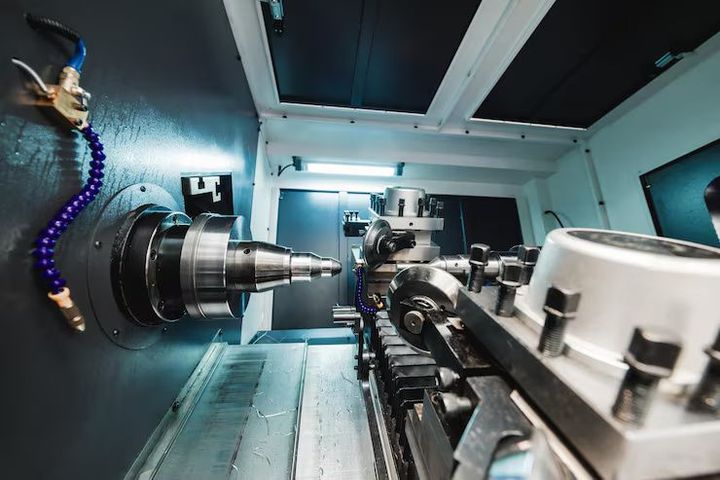
CNC Swiss-Type Lathes Guide: Explore Types, Components, Applications, Benefits, and Selection Factors
A CNC Swiss-type lathe is a computer-controlled machine tool designed primarily for producing small, precise components from metal or other machinable materials. Unlike a conventional lathe, a Swiss-type lathe generally supports the workpiece close to the cutting area while the material moves through a guide bushing. This arrangement helps maintain support when machining long, narrow components.
The term “Swiss-type” comes from the development of this machining approach for precision component production in Switzerland. The method was initially associated with small components used in watchmaking and similar applications. Over time, the technology expanded into industries requiring repeatable production of miniature and slender parts.
CNC stands for computer numerical control. In a CNC Swiss-type lathe, programmed instructions control movements, spindle rotation, cutting tools, and other machine functions. This allows a sequence of machining operations to be performed with limited manual intervention.
How a CNC Swiss-Type Lathe Differs From a Conventional Lathe
In a conventional turning machine, the workpiece is commonly held by a chuck while the cutting tool moves along the material. In a Swiss-type configuration, the material is supported near the cutting zone by a guide bushing, and the headstock can move the material longitudinally.
This design can be particularly useful when the component has a small diameter compared with its length. The close support helps reduce unwanted movement during cutting and can contribute to dimensional control.
Main Types of CNC Swiss-Type Lathes
CNC Swiss-type lathes can be grouped according to their configuration and machining capabilities. Common categories include:
- Gang-tool Swiss lathes: Multiple tools are arranged on a tool plate or gang system for rapid access to cutting operations.
- Sliding-headstock Swiss lathes: The headstock moves along the longitudinal axis while the material passes through the guide bushing.
- Fixed-headstock configurations: The material remains more stationary relative to the headstock, while other machine elements provide the required cutting movement.
- Multi-axis Swiss lathes: Additional controlled axes allow several cutting operations to be coordinated during one machining cycle.
- Multi-spindle Swiss lathes: Multiple spindles can support different stages or components of a production process, depending on machine design.
The appropriate configuration depends on part geometry, material characteristics, machining operations, production volume, and required dimensional control.
Importance
CNC Swiss-type lathes are important in manufacturing because many modern products contain small components that require controlled dimensions and repeatable machining. Examples include precision fasteners, connectors, shafts, pins, medical components, electronic hardware, and small mechanical parts.
The machine design addresses a particular machining challenge: cutting long or narrow workpieces without allowing excessive deflection. Supporting the material near the cutting point can help maintain stability during turning, drilling, threading, grooving, and related operations.
Where CNC Swiss-Type Lathes Are Used
Swiss-type machining is found across several manufacturing sectors:
- Medical and dental component production
- Automotive component manufacturing
- Electronics and electrical hardware
- Aerospace component production
- Instrumentation
- Precision engineering
- Optical equipment
- Small mechanical assemblies
The exact application depends on the machine's working envelope, spindle arrangement, tooling, control system, and material-handling capabilities.
Typical Machining Operations
A CNC Swiss-type lathe can combine several operations in one programmed cycle. These may include:
- Turning and facing
- Drilling
- Boring
- Threading
- Grooving
- Parting
- Knurling
- Milling
- Cross drilling
- Polygon turning
The ability to combine operations can reduce the number of separate machining stages required for certain component designs. However, the available operations depend on the specific machine configuration and installed tooling.
Benefits of the Swiss-Type Design
The guide-bushing arrangement provides close support for slender material during machining. This can help reduce deflection and vibration compared with an unsupported section of similar length.
Another benefit is process integration. Machines with multiple tools and driven tooling can perform several operations during one cycle. This can reduce intermediate handling and simplify the movement of components between machining stages.
CNC control also allows programmed movements and cutting sequences to be repeated. Once a suitable program and setup have been established, the same machining sequence can be applied to subsequent components under controlled production conditions.
Recent Updates
From 2024 through 2026, developments in CNC Swiss-type machining have generally followed wider manufacturing trends toward automation, multi-axis machining, digital monitoring, and improved process integration. Machine builders have continued developing systems that combine turning and milling operations, increase the number of controlled axes, and integrate automated material handling.
Automation and Digital Monitoring
Modern CNC systems increasingly support data collection and machine monitoring. Depending on the equipment, information such as spindle load, operating status, tool condition, alarms, and production-cycle data can be monitored through connected control systems.
These capabilities can support production tracking and process analysis. They also fit within broader smart-manufacturing systems where machine data is connected with factory-level software.
Multi-Axis Machining
Multi-axis Swiss-type lathes are increasingly used for components requiring several machining directions. Additional axes and driven tools can allow milling, drilling, and turning operations to be coordinated within one setup.
This is particularly relevant for components with cross holes, flats, slots, angled features, or other complex geometry. The number of axes alone does not determine machining capability; spindle arrangement, tool positions, software, and workholding also influence what a machine can produce.
Tool and Process Monitoring
Tool monitoring is another area of development. Sensors and software can detect changes in cutting conditions, spindle load, vibration, or tool behavior. Such systems can help identify process changes before they result in significant dimensional variation or machine interruptions.
These technologies are part of a broader shift toward data-supported manufacturing rather than relying entirely on manual observation.
Laws or Policies
In India, CNC Swiss-type lathes fall within the wider area of machine-tool safety and industrial workplace requirements. The Bureau of Indian Standards identifies machine tools as an important area of standardization and provides technical material covering CNC and NC machine tools, including accuracy and safety considerations.
BIS currently provides machine-safety information under its certification framework. Its product-specific information includes guidelines for metal-cutting machines, while its current Scheme-X information identifies metal-cutting machine tools under headings 8456 to 8461 within the machinery covered by the applicable technical regulation framework.
For turning machines, BIS guidance references IS 17258/ISO 23125 for applicable safety requirements and identifies requirements concerning safety-related parts of control systems.
Workplace safety is also governed by India's occupational safety framework. The Ministry of Labour and Employment provides information concerning the Occupational Safety, Health and Working Conditions Code, 2020 and associated rules. Applicable requirements can depend on the workplace, establishment, machinery, and state-level implementation.
BIS certification should not be assumed to apply identically to every machine or component. BIS states that certification is generally voluntary unless the Central Government makes compliance compulsory through applicable legal instruments such as Quality Control Orders or other regulations.
Tools and Resources
Several resources can help readers understand CNC Swiss-type lathes and their operating requirements.
CNC Programming Resources
CNC programming references explain coordinate systems, tool offsets, cutting cycles, spindle commands, feed rates, tool compensation, and other programming concepts. The exact programming language and commands depend on the controller installed on the machine.
Machine Manuals
The manufacturer's machine manual is an important technical reference for a particular CNC Swiss-type lathe. It normally explains machine specifications, operating controls, allowable tooling, maintenance procedures, safety functions, alarms, and machine-specific programming information.
CAD/CAM Software
CAD/CAM platforms can be used to create component geometry and generate CNC machining programs. CAM software can simulate toolpaths and help identify potential collisions or machining problems before a program is transferred to the machine.
Measurement Equipment
Precision machining commonly involves measurement tools such as micrometers, vernier instruments, gauges, optical measurement systems, and coordinate measurement equipment. The appropriate instrument depends on the component's dimensions and required measurement resolution.
BIS Standards Resources
BIS provides a “Know Your Standard” portal that allows users to search Indian Standards using an IS number or keyword. The platform can provide access to standard-related documents, amendments, notifications, testing information, and other details.
BIS also maintains current information about machinery safety certification and associated application procedures. Its machine-safety certification resources were updated during 2026.
Common Selection Factors
When comparing CNC Swiss-type lathes, several technical factors are relevant:
| Selection factor | What to examine |
|---|---|
| Maximum bar diameter | Maximum material diameter the machine can accommodate |
| Guide bushing | Type, size range, and compatibility |
| Number of axes | Available controlled machining directions |
| Spindle configuration | Main spindle, sub-spindle, or multi-spindle arrangement |
| Tool capacity | Number and type of available tool positions |
| Driven tooling | Capability for milling and cross-machining |
| Machine travel | Available movement along each axis |
| Control system | Programming, monitoring, and automation functions |
| Material handling | Bar feeding and workpiece transfer arrangement |
| Chip management | Chip evacuation and collection system |
| Coolant system | Delivery method and process requirements |
| Measurement capability | Available inspection and monitoring options |
The selection process should be based on the actual component geometry and production requirements rather than machine specifications considered individually.
FAQs
What is a CNC Swiss-type lathe?
A CNC Swiss-type lathe is a computer-controlled turning machine designed particularly for small and slender components. Its guide-bushing arrangement supports the material close to the cutting area while the machine performs programmed machining operations.
How does a CNC Swiss-type lathe work?
The machine feeds bar material through a guide bushing and positions the cutting tools according to a CNC program. Depending on its design, the headstock or cutting tools move along controlled axes while turning, drilling, milling, threading, or other operations are performed.
What are the main CNC Swiss-type lathe components?
Common components include the CNC controller, spindle or spindles, sliding headstock, guide bushing, tool holders, cutting tools, workholding elements, coolant system, chip-management equipment, and machine enclosure. Multi-axis machines may include additional driven-tool and positioning systems.
What applications use Swiss-type lathes?
Swiss-type lathes are commonly associated with small precision components used in medical, automotive, electronics, aerospace, instrumentation, and general precision-engineering applications.
What factors should be considered when selecting a CNC Swiss-type lathe?
Important factors include maximum material diameter, component length, guide-bushing arrangement, spindle configuration, number of axes, tool capacity, driven tooling, machine travel, control functions, material handling, and the machining operations required for the component.
Conclusion
CNC Swiss-type lathes are specialized machine tools designed to produce small and slender components through controlled turning and related machining operations. Their guide-bushing arrangement provides support near the cutting area, while CNC controls coordinate tools, spindles, and machine movements. Recent developments have focused on multi-axis machining, automation, monitoring, and digital manufacturing integration. In India, applicable BIS standards and occupational safety requirements provide important references for machine design, conformity, and workplace operation.