Explore the Mechanics and Engineering of Modern Block Making Machines
Modern construction relies heavily on uniform, durable masonry units to build safe structures efficiently. To explore the mechanics and engineering of modern block making machines, we must examine how mechanical force, hydraulic pressure, and vibration science transform raw aggregate into solid building blocks.
Understanding these engineering principles helps builders, engineers, and students appreciate the precision behind contemporary masonry production.
Context
A modern block making machine is an industrial system designed to compress concrete, fly ash, or clay mixtures into standardized masonry units. Historically, workers formed blocks manually using wooden molds and hand tamping, which resulted in inconsistent density and slow output. Today, automated equipment combines mechanical precision with hydraulic power to produce thousands of uniform blocks within a single shift.
The primary purpose of this machinery is to achieve maximum material compaction while maintaining exact dimensional tolerances. Raw materials such as cement, sand, gravel, and water are mixed to a specific moisture level before entering a steel mold box. Once inside, the machine applies intense downward pressure alongside high-frequency vibration to eliminate air pockets and bond the particles tightly together.
Core Mechanical Subsystems
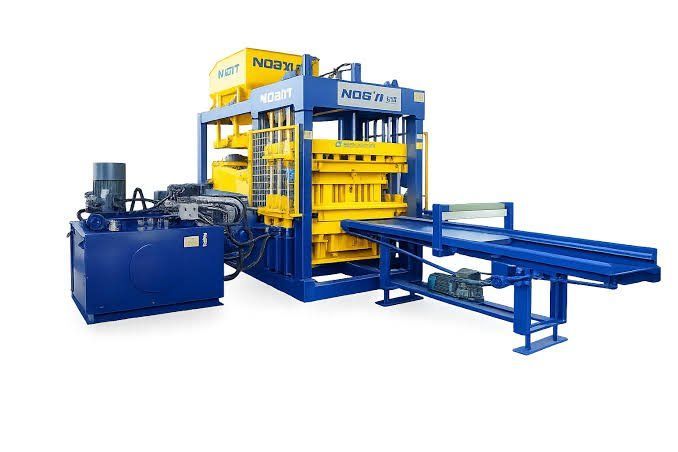
Every automated block production line relies on four primary engineering subsystems working in synchronization:
Material feeding systems use belt conveyors and agitator boxes to distribute raw concrete evenly into the mold cavities.
Hydraulic power units generate high fluid pressure to drive heavy steel rams and tamper heads downward.
Vibration tables utilize eccentric shafts driven by electric motors to create rapid vertical oscillations.
Pallet handling mechanisms transport freshly molded blocks away from the press toward curing racks.
Importance
The engineering behind block production directly impacts structural safety, construction speed, and environmental sustainability. High-density blocks produced through precision compaction exhibit superior load-bearing capacity and resistance to moisture penetration. When masonry units meet strict dimensional standards, builders require less mortar and achieve stronger structural alignment across walls and foundations.
This technology affects a wide range of stakeholders across the built environment:
Civil and structural engineers rely on predictable compressive strength ratings when designing multi-story buildings and infrastructure.
Masonry contractors benefit from uniform block dimensions that accelerate wall assembly and reduce material waste on site.
Urban planners and municipal authorities depend on durable, fire-resistant building materials to support expanding residential zones.
Environmental researchers utilize these machines to repurpose industrial byproducts like fly ash and recycled aggregates into viable construction units.
Compaction Method Comparison
| Engineering Feature | Hydraulic Compression | High-Frequency Vibration | Vibro-Compaction Hybrid |
| Primary Force Mechanism | Static downward fluid pressure | Rapid vertical mechanical oscillation | Simultaneous pressure and vibration |
| Air Void Reduction | Moderate in deep molds | High near vibrating surfaces | Very high throughout full block depth |
| Ideal Material Mix | Wet or semi-dry earth mixes | Low-slump concrete aggregates | Zero-slump concrete and fly ash |
| Typical Cycle Speed | Moderate cycle duration | Fast cycle duration | Rapid, synchronized cycle duration |
Recent Updates
Engineering advancements have transformed traditional mechanical presses into intelligent, energy-efficient manufacturing systems. Modern equipment increasingly integrates servo-hydraulic technology, which adjusts pump motor speeds dynamically based on real-time pressure demands. This engineering refinement significantly reduces electrical energy consumption and lowers hydraulic fluid operating temperatures during continuous operation.
Automation and digital telemetry have also reshaped how operators monitor mechanical performance. Programmable logic controllers now regulate vibration frequency, amplitude, and pressing duration down to fractions of a second. Sensors embedded within the hydraulic manifolds and vibration tables track component wear, alerting maintenance teams before mechanical tolerances drift out of specification.
Additionally, modular mold engineering allows facilities to switch between hollow blocks, solid bricks, interlocking pavers, and curb stones quickly. Quick-change mold clamping systems use hydraulic locks rather than manual bolts, minimizing equipment downtime during product transitions.
Laws or Policies
The engineering and operation of block making machinery are governed by strict industrial safety rules and building material standards. International and national regulatory bodies establish baseline requirements for both equipment design and final block performance.
In the United States, the Occupational Safety and Health Administration enforces machine guarding standards under 29 CFR 1910 to protect workers from moving rams, conveyors, and pinch points. Equipment must feature physical barriers, light curtains, and emergency stop circuits that immediately depressurize hydraulic lines when triggered.
Regarding product quality, organizations such as ASTM International publish specifications like ASTM C90 for load-bearing concrete masonry units. In India, the Bureau of Indian Standards enforces IS 2185 for hollow and solid concrete blocks, alongside environmental mandates encouraging fly ash utilization near thermal power plants. Manufacturers configure machine compaction settings specifically to satisfy these compressive strength, water absorption, and dimensional accuracy regulations.
Tools and Resources
Engineers, students, and facility operators can access several technical platforms and calculation tools to study block production mechanics:
ASTM International Digital Library provides access to official testing standards for concrete masonry strength, density, and durability.
Bureau of Indian Standards Portal offers technical documentation on masonry specifications and industrial safety codes.
Portland Cement Association Resources feature educational guides on concrete mix design, aggregate grading, and moisture optimization.
Engineering Toolbox provides online calculators for hydraulic cylinder force, fluid flow rates, and electric motor power sizing.
National Concrete Masonry Association Technical Notes contain detailed architectural and structural engineering references for block applications.
FAQs
How do modern block making machines achieve uniform block density?
Modern block making machines combine synchronized high-frequency vibration with hydraulic top-pressing. The vibration temporarily reduces internal friction between aggregate particles, allowing them to settle tightly as the hydraulic tamper head compresses the mixture from above.
What is the role of vibration frequency in block engineering?
Vibration frequency determines how effectively air pockets escape from the concrete mixture during molding. Higher frequencies work best for fine aggregates and smooth surface finishes, while lower frequencies with higher amplitude help settle larger gravel particles.
Why is zero-slump concrete used in automated block production?
Zero-slump concrete contains minimal water, which allows freshly molded blocks to hold their exact shape immediately after the steel mold lifts away. This immediate structural stability enables continuous high-speed production without waiting for the concrete to harden inside the mold.
How do servo-hydraulic systems improve block machine performance?
Servo-hydraulic systems regulate hydraulic pump output precisely according to each phase of the molding cycle. This design eliminates unnecessary fluid bypass, reduces heat generation, lowers noise levels, and improves positioning accuracy for the compression ram.
What maintenance checks preserve mechanical accuracy in block machines?
Technicians regularly inspect mold liner wear, hydraulic seal integrity, and vibration shaft bearings. Maintaining proper lubrication on guide columns and verifying pressure sensor calibration ensures consistent block dimensions over long production runs.
Conclusion
Exploring the mechanics and engineering of modern block making machines reveals a precise balance of fluid power, vibration physics, and automated control. By synchronizing hydraulic compression with high-frequency oscillation, these systems transform basic raw aggregates into high-strength masonry units that meet strict structural standards. Ongoing advancements in servo-hydraulics, digital monitoring, and modular tooling continue to enhance production efficiency and material sustainability across global construction.