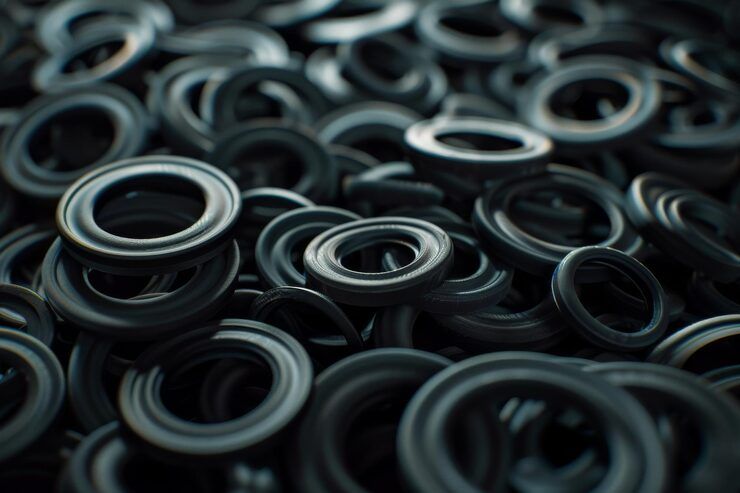
O-rings are circular sealing components with a round cross-section, designed to fit into grooves and create a seal between two or more mechanical parts. They exist to prevent the leakage of fluids or gases and to block the entry of contaminants such as dust or moisture. Their simple shape makes them one of the most widely used sealing elements in mechanical systems.
The concept of the O-ring emerged as machinery became more complex and reliable sealing methods were required. Earlier sealing approaches relied on flat gaskets or packed materials, which were often bulky and inconsistent. O-rings offered a compact and efficient alternative, capable of sealing under both static and dynamic conditions.
Today, O-rings are used in a wide range of mechanical systems, including hydraulic equipment, pneumatic systems, automotive components, aerospace assemblies, and industrial machinery. Their continued use reflects their adaptability, reliability, and effectiveness in diverse operating environments.
Importance: Why O-Rings Matter Today
O-rings matter today because modern mechanical systems depend heavily on controlled sealing. Even minor leakage can lead to efficiency losses, equipment damage, or safety concerns. O-rings provide a dependable solution for maintaining system integrity.
This topic matters because O-rings:
-
Prevent fluid and gas leakage
-
Protect components from contamination
-
Support pressure and temperature control
-
Enable compact and efficient mechanical design
O-rings affect engineers, maintenance teams, equipment designers, and safety regulators. In hydraulic and pneumatic systems, O-rings help maintain pressure stability. In rotating or moving assemblies, they reduce the risk of seal failure caused by vibration or thermal expansion.
By solving sealing challenges in a simple and scalable way, O-rings remain essential components in modern mechanical engineering.
Recent Updates: Developments in O-Ring Technology
During 2024 and early 2025, discussions around O-rings focused on material innovation and performance optimization. In early 2024, attention increased on advanced elastomer materials designed to withstand higher temperatures and aggressive chemical environments.
By mid-2024, sustainability considerations became more visible. Research highlighted longer-lasting O-ring materials that reduce replacement frequency and material waste. This trend aligned with broader industrial goals related to efficiency and environmental responsibility.
In late 2024, digital design tools and simulation models gained wider use. These tools allow engineers to analyze O-ring compression, groove design, and wear behavior before physical assembly, improving reliability and reducing trial-and-error in system design.
Another notable update involved standardization. Greater emphasis was placed on consistent sizing and tolerance control to support global manufacturing and equipment compatibility.
Laws and Policies: Standards Affecting O-Rings
O-rings are influenced primarily by technical standards rather than consumer-facing regulations. These standards ensure consistent performance, safety, and interchangeability across industries.
Many O-ring dimensions, materials, and testing methods align with guidance from the International Organization for Standardization, which publishes specifications for elastomer seals and mechanical components.
In industrial environments, workplace safety and equipment reliability regulations indirectly influence O-ring selection. Seals used in pressure systems must meet defined safety margins to prevent failure. Environmental policies may also affect material choices, particularly where chemical resistance or long service life is required.
Together, these frameworks help ensure that O-rings perform reliably across different applications and operating conditions.
Tools and Resources: Understanding O-Rings in Practice
Several technical tools and educational resources support understanding of O-rings and their role in mechanical systems. These resources focus on design knowledge, material selection, and application awareness.
Helpful tools and references include:
-
O-ring size and groove design charts
-
Material compatibility reference tables
-
Pressure and temperature performance guides
-
Engineering handbooks on sealing technology
-
Simulation tools for seal compression analysis
The table below outlines common O-ring materials and their general characteristics:
| Material Type | General Properties | Typical Use Environment |
|---|---|---|
| Nitrile rubber | Good oil resistance, flexible | Hydraulic systems |
| Fluorocarbon | High temperature resistance | Chemical processing |
| Silicone | Wide temperature range | Static sealing |
| EPDM | Weather and water resistance | Outdoor equipment |
| PTFE-based blends | Low friction, chemical stability | Specialized applications |
Another table highlights typical O-ring applications in mechanical systems:
| Application Area | Role of O-Ring |
|---|---|
| Hydraulic cylinders | Maintain pressure seal |
| Pneumatic valves | Control air leakage |
| Automotive engines | Seal fluids and gases |
| Industrial pumps | Prevent fluid loss |
| Aerospace systems | Support reliability under extremes |
These resources help learners understand how O-rings are selected and applied in real-world systems.
Frequently Asked Questions About O-Rings
What is the main function of an O-ring?
An O-ring creates a seal that prevents leakage of fluids or gases between mechanical parts.
Why are O-rings round in shape?
The circular shape allows even compression and consistent sealing in a groove.
Can O-rings be used in moving systems?
Yes, O-rings are used in both static and dynamic applications when properly designed.
What factors affect O-ring performance?
Material choice, pressure, temperature, groove design, and lubrication all influence performance.
Are O-rings standardized?
Many O-ring sizes and materials follow international standards to ensure compatibility.
Conclusion: The Role of O-Rings in Mechanical Systems
O-rings are small components with a significant impact on mechanical system reliability. Their simple design enables effective sealing across a wide range of pressures, temperatures, and applications. From industrial machinery to advanced engineering systems, O-rings help maintain efficiency, safety, and durability.
By understanding the context, importance, recent developments, standards, tools, and common questions surrounding O-rings, readers gain a clearer view of why these components remain essential. O-rings continue to support modern mechanical systems by solving fundamental sealing challenges in a practical and dependable way.