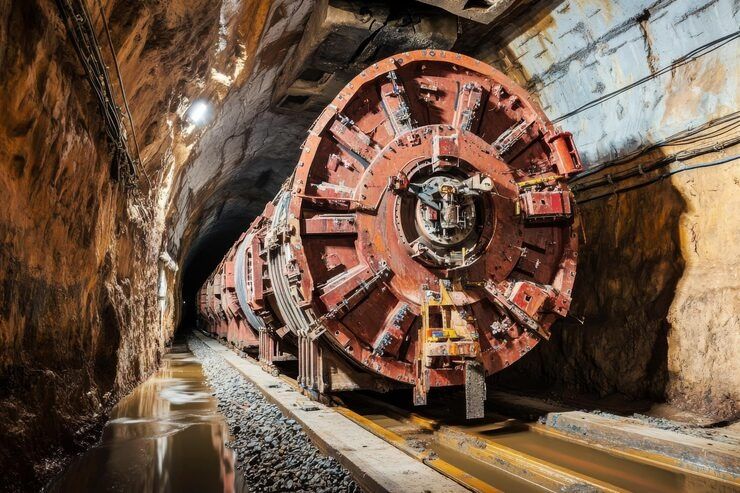
A tunnel boring machine (TBM) is a large-scale mechanical system designed to excavate tunnels through soil and rock with high precision. TBMs exist to address the limitations of traditional drilling and blasting methods, especially in urban and geologically sensitive areas. By using rotating cutter heads, thrust systems, and controlled excavation processes, TBMs create circular tunnels with minimal surface disruption.
The concept of mechanized tunneling developed as cities expanded and underground space became essential for transportation, utilities, and water management. Early tunneling methods were slow and labor-intensive, with higher safety risks. Modern TBMs combine mechanical engineering, hydraulics, electronics, and software-based control systems to achieve consistent excavation while supporting tunnel walls during construction.
Today, tunnel boring machines are used for metro rail corridors, road tunnels, water conveyance systems, sewer networks, and underground power infrastructure. Their design varies based on ground conditions, tunnel diameter, and project requirements, but all TBMs rely on coordinated mechanical and control systems to function effectively.
Importance: Why Tunnel Boring Machine Knowledge Matters Today
Understanding the mechanical and control systems of a tunnel boring machine is important because underground construction plays a growing role in urban development. As surface space becomes limited, cities increasingly rely on subsurface infrastructure to support transportation, utilities, and population growth.
This topic matters to civil engineers, infrastructure planners, policymakers, safety specialists, and students of construction technology. TBMs help solve several modern challenges, including:
-
Reducing surface disruption in densely populated areas
-
Improving worker safety compared to conventional excavation
-
Achieving consistent tunnel geometry and alignment
-
Supporting large-scale infrastructure expansion
Mechanical and control systems work together to manage thrust, torque, cutter head rotation, and ground pressure. A clear understanding of these systems helps ensure tunnel stability, operational safety, and predictable excavation performance.
Mechanical Systems in a Tunnel Boring Machine
The mechanical system of a TBM forms its structural and functional backbone. These components handle cutting, material removal, machine movement, and tunnel support.
Key mechanical components include:
-
Cutter head that rotates to break soil or rock
-
Cutting tools such as disc cutters, scrapers, or picks
-
Main bearing supporting the rotating cutter head
-
Thrust cylinders pushing the machine forward
-
Screw conveyor or conveyor belts removing excavated material
-
Segment erector installing tunnel lining segments
Table: Core Mechanical Components and Their Functions
| Component | Primary Role | Operational Impact |
|---|---|---|
| Cutter Head | Excavates ground | Determines excavation rate |
| Disc Cutters | Break hard rock | Influences tool wear |
| Thrust Cylinders | Propel TBM forward | Controls advance speed |
| Screw Conveyor | Removes spoil | Maintains face pressure |
| Segment Erector | Places lining segments | Ensures tunnel stability |
Each mechanical element must operate within defined limits to prevent damage, excessive wear, or ground instability.
Control Systems and Automation in TBMs
Control systems act as the operational brain of a tunnel boring machine. These systems monitor, regulate, and coordinate mechanical functions in real time. Modern TBMs use programmable logic controllers (PLCs), sensors, and human-machine interfaces (HMIs) to maintain stable excavation conditions.
Control systems manage parameters such as:
-
Cutter head rotation speed
-
Thrust force and advance rate
-
Earth pressure or slurry pressure at the tunnel face
-
Torque and vibration levels
-
Alignment and guidance data
Operators monitor these values through centralized control panels. Automated feedback loops adjust machine behavior based on ground conditions, helping reduce the risk of face collapse or excessive settlement.
Table: Key Control Parameters and Their Purpose
| Parameter | Controlled Aspect | Why It Matters |
|---|---|---|
| Torque | Cutter head load | Prevents overload |
| Thrust | Forward movement | Maintains steady advance |
| Face Pressure | Ground stability | Reduces settlement |
| Alignment Data | Tunnel direction | Ensures accuracy |
Advanced control systems improve consistency, reduce manual intervention, and support long-distance tunneling with minimal deviation.
Interaction Between Mechanical and Control Systems
The effectiveness of a tunnel boring machine depends on how well mechanical and control systems interact. Sensors embedded in mechanical components continuously transmit data to control units. This information allows real-time adjustments that protect equipment and surrounding ground.
For example, if cutter head torque increases suddenly, the control system may reduce advance speed or adjust rotation to prevent damage. Similarly, changes in soil pressure trigger automatic regulation of excavation and spoil removal systems.
This integration helps TBMs adapt to varying geology, including transitions between soft soil and hard rock. It also supports predictive maintenance by identifying abnormal patterns before mechanical failure occurs.
Recent Updates: Trends and Developments in the Past Year
During 2024 and early 2025, tunnel boring machine technology reflected broader trends in digitalization and sustainability. One major update involved the increased use of data-driven monitoring systems. Several infrastructure projects reported the integration of advanced sensor arrays and cloud-based analytics platforms by mid-2024, improving performance tracking and maintenance planning.
Another trend observed in late 2024 was the refinement of variable density TBMs. These machines allow operators to adjust excavation modes for mixed ground conditions, enhancing flexibility in complex geological zones.
Energy efficiency also gained attention. New TBM designs introduced in 2025 emphasized optimized drive systems and reduced energy losses during cutter head rotation. These updates align with global infrastructure goals focused on efficiency and environmental responsibility.
Laws and Policies Influencing Tunnel Boring Machines
Tunnel boring machine usage is influenced by national infrastructure policies, safety regulations, and environmental standards. Government guidelines often define how underground construction projects should manage ground movement, noise, vibration, and worker safety.
Key regulatory considerations include:
-
Construction safety standards for heavy machinery
-
Environmental impact assessment requirements for tunneling projects
-
Urban planning policies governing underground development
-
Public infrastructure programs supporting metro and water projects
In many countries, government-funded transportation and water management initiatives encourage mechanized tunneling to minimize disruption and improve long-term infrastructure resilience. Compliance with these policies ensures TBM operation aligns with safety, environmental, and engineering standards.
Tools and Resources Related to TBM Systems
Several technical tools and resources support understanding and managing tunnel boring machine mechanical and control systems. These references focus on analysis, planning, and education.
Helpful resources include:
-
TBM performance monitoring dashboards
-
Geological modeling software for tunnel alignment planning
-
Thrust and torque calculation references
-
Maintenance planning templates for mechanical components
-
Engineering handbooks on mechanized tunneling principles
Table: Example Monitoring Data Used in TBM Operations
| Data Type | Measured Area | Purpose |
|---|---|---|
| Cutter Wear | Cutting tools | Maintenance planning |
| Advance Rate | Machine movement | Productivity analysis |
| Face Pressure | Tunnel face | Ground stability |
| Vibration | Structural load | Safety monitoring |
These tools help engineers and operators make informed decisions during tunnel excavation.
FAQs: Common Questions About Tunnel Boring Machines
What is the main purpose of a tunnel boring machine?
A tunnel boring machine excavates tunnels with controlled precision while supporting the surrounding ground during construction.
How do control systems improve TBM safety?
Control systems monitor critical parameters and adjust operations automatically, reducing the risk of mechanical overload or ground instability.
Are all tunnel boring machines the same?
No. TBMs vary by design, diameter, and excavation method depending on soil, rock type, and project requirements.
Why is face pressure important in TBM operation?
Maintaining correct face pressure helps prevent ground collapse and surface settlement above the tunnel.
How is tunnel alignment maintained?
Guidance systems use lasers, sensors, and control software to keep the machine on its planned path.
Conclusion
Tunnel boring machine information covering mechanical and control systems highlights the complexity behind modern underground construction. These machines combine heavy mechanical components with advanced control technology to excavate tunnels safely and accurately. Their importance continues to grow as cities expand and infrastructure moves below ground.
Recent developments emphasize digital monitoring, adaptability to mixed geology, and improved energy efficiency. At the same time, laws and policies ensure TBM operations meet safety and environmental standards. A clear understanding of TBM systems supports better planning, safer execution, and reliable long-term infrastructure outcomes.