How Do Food Service Machines Work? A Guide to Commercial Kitchen Equipment
Food service machines are specialized equipment used to prepare, cook, store, clean, and manage food in commercial kitchens. They are found in restaurants, hotels, cafeterias, hospitals, schools, catering kitchens, bakeries, and institutional food facilities.
Unlike ordinary household appliances, commercial kitchen equipment is designed for repeated use, higher workloads, and strict hygiene requirements. A commercial oven may operate for many hours each day, while refrigeration systems must maintain stable temperatures for ingredients and prepared food. Other machines may mix, slice, wash, fry, steam, or package food.
The basic working principle is simple: each machine is designed to perform a specific kitchen task with controlled heat, pressure, motion, temperature, water, or airflow. Together, these systems create a connected food preparation process.
A typical commercial kitchen may use several categories of equipment:
- Cooking equipment such as ovens, fryers, grills, steamers, and induction systems
- Food preparation equipment such as mixers, slicers, cutters, and processors
- Refrigeration equipment such as chillers, freezers, and cold-storage units
- Cleaning equipment such as commercial dishwashers and sanitation systems
- Ventilation equipment for removing heat, smoke, steam, and airborne particles
- Monitoring equipment for tracking temperatures, cleaning routines, and food safety conditions
The development of food service machines has been driven by the need to handle larger volumes of food while maintaining consistency, safety, and efficient kitchen operations. Modern equipment increasingly combines mechanical systems with sensors, digital controls, automation, and data monitoring.
Why Food Service Machines Matter Today
Modern food preparation depends on reliable equipment. As kitchens serve larger numbers of people, manual preparation alone can become difficult to manage. Food service machines help organize repeated tasks and support consistent preparation methods.
They also affect several important areas of commercial kitchen management.
Improving kitchen productivity
A food processor can complete repetitive cutting or mixing tasks quickly. A commercial mixer can handle large batches of dough or other ingredients. Automated cooking controls can help maintain more consistent temperatures and cooking times.
This does not eliminate the need for skilled kitchen staff. Instead, machines help reduce repetitive physical work and allow people to focus on food preparation, supervision, quality checks, and kitchen management.
Supporting food safety
Temperature control is one of the most important functions in a commercial kitchen. Refrigeration systems help keep perishable foods within appropriate temperature ranges. Cooking equipment helps reach required internal temperatures, while dishwashing systems use controlled heat and cleaning processes.
Temperature monitoring tools can also provide records that help kitchen managers identify problems before they become serious food safety concerns.
Reducing waste through better control
Food waste can occur when ingredients are stored incorrectly, cooked unevenly, or prepared in quantities that are difficult to manage. Equipment with accurate controls can support more predictable cooking and storage processes.
For example, programmable ovens and temperature monitoring systems may help reduce overcooking or improper storage. However, actual results depend on equipment condition, kitchen procedures, maintenance, and correct operation.
Supporting energy efficiency
Energy use is an important consideration for commercial kitchens. Heating equipment, refrigeration systems, ventilation units, and dishwashers can operate for long periods.
Recent equipment design increasingly focuses on improved insulation, efficient heating methods, variable-speed systems, and digital monitoring. Induction cooking and combination ovens are examples of technologies that can combine precise control with different cooking functions.
Helping different industries
Food service equipment is used in many environments, including:
- Restaurants and hotels
- School and university cafeterias
- Hospitals and care facilities
- Catering and event kitchens
- Bakeries and food production kitchens
- Workplace dining facilities
- Military and institutional kitchens
Each environment has different requirements. A hospital kitchen may focus heavily on controlled food handling, while a bakery may depend more on mixers, proofing systems, and specialized ovens.
How Different Food Service Machines Work
Food service machines use different operating principles depending on their purpose.
Commercial cooking machines
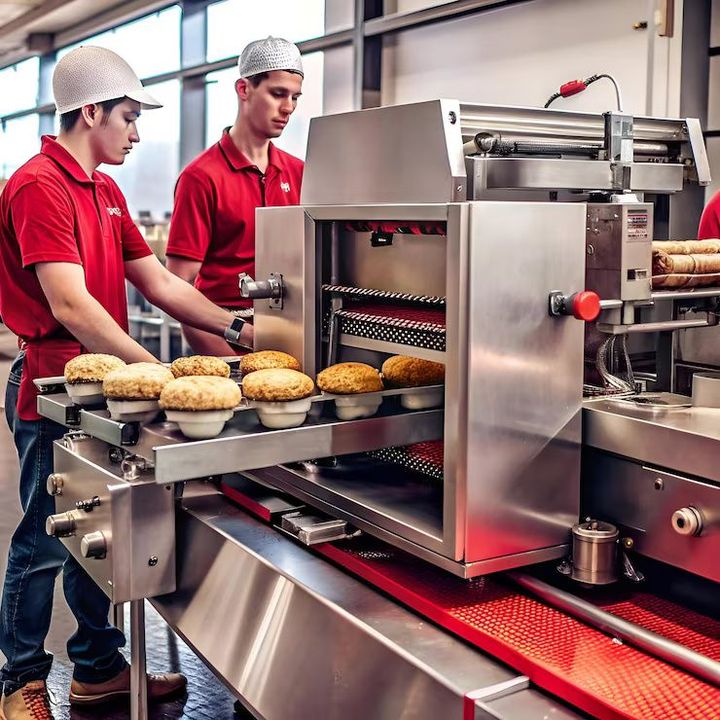
Ovens transfer heat to food through methods such as convection, conduction, radiation, steam, or a combination of these processes. Convection ovens use fans to circulate heated air, helping distribute heat throughout the cooking chamber.
Combination ovens may use multiple cooking methods, including hot air and steam. This allows kitchens to prepare different types of food using controlled temperature and humidity.
Fryers heat cooking oil to a controlled temperature. Food is placed into the heated oil, where heat moves rapidly through the surface and into the food. Accurate temperature controls are important because excessive heat can affect food quality and create safety concerns.
Induction equipment works differently. It uses an electromagnetic field to heat compatible cookware directly rather than relying primarily on a traditional heating element.
Food preparation machines
Food preparation equipment uses mechanical movement. Blades, rotating tools, rollers, or mixing attachments perform tasks such as chopping, slicing, grinding, blending, and mixing.
A commercial mixer, for example, uses a motor connected to a rotating attachment. Different attachments may perform different tasks. The machine's design determines the speed, capacity, and type of ingredients it can handle.
Safety features are essential because many preparation machines contain moving components. Guards, interlocks, emergency controls, and correct operating procedures help reduce risks.
Refrigeration systems
Commercial refrigeration equipment removes heat from an enclosed space. A refrigeration cycle generally uses a compressor, condenser, expansion device, and evaporator.
The system absorbs heat from the storage area and transfers it outside the refrigerated space. A thermostat or electronic controller monitors temperature and activates the system when cooling is needed.
Modern refrigeration systems may include digital displays, alarms, remote monitoring, and improved insulation. Proper airflow and regular maintenance are important for reliable performance.
Commercial dishwashers
Commercial dishwashing equipment combines water, detergent, heat, and mechanical spraying to clean dishes, utensils, trays, and other kitchen items.
Some systems use multiple stages, including washing, rinsing, and sanitizing. The exact process depends on the machine design and local food safety requirements.
Cleaning performance depends on several factors, including water temperature, chemical concentration, spray pressure, cycle duration, loading method, and pre-cleaning procedures.
Ventilation systems
Cooking creates heat, steam, smoke, grease particles, and odors. Commercial ventilation systems use hoods, filters, fans, and ductwork to remove or control these materials.
Proper ventilation can help maintain indoor air quality and reduce the buildup of grease. Kitchen ventilation must be designed and maintained according to applicable building, fire, and environmental requirements.
Recent Trends and Updates in Food Service Equipment
Food service equipment has continued to develop through automation, digital controls, energy efficiency, and improved monitoring.
In 2025 and 2026, commercial kitchen technology has increasingly focused on equipment that can perform multiple functions in a smaller footprint. Combination cooking systems, digital temperature controls, connected monitoring, and more efficient refrigeration are important examples of this direction.
Another major trend is the use of smart monitoring. Sensors can track temperature, equipment status, cleaning cycles, and maintenance conditions. The purpose is not simply to add technology, but to provide better information for kitchen management.
Energy efficiency is also becoming a larger part of equipment planning. Induction cooking, improved insulation, efficient refrigeration, and advanced ventilation can help reduce unnecessary energy use when correctly selected and operated.
Food safety technology is also receiving continued attention. In November 2024, the U.S. Food and Drug Administration published a Supplement to the 2022 Food Code. The update included provisions related to sanitation of food-contact and equipment surfaces, reusable containers, food defense, food safety management systems, and other food safety topics. The FDA stated that a complete revision was planned for 2026.
These developments show that commercial kitchen equipment is increasingly connected to broader goals such as food safety, energy management, data monitoring, and operational consistency.
Laws, Regulations, and Food Safety Policies
Food service machines are affected by several types of rules. Requirements vary by country, state, city, and type of food operation.
In the United States, the FDA Food Code provides a model framework for retail food and food service safety. It is not itself a federal law applied automatically everywhere. Instead, state, local, tribal, and territorial authorities may adopt or adapt it through their own regulations. The 2022 Food Code remains the most recent complete edition listed by the FDA, with a supplement published in 2024.
Rules may address:
- Equipment design and sanitation
- Food-contact surfaces
- Temperature control
- Cleaning and sanitizing procedures
- Water and plumbing systems
- Ventilation and physical facilities
- Employee hygiene
- Storage and handling procedures
- Prevention of cross-contamination
Equipment may also need to comply with electrical, fire safety, building, environmental, and workplace safety requirements.
Because regulations differ by location, kitchen operators should check the rules issued by the relevant local health authority and other responsible agencies. A machine that meets requirements in one jurisdiction may require additional approval or installation controls in another.
Tools and Resources for Understanding Commercial Kitchen Equipment
Several general tools can help people learn about and manage food service machines.
Equipment specification sheets help users compare capacity, power requirements, operating temperatures, dimensions, and installation needs.
Temperature logs and digital monitoring tools help record refrigeration and cooking conditions.
Maintenance checklists can track inspections, cleaning routines, filter replacement, lubrication requirements, and safety checks.
Energy-use calculators can help estimate the electricity or fuel consumption of equipment based on operating hours and power ratings.
Kitchen workflow templates can help organize food preparation, cooking, storage, cleaning, and inspection activities.
Food safety training materials can explain hygiene, temperature control, cross-contamination prevention, and sanitation principles.
Equipment manuals and technical documentation provide important information about safe operation, cleaning, maintenance, and troubleshooting.
The most useful resource depends on the type of kitchen, equipment, local rules, and food preparation process.
FAQs About Food Service Machines
What are food service machines used for?
Food service machines are used for tasks such as food preparation, cooking, refrigeration, freezing, cleaning, sanitation, ventilation, and monitoring in commercial or institutional kitchens.
How are commercial kitchen machines different from household appliances?
Commercial equipment is generally designed for higher workloads and repeated operation. It may also have different capacity, controls, construction, safety features, and installation requirements.
Why is temperature control important in food service equipment?
Temperature control helps support safe food storage and preparation. Refrigeration, cooking, and holding equipment must be operated according to applicable food safety procedures and local regulations.
Are automated kitchen machines completely independent?
No. Most automated machines still require correct setup, monitoring, cleaning, maintenance, and human supervision. Automation can support kitchen operations but does not replace food safety responsibilities.
What should be considered when selecting food service equipment?
Important factors include the kitchen's available space, food volume, workflow, power requirements, ventilation needs, sanitation requirements, safety features, maintenance needs, and applicable regulations.
Conclusion
Food service machines are an important part of modern commercial kitchen equipment. They use heat, cooling, mechanical movement, water, airflow, and digital controls to support food preparation and kitchen operations.
From commercial ovens and refrigeration systems to food processors, dishwashers, and ventilation equipment, each machine has a specific role. Together, these systems help kitchens handle repeated tasks while supporting consistency, hygiene, and organized workflows.