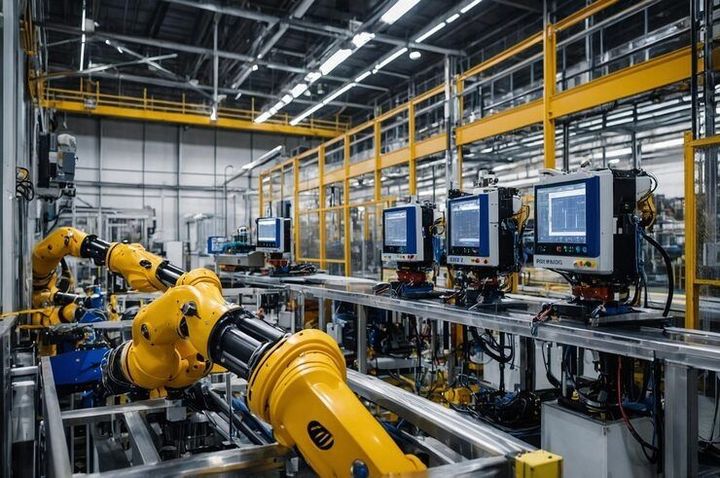
Industrial Automation Plants Guide: Modern Manufacturing Systems Explained
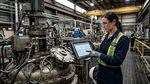
Industrial automation plants are manufacturing facilities where machines, control systems, software, sensors, and robotics work together to perform production activities with limited manual intervention. These systems are designed to control repetitive, precise, or continuous operations while allowing people to supervise processes, manage exceptions, and make operational decisions.
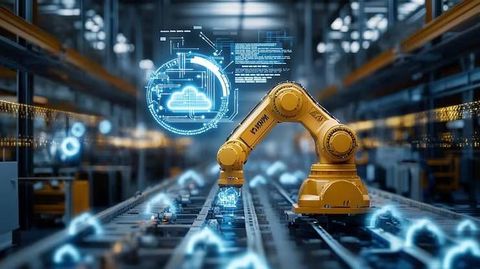
Industrial automation developed from basic mechanical controls into advanced manufacturing systems. Early factories depended heavily on manual operation and simple electrical controls. Modern facilities can combine programmable logic controllers (PLCs), industrial robots, human-machine interfaces (HMIs), supervisory control and data acquisition (SCADA), machine vision, industrial networks, and manufacturing execution systems (MES).
The main purpose is not simply to replace manual activity. Automation helps manufacturers create repeatable processes, monitor production conditions, reduce process variation, and collect useful information from equipment.
A modern automated plant may include:
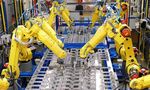
- Robotic arms for assembly, welding, handling, or inspection
- PLCs for controlling machines and production sequences
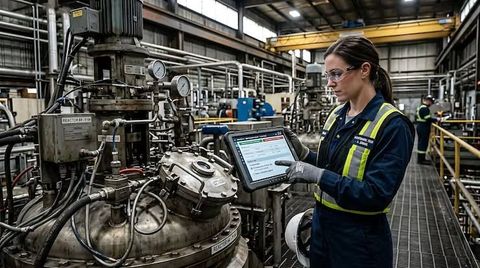
- Sensors for temperature, pressure, position, speed, and vibration
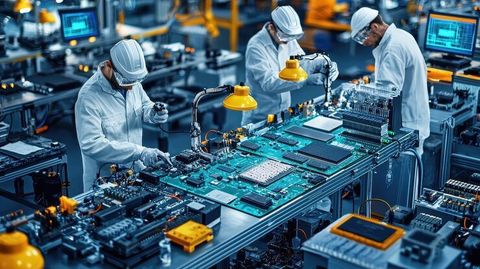
- Machine-vision systems for quality inspection
- SCADA platforms for monitoring industrial processes
- MES platforms for production tracking and coordination
- Industrial communication networks for connected equipment
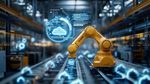
- Data analytics and artificial intelligence for process analysis
Together, these technologies form an integrated manufacturing environment often associated with Industry 4.0 and smart factories.
Importance
Why Industrial Automation Matters Today
Manufacturing companies increasingly need consistent quality, efficient production planning, accurate monitoring, and flexible processes. Industrial automation can address several of these requirements by connecting production equipment with control and information systems.
Automation is especially important in industries where repetitive production, strict quality requirements, or continuous operation are common. Automotive, electronics, pharmaceuticals, food processing, chemicals, metals, packaging, and energy-related manufacturing are examples where automated systems can play an important role.
The impact extends beyond factory equipment. Engineers, operators, maintenance teams, production planners, and quality professionals all interact with automated manufacturing environments.
Key advantages include:
- Process consistency: Automated sequences can repeat defined operations with limited variation.
- Production monitoring: Sensors and control platforms provide information about machine conditions.
- Quality management: Automated inspection can identify certain defects during production.
- Workplace safety: Robots and automated equipment can handle selected hazardous or repetitive activities.
- Data availability: Connected equipment creates production data that can support analysis and planning.
- Flexible manufacturing: Programmable systems can be adapted for different products or production requirements.
Automation also creates new technical requirements. Plants need suitable cybersecurity practices, reliable industrial networks, trained personnel, preventive maintenance, and clear operating procedures.
Main Technologies Used in Automated Plants
| Technology | Main Function | Typical Application |
|---|---|---|
| PLC | Machine and process control | Production lines |
| Industrial Robot | Automated physical movement | Assembly and handling |
| SCADA | Monitoring and supervisory control | Process plants |
| HMI | Human-machine interaction | Machine operation |
| Machine Vision | Image-based inspection | Quality control |
| MES | Production information management | Manufacturing tracking |
| IIoT Sensors | Data collection | Condition monitoring |
| Digital Twin | Virtual process representation | Simulation and optimization |
The most effective systems are usually integrated rather than isolated. For example, a sensor can detect equipment conditions, a PLC can respond to the signal, an HMI can display the status, and an MES platform can record production information.
Recent Updates
Automation Trends During 2025 and 2026
Industrial automation has increasingly moved toward connected and intelligent manufacturing. During 2025, robotics and collaborative robots received growing attention in Indian manufacturing, particularly in automotive, electronics, packaging, and precision production. Industry reporting during May 2025 highlighted the wider use of robots and cobots for assembly, machine tending, inspection, packaging, and other repetitive activities.
Artificial intelligence, industrial Internet of Things (IIoT), digital twins, and advanced robotics are also becoming important parts of smart-factory planning. In October 2025, NITI Aayog released a roadmap for advanced manufacturing that identified artificial intelligence and machine learning, advanced materials, digital twins, and robotics as important technologies across priority manufacturing sectors.
Another major development occurred in February 2026. A stakeholder consultation on an Advanced Manufacturing Systems Mission was held at the Central Manufacturing Technology Institute in Bengaluru. The discussion involved government bodies, manufacturers, MSMEs, startups, research institutions, academia, and technology developers.
The direction of automation is therefore shifting from isolated machine control toward connected manufacturing ecosystems. Plants are increasingly expected to combine operational technology with data systems so that production information can be understood across different stages.
AI and Predictive Manufacturing
AI is increasingly being explored for predictive maintenance, visual inspection, process optimization, production forecasting, and anomaly detection. However, AI does not automatically improve every manufacturing process. Accurate data, reliable sensors, suitable integration, cybersecurity, and clear operational objectives remain essential.
Digital twins are another developing area. A digital twin can represent equipment, production processes, or an entire manufacturing environment in a digital model. Engineers can use these models for simulation, process planning, training, and evaluation before changing physical production conditions.
Laws or Policies
Indian Manufacturing Policy Environment
Industrial automation plants in India operate within a broader manufacturing and industrial policy framework. The National Manufacturing Policy aims to strengthen manufacturing activity and encourages infrastructure development and technology adoption.
In February 2025, the Union Budget announced the National Manufacturing Mission for small, medium, and large industries. Its focus areas include technology availability, quality products, a future-ready workforce, MSME development, and manufacturing competitiveness.
The Production Linked Incentive (PLI) framework also remains relevant to selected manufacturing sectors. In March 2026, the Government of India reported substantial investment and production associated with PLI schemes across covered sectors.
Industrial infrastructure is another policy area connected with modern manufacturing. In 2026, the Bharat Audyogik Vikas Yojna (BHAVYA) was approved with an allocation of ₹33,660 crore for developing 100 plug-and-play industrial parks over six years from financial year 2026–27 to 2031–32.
Factories must also consider applicable occupational safety, electrical safety, environmental, machinery, data, and cybersecurity requirements. Exact compliance requirements vary according to the industry, equipment, location, and manufacturing process.
Why Compliance Matters
Automated plants contain interconnected machines and control systems. A poorly configured system can create safety, operational, or cybersecurity risks. Therefore, plant planning should include:
- Machine safety assessments
- Electrical and control-system protection
- Emergency shutdown procedures
- Appropriate worker training
- Industrial network security
- Environmental and process compliance
- Equipment inspection and maintenance records
Organizations should verify current requirements with the relevant Indian authorities and applicable industry standards before implementing or modifying industrial automation systems.
Tools and Resources
Useful Tools for Automation Planning
Manufacturers, engineers, students, and plant managers can use several categories of tools when learning about or planning automation.
PLC simulation tools can help learners understand control logic without immediately working with physical equipment.
Process simulation software can model production lines, machine sequences, material movement, and plant layouts.
Industrial calculators can help with electrical loads, motor sizing, production rates, pneumatic requirements, energy consumption, and equipment capacity.
Maintenance dashboards can organize inspection schedules, equipment conditions, downtime information, and maintenance records.
Data analytics tools can help identify production patterns, equipment anomalies, quality trends, and process variations.
Digital twin platforms can support virtual testing and process visualization.
Technical standards libraries provide information about machinery safety, industrial communication, electrical systems, functional safety, and automation practices.
For learning, useful resources include engineering textbooks, technical manuals, industrial training materials, government manufacturing publications, academic papers, and structured automation courses.
FAQs
What Is the Main Purpose of an Industrial Automation Plant?
The main purpose is to control and monitor manufacturing activities using machines, software, sensors, robotics, and industrial control systems. Automation can improve consistency, monitoring, safety, and production coordination while allowing people to supervise and manage the overall process.
Which Technologies Are Commonly Used in Industrial Automation?
Common technologies include PLCs, HMIs, SCADA, industrial robots, sensors, machine vision, industrial networks, MES platforms, IIoT devices, and data analytics systems. Advanced plants may also use AI and digital twins.
Is Industrial Automation Only Suitable for Large Factories?
No. Automation can be applied at different scales. Smaller facilities may begin with a single automated machine, inspection system, robotic cell, or connected production process. Larger plants may integrate multiple production lines through centralized monitoring and manufacturing information systems.
How Does AI Support Industrial Automation?
AI can analyze production data and help identify patterns, anomalies, equipment conditions, and quality issues. It can support predictive maintenance, visual inspection, forecasting, and process analysis. Human oversight remains important because AI results depend on data quality and appropriate system design.
What Skills Are Important for Modern Automation Plants?
Important skills include PLC programming, robotics, electrical engineering, mechanical systems, industrial networking, data analysis, cybersecurity, machine vision, process control, and equipment maintenance. Cross-disciplinary knowledge is becoming increasingly useful as factory systems become more connected.
Conclusion
Industrial automation plants represent an important stage in the development of modern manufacturing. Instead of treating machines as isolated pieces of equipment, contemporary factories increasingly connect control systems, sensors, robotics, software, and production data into coordinated environments.