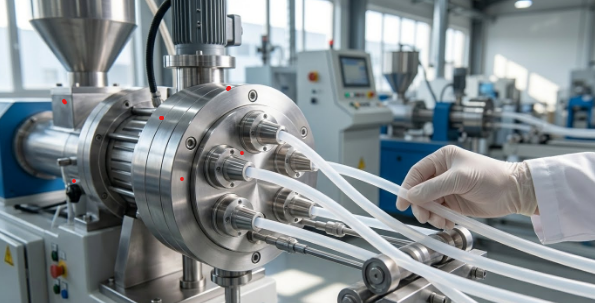
Plastic Extrusion and Its Role in Producing Plastic: Process, Types, and Applications
Plastic extrusion is a continuous manufacturing process used to produce pipes, sheets, films, profiles, tubing, and other plastic products. This guide explains its process, types, applications, recent developments, policies, tools, and key considerations.
The process exists because manufacturers need an efficient and consistent method for producing long plastic products with uniform cross-sections. Unlike processes designed for individual molded pieces, extrusion can continuously produce materials such as pipes, sheets, films, rods, and profiles.
Common plastics used in extrusion include polyethylene (PE), polypropylene (PP), polyvinyl chloride (PVC), polystyrene (PS), and acrylonitrile butadiene styrene (ABS). Material selection depends on factors such as strength, temperature resistance, flexibility, chemical resistance, and the intended application.
Basic Plastic Extrusion Process
The extrusion process generally follows several connected stages:
- Material preparation: Plastic pellets, granules, or suitable recycled material are prepared for processing.
- Feeding: Material enters the extrusion machine through a hopper.
- Melting: A rotating screw moves the material through a heated barrel while mechanical energy and heat soften it.
- Mixing: The screw helps create a more consistent melt.
- Die forming: The molten plastic passes through a die that gives it the required profile.
- Cooling: The newly formed plastic is cooled using air, water, or controlled cooling equipment.
- Sizing: Calibrators, rollers, or other equipment help maintain dimensional accuracy.
- Cutting or winding: Finished products may be cut into predetermined lengths or wound into rolls.
The basic sequence can be represented as:
Plastic Material → Feeding → Heating & Melting → Mixing → Die Forming → Cooling → Sizing → Cutting/Winding
Main Components of an Extrusion System
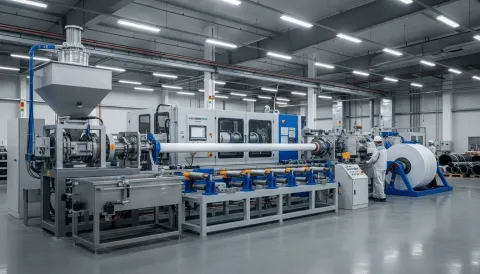
A typical extrusion line contains several important components:
| Component | Main Function |
|---|---|
| Hopper | Feeds plastic material into the machine |
| Screw | Conveys, melts, mixes, and pressurizes material |
| Barrel | Contains the screw and provides controlled heating |
| Die | Creates the required product shape |
| Cooling Unit | Removes heat from the extruded product |
| Sizing Equipment | Helps maintain product dimensions |
| Haul-Off | Pulls the product through the production line |
| Cutter or Winder | Prepares the final continuous product |
Why Plastic Extrusion Matters Today
Plastic extrusion remains important because it supports the production of many everyday and industrial products. Its continuous nature makes it suitable for products that require long lengths and consistent profiles.
The process affects several industries, including construction, packaging, automotive manufacturing, electrical equipment, agriculture, consumer products, and infrastructure.
For example, extrusion is widely associated with plastic pipes used in water distribution, drainage, irrigation, and industrial applications. Plastic films and sheets produced through extrusion also support packaging and protective applications.
Problems Addressed by Extrusion
Plastic extrusion can address several manufacturing requirements:
- Consistent product dimensions
- Continuous production of long profiles
- Flexible product shapes
- Controlled material usage
- Integration of recycled plastic into suitable applications
- Production of lightweight components
- Custom profiles for specific engineering requirements
The process also connects closely with industrial automation. Modern extrusion lines can use sensors and control systems to monitor temperature, pressure, speed, thickness, and other operating parameters.
Common Extruded Products
Examples include:
- Plastic pipes and tubes
- Plastic sheets
- Films
- Window and door profiles
- Cable insulation
- Plastic rods
- Automotive profiles
- Medical tubing
- Agricultural films
- Edge strips and technical profiles
Types of Plastic Extrusion
Different extrusion methods are used according to the required product shape, material, and application.
Sheet Extrusion
Sheet extrusion produces relatively thick, flat plastic sheets. The molten polymer passes through a flat die before being cooled and sized by rollers.
These sheets can be used in packaging, construction, transportation, protective components, and industrial fabrication.
Film Extrusion
Film extrusion produces thin plastic films. Blown film extrusion forms a tubular film that is expanded using air, while cast film extrusion produces film through a flat die and cooling system.
Film thickness, transparency, strength, and flexibility can be controlled through process conditions and material selection.
Pipe and Profile Extrusion
Pipe extrusion is used to produce continuous cylindrical products, while profile extrusion creates shapes such as channels, trims, frames, and specialized structural sections.
Sizing equipment is particularly important because dimensional consistency can affect how these products fit into larger assemblies.
Blown Film Extrusion
In blown film extrusion, molten plastic leaves a circular die and forms a tube. Air is introduced into the tube, creating a bubble that is cooled and collapsed into film.
The process is commonly associated with flexible packaging and agricultural film production.
Co-Extrusion
Co-extrusion combines two or more polymer layers in one product. Different materials can provide different properties, such as structural support, barrier performance, flexibility, or surface characteristics.
This approach is useful when a single polymer cannot provide all the required properties.
Recent Developments and Trends
Plastic extrusion has been influenced by developments in automation, energy management, recycling, material science, and digital process monitoring.
Greater Use of Recycled Materials
Over the past year, manufacturers have continued focusing on circular material use and improved recycling practices. Extrusion equipment can process certain recycled polymers when the material has suitable quality and processing characteristics.
However, recycled material may have differences in moisture, contamination, melt behavior, color, or mechanical properties. These factors can require careful material preparation and process control.
Smart Process Monitoring
Modern extrusion systems increasingly use sensors and digital controls to monitor variables such as:
- Melt temperature
- Barrel temperature
- Pressure
- Screw speed
- Line speed
- Product thickness
- Energy consumption
Data from these measurements can help operators identify process variations earlier and maintain more consistent production conditions.
Energy Efficiency
Energy management has also become an important area of development. Improvements can include more precise heating systems, efficient motors, optimized screw designs, improved insulation, and automated temperature control.
The goal is to reduce unnecessary energy use while maintaining stable processing conditions.
Advanced Polymer Materials
Engineering polymers and specialized formulations continue to expand the range of extrusion applications. Materials may be developed for improved heat resistance, chemical resistance, flexibility, strength, or dimensional stability.
These developments are particularly relevant to automotive, electrical, electronics, infrastructure, and technical manufacturing applications.
Laws, Policies, and Environmental Considerations in India
In India, plastic manufacturing and waste management are influenced by environmental regulations and government frameworks. The Plastic Waste Management Rules, 2016, along with subsequent amendments and related requirements, provide an important regulatory foundation for plastic waste management.
Extended Producer Responsibility (EPR) requirements have also become increasingly relevant to plastic packaging. EPR places responsibilities on relevant producers, importers, and brand owners concerning the management of covered plastic packaging waste.
India has also introduced restrictions on identified single-use plastic items, with implementation beginning on July 1, 2022 for specified items.
For extrusion manufacturers, these policies highlight the importance of understanding material selection, product classification, recycling practices, waste handling, and applicable documentation.
Regulatory requirements can change, so businesses should verify the latest rules and notifications applicable to their specific material and product category.
Tools and Resources for Plastic Extrusion
Several general tools can help students, engineers, operators, and researchers understand or evaluate extrusion processes.
Process Calculators
Engineering calculators can help estimate:
- Material throughput
- Screw speed relationships
- Production rates
- Cooling requirements
- Basic dimensional parameters
- Energy-related measurements
These calculations should be treated as engineering estimates rather than substitutes for validated production data.
Material Data Sheets
Polymer technical data sheets provide information about properties such as:
- Melt temperature ranges
- Density
- Tensile strength
- Thermal characteristics
- Moisture sensitivity
- Processing guidance
Material information should always be checked for the specific polymer grade being considered.
Process Monitoring Templates
Simple production templates can track:
| Parameter | Typical Monitoring Purpose |
| Temperature | Controls melting and material stability |
| Pressure | Indicates flow and process conditions |
| Screw Speed | Influences throughput and mixing |
| Line Speed | Affects dimensions and production rate |
| Product Thickness | Helps maintain specifications |
| Cooling Conditions | Supports dimensional stability |
| Material Batch | Supports production traceability |
Learning Resources
Useful learning materials include polymer processing textbooks, engineering manuals, technical standards, educational videos, laboratory demonstrations, and manufacturer-neutral extrusion training materials.
Frequently Asked Questions
What is plastic extrusion used for?
Plastic extrusion is used to produce continuous plastic products such as pipes, tubes, films, sheets, cable insulation, rods, profiles, and specialized sections.
How does a plastic extrusion machine work?
Plastic material enters through a hopper and moves through a heated barrel using a rotating screw. The material melts, becomes pressurized, passes through a die, and is then cooled and sized.
What plastics can be used in extrusion?
Common extrusion materials include PE, PP, PVC, PS, and ABS. The appropriate material depends on the required mechanical, thermal, chemical, and processing characteristics.
What is the difference between extrusion and injection molding?
Extrusion generally produces continuous products with a consistent cross-section, while injection molding typically creates individual parts by injecting molten plastic into a mold.
Can recycled plastic be used in extrusion?
Yes, suitable recycled plastics can be incorporated into some extrusion processes. Material quality, contamination, moisture, polymer compatibility, and required product properties must be evaluated before processing.
Conclusion
Plastic extrusion is an important polymer processing method that converts plastic materials into continuous products with controlled shapes and dimensions. Its applications range from pipes and films to technical profiles, sheets, tubing, and electrical components.