Industrial Automation Machines: Complete Guide to Factory Automation
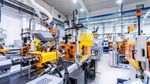
Industrial automation machines are changing how modern factories design, control, monitor, and optimize production. From robotic arms and automated assembly equipment to programmable logic controllers, machine vision systems, and industrial control software, automation connects physical machinery with digital intelligence.
The goal is not simply to make factories run faster. Modern factory automation focuses on improving consistency, reducing avoidable errors, supporting workplace safety, monitoring equipment performance, and helping manufacturers make better decisions using production data.
As artificial intelligence, robotics, Industrial Internet of Things technologies, and digital twins continue developing, automation is becoming an important part of smart manufacturing strategies across automotive, electronics, food processing, pharmaceuticals, packaging, logistics, and other industrial sectors.
What Are Industrial Automation Machines?
Industrial automation machines are equipment and integrated systems designed to perform manufacturing or production tasks with limited manual intervention.
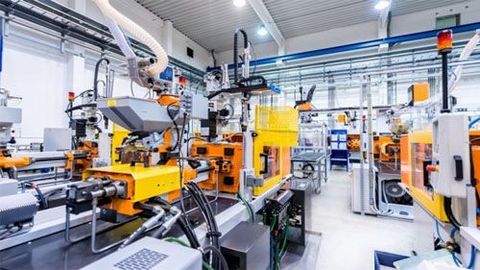
A typical automated production environment may include:
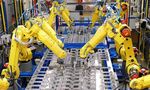
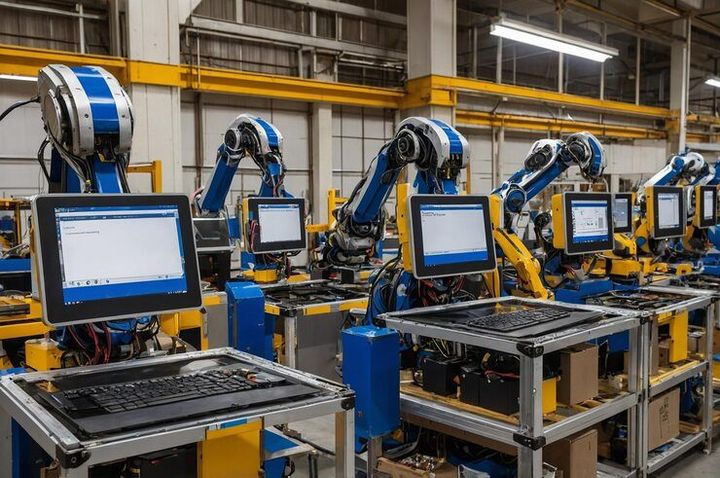
- Robotic arms for handling, welding, assembly, or material movement
- CNC machines for precision machining
- Programmable logic controllers for machine control
- Sensors for temperature, pressure, position, speed, and vibration
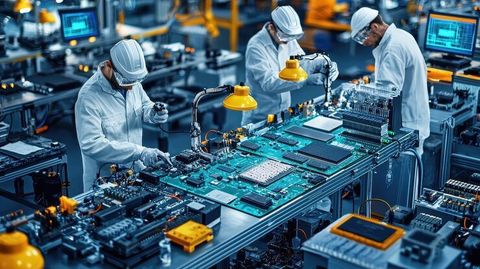
- Machine vision systems for inspection and measurement
- Conveyor systems for automated material movement
- Automated packaging and labeling equipment
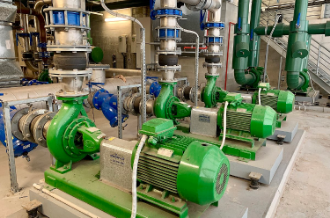
- Industrial motors, drives, and motion-control systems
- Supervisory control and data acquisition systems
- Industrial computers and manufacturing software
These technologies can operate individually or as connected production systems. Their purpose is to coordinate repetitive physical operations while collecting information that helps operators understand what is happening on the factory floor.
Why Factory Automation Matters Today
Manufacturing environments face increasing demands for product consistency, production visibility, energy efficiency, workplace safety, and flexible production. Automation can address several of these challenges when it is properly designed and maintained.
One important advantage is repeatability. Machines can perform programmed movements and processes consistently, which is particularly useful for precision manufacturing and high-volume production.
Automation also supports production monitoring. Sensors can continuously collect information about equipment conditions, temperatures, pressures, cycle times, and other operating parameters. This information can help engineers identify unusual patterns before they develop into larger operational problems.
Another important area is predictive maintenance. Instead of depending only on fixed maintenance schedules, manufacturers can analyze vibration, temperature, current, and other machine data to identify potential equipment issues.
Automation also affects workplace safety. Machines can perform certain repetitive, physically demanding, or hazardous activities, while workers can concentrate on supervision, quality management, maintenance, programming, and other responsibilities.
Main Types of Industrial Automation Machines
Different manufacturing processes require different automation technologies. The following categories represent some of the most common systems.
Robotic Automation
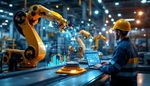
Industrial robots are widely used for welding, assembly, palletizing, material handling, painting, and machine tending. Collaborative robots can also be designed for specific environments where people and robotic systems operate within the same broader workspace, subject to appropriate safety controls.
CNC Automation
Computer numerical control machines use programmed instructions to control machining operations. CNC automation is important for producing components with repeatable dimensions and precise cutting, drilling, milling, or turning operations.
PLC-Based Automation
Programmable logic controllers are industrial control computers designed to monitor inputs and control outputs. PLC systems can coordinate motors, valves, sensors, conveyors, safety devices, and other factory equipment.
Machine Vision Systems
Machine vision uses cameras, lighting, image processing, and software to inspect products or identify specific visual characteristics. Applications include defect detection, dimensional inspection, barcode reading, and automated positioning.
Automated Material Handling
Conveyors, automated guided vehicles, autonomous mobile robots, robotic palletizers, and storage systems can move materials between production stages. These systems help coordinate the physical flow of components and finished products.
Process Automation
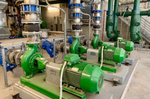
Process automation is commonly used in industries such as chemicals, food processing, pharmaceuticals, energy, and water treatment. Sensors, controllers, valves, pumps, and monitoring systems work together to manage continuous or batch processes.
How an Automated Factory Works
A modern automated factory generally operates through several connected layers.
Sensors first collect information from machines and processes. Controllers then interpret signals and execute programmed instructions. Actuators, motors, valves, and robotic equipment perform physical actions.
Supervisory systems collect operational information and provide dashboards for monitoring. Higher-level manufacturing platforms can combine production information with maintenance, quality, inventory, and planning data.
A simplified automation flow looks like this:
| Automation Layer | Main Function |
|---|---|
| Sensors | Capture machine and process data |
| PLCs and Controllers | Execute control logic |
| Drives and Actuators | Produce physical movement |
| Robots and Machines | Perform production tasks |
| SCADA Systems | Monitor and visualize operations |
| Manufacturing Software | Analyze and coordinate production data |
| AI and Analytics | Identify patterns and support decisions |
This layered approach allows factories to connect physical machinery with digital monitoring and decision-making systems.
Recent Industrial Automation Trends in 2025–2026
Artificial intelligence has become one of the most important developments in industrial automation. Manufacturers are increasingly exploring AI for visual inspection, predictive maintenance, production optimization, robotics, and process analysis.
India has also increased its focus on AI-enabled manufacturing. In October 2025, NITI Aayog released a roadmap for advanced manufacturing that identified artificial intelligence and machine learning, digital twins, robotics, and advanced materials as important technologies across priority manufacturing sectors.
In February 2026, India’s Ministry of Electronics and Information Technology highlighted AI for Manufacturing Engineering Technology, with emphasis on responsible AI adoption, skills development, and scalable implementation.
Another important trend is the development of connected factories. Industrial IoT devices can connect equipment, sensors, and production systems so that information can be viewed and analyzed more easily.
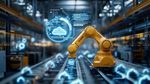
Digital twins are also gaining attention. A digital twin creates a digital representation of equipment, processes, or facilities that can be used for simulation, monitoring, and analysis.
Robotics is becoming more adaptable as well. Advances in machine vision, AI-based perception, and improved programming methods are helping robots perform more varied manufacturing tasks.
Laws, Standards, and Policies
Industrial automation is affected by several categories of rules, including machinery safety, electrical safety, workplace safety, cybersecurity, data protection, and artificial intelligence regulation. Requirements vary according to the country, industry, machine type, and intended application.
For businesses operating in India, industrial automation projects may need to consider applicable machinery, electrical, occupational safety, environmental, and data protection requirements. India's Digital Personal Data Protection Rules were notified in November 2025, establishing implementation provisions associated with the Digital Personal Data Protection Act.
AI governance is also developing in India. In April 2026, the Ministry of Electronics and Information Technology announced the creation of an AI Governance and Economic Group to coordinate national AI governance and address economic and societal impacts.
The European Union has introduced another significant framework through the EU AI Act. As of August 2, 2026, many provisions of the Act became applicable and enforcement began for applicable rules. The updated timeline delays certain high-risk AI requirements to December 2, 2027, while high-risk AI systems embedded in regulated products, including relevant machinery, have requirements scheduled for August 2, 2028.
Manufacturers should therefore evaluate automation systems against the regulations applicable to their operating region rather than assuming that one compliance approach works worldwide.
Tools and Resources for Factory Automation
Manufacturers, engineers, students, and technical teams can use several types of resources when learning about or planning industrial automation.
Useful categories include:
- PLC programming and simulation software
- Industrial network monitoring tools
- Machine condition-monitoring dashboards
- Energy monitoring calculators
- Predictive maintenance analysis tools
- Digital twin and process simulation platforms
- CAD and manufacturing design software
- Robotics programming environments
- Machine vision development tools
- Industrial cybersecurity assessment frameworks
- Preventive maintenance templates
- Production efficiency calculation spreadsheets
- Technical standards and safety documentation
- Industrial automation training materials
A useful starting point is to document the production process before selecting technology. Mapping machine inputs, outputs, cycle times, safety requirements, maintenance needs, and data requirements can make automation planning more structured.
Key Benefits and Challenges
Industrial automation can provide several operational advantages, but it also introduces technical challenges.
| Potential Benefits | Common Challenges |
| Better process consistency | Complex system integration |
| Improved production monitoring | Cybersecurity risks |
| Reduced repetitive manual work | Technical skills requirements |
| Better quality inspection | Equipment downtime during upgrades |
| More data-driven decisions | Legacy machine compatibility |
| Improved workplace safety in suitable tasks | Maintenance complexity |
| Predictive maintenance capabilities | Regulatory requirements |
Automation should therefore be viewed as a long-term engineering strategy rather than simply adding individual machines to a production line.
Frequently Asked Questions
What are industrial automation machines?
Industrial automation machines are equipment and integrated systems that use controllers, sensors, software, robotics, and mechanical components to perform manufacturing tasks with limited manual intervention.
What is the difference between automation and robotics?
Automation is a broad concept covering control systems, machines, software, sensors, and production processes. Robotics is one part of automation focused specifically on programmable robotic machines and their applications.
How does AI improve industrial automation?
AI can analyze production and machine data to identify patterns, support visual inspection, detect unusual equipment behavior, optimize selected processes, and assist decision-making. Results depend on data quality, system design, and appropriate validation.
What is predictive maintenance in manufacturing?
Predictive maintenance uses machine-condition information such as vibration, temperature, pressure, or electrical measurements to identify patterns that may indicate developing equipment problems.
Is factory automation suitable for every manufacturer?
Not necessarily. The appropriate level of automation depends on production volume, process complexity, product variation, safety requirements, available infrastructure, technical capabilities, and the expected operational benefits.
Conclusion
Industrial automation machines are becoming central to modern manufacturing as factories combine mechanical equipment with sensors, robotics, control systems, industrial software, and artificial intelligence.