Cake Manufacturing Machines Guide: Process, Equipment & Industry Trends
Cake manufacturing has developed from largely manual preparation into a structured food production process supported by specialized bakery equipment. Cake manufacturing machines help control important stages such as ingredient mixing, batter handling, baking, cooling, decorating, and packaging.
The equipment used depends on the cake type, production volume, recipe, available floor space, and required level of automation. Small bakeries may use individual machines, while large food manufacturing facilities can connect several machines into an integrated production line.
Modern industrial baking equipment is also increasingly focused on consistency, hygiene, energy management, process monitoring, and reduced manual handling. Understanding how these machines work helps bakery operators, food-processing professionals, students, and general readers understand the technology behind commercial cake production.
What Are Cake Manufacturing Machines?
Cake manufacturing machines are specialized food processing equipment designed to perform one or more stages of cake production. They can automate repetitive activities that require accurate timing, temperature control, mixing, portioning, or movement of products.
Common equipment includes:
- Ingredient weighing and dosing systems
- Industrial cake mixers
- Batter depositors
- Cake baking ovens
- Cooling conveyors and racks
- Cake cutting machines
- Cream and filling applicators
- Decorating equipment
- Packaging and sealing machines
- Conveyors and material-handling systems
The machines do not replace the importance of recipes and food safety procedures. Instead, they provide controlled methods for carrying out production steps repeatedly.
How the Cake Manufacturing Process Works
A typical cake manufacturing process follows several connected stages. The exact sequence varies according to the recipe and cake style.
Ingredient Preparation
Ingredients such as flour, sugar, eggs, fats, dairy ingredients, raising agents, and flavoring materials are prepared according to a controlled formulation.
Accurate measurement is important because changes in ingredient ratios can affect texture, volume, moisture, and baking performance.
Mixing and Batter Preparation
Industrial cake mixers combine ingredients into a uniform batter. Different mixing speeds and mixing times may be used depending on the formulation.
Planetary mixers, continuous mixers, and other industrial mixing systems can be selected according to production requirements.
The objective is not simply to mix ingredients. The process must also achieve the required batter consistency without unnecessarily damaging its structure.
Batter Depositing
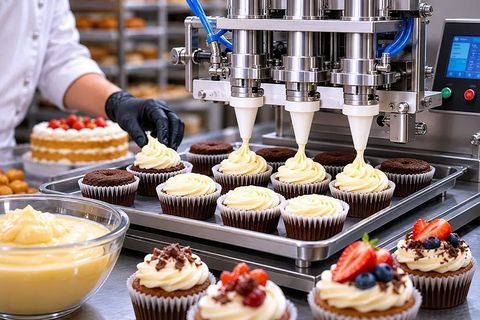
After mixing, the batter can be transferred to molds or trays. A batter depositor controls the quantity placed into each mold.
Accurate depositing helps produce cakes with similar weight and dimensions. It can also reduce variations caused by manual portioning.
Baking
Industrial ovens provide controlled heat for converting batter into a finished cake structure. Temperature, baking time, airflow, humidity, and product size can influence the final result.
Common oven configurations include:
- Batch ovens
- Rack ovens
- Tunnel ovens
- Convection ovens
- Continuous baking systems
For larger production environments, automated ovens can be integrated with conveyors and temperature-monitoring systems.
Cooling
Freshly baked cakes must be cooled before many downstream processes. Cooling systems may use racks, conveyors, ambient air, or controlled airflow.
Proper cooling helps reduce condensation and makes cakes easier to cut, fill, decorate, or package.
Cutting, Filling, and Decorating
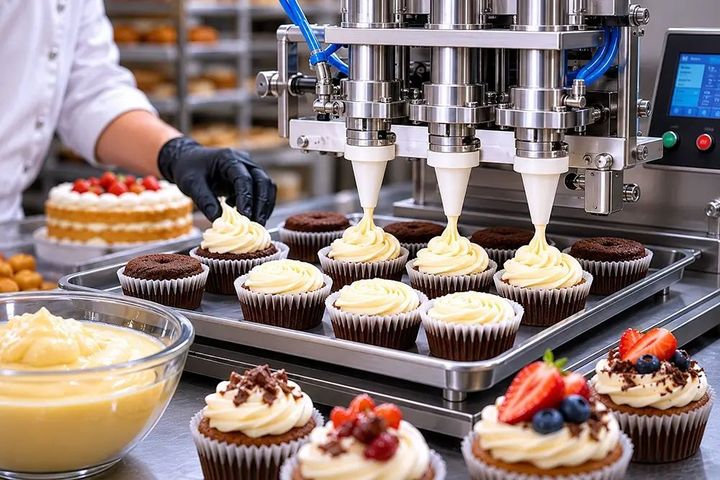
Depending on the product, machines may slice cakes into layers and apply cream, filling, icing, or decorative elements.
Automated decorating systems can control the amount and placement of icing or other toppings. This is particularly useful when products need a consistent appearance.
Packaging
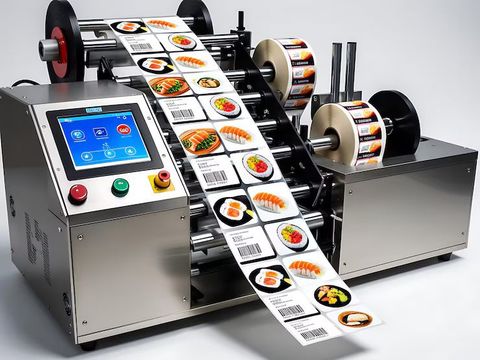
The final stage may involve wrapping, sealing, labeling, coding, and placing products into cartons or other approved packaging.
Packaging equipment can help protect cakes from contamination and physical damage during handling and distribution.
Why Cake Manufacturing Equipment Matters Today
Cake manufacturing machines matter because modern food production requires consistency, hygiene, productivity, and process control.
For bakeries and food manufacturers, equipment selection affects how ingredients move through the production process and how consistently finished cakes are produced.
The technology is particularly relevant to:
- Commercial bakeries
- Industrial food manufacturers
- Central bakery facilities
- Hotels and institutional kitchens
- Frozen and packaged food producers
- Bakery equipment planners
- Food technology students and researchers
Automation can also reduce repetitive manual activities and provide more predictable production conditions.
Key Production Benefits
| Production area | Role of machinery |
|---|---|
| Mixing | Creates controlled batter consistency |
| Depositing | Provides repeatable portions |
| Baking | Controls temperature and baking conditions |
| Cooling | Supports controlled product handling |
| Decorating | Improves repeatability of finishing |
| Packaging | Supports hygienic product protection |
The greatest benefit is usually achieved when individual machines work as part of a properly planned process rather than operating as isolated equipment.
Recent Cake Manufacturing Trends
Cake production technology has continued to develop during 2025 and 2026. Several broader food-processing trends are influencing bakery equipment design.
Greater Process Automation
Automation is increasingly used for dosing, mixing, conveying, oven monitoring, depositing, and packaging. Sensors and programmable controls can help operators monitor process conditions and identify deviations.
Digital Process Monitoring
Digital control systems can record parameters such as temperature, production time, equipment status, and batch information. This supports better process documentation and production planning.
More Flexible Production
Manufacturers increasingly need equipment capable of handling different recipes, shapes, sizes, and batch requirements. Flexible machines can reduce the need for completely separate production systems for every product type.
Hygiene-Focused Equipment Design
Food manufacturers continue to place strong emphasis on hygienic equipment construction, cleanable surfaces, controlled product movement, and prevention of cross-contamination.
Energy and Resource Management
Energy-efficient ovens, improved insulation, controlled heating, and optimized production schedules are becoming important areas of equipment development. These approaches can help reduce unnecessary energy use while maintaining required baking conditions.
Recent Regulatory Updates in India
For cake manufacturing in India, food safety compliance remains an important part of production planning. The Food Safety and Standards Authority of India (FSSAI) requires food business operators to be registered or licensed under the applicable framework.
Recent regulatory activity continued through 2026. FSSAI published an amendment to the Food Safety and Standards (Licensing and Registration of Food Businesses) Regulations in March 2026, followed by a related Gazette notification in June 2026.
FSSAI also published 2026 amendments relating to vegan-food requirements and other food-safety provisions. These developments demonstrate why food manufacturers should monitor current regulatory notifications rather than relying only on older compliance information.
Laws, Policies, and Food Safety Requirements
Cake production in India is affected by the Food Safety and Standards Act, 2006 and associated regulations. Food businesses must follow applicable requirements concerning licensing or registration, hygiene, sanitation, food standards, labeling, and other safety controls.
Important areas include:
- Appropriate FSSAI registration or licensing
- Hygienic manufacturing conditions
- Safe handling of ingredients
- Appropriate food-contact equipment
- Sanitation and cleaning procedures
- Applicable food standards and additives requirements
- Correct labeling and display information
- Record keeping and compliance monitoring
The applicable category can depend on the nature and scale of the food business. Operators should check the current requirements applicable to their particular activity.
Tools and Resources for Cake Production Planning
Several general tools can help understand and manage cake manufacturing processes.
Production Planning Tools
Spreadsheet templates can be used to track batch quantities, ingredient requirements, production schedules, equipment capacity, and downtime.
Recipe Scaling Calculators
Recipe calculators help convert ingredient quantities between different batch sizes. This can be useful when evaluating how a formulation behaves at different production volumes.
Temperature and Time Records
Digital or paper-based production logs can record oven temperatures, baking times, cooling periods, and batch information.
Equipment Capacity Charts
Capacity charts help compare mixers, ovens, depositors, conveyors, and packaging systems against expected production requirements.
Food Safety Checklists
Hygiene and sanitation checklists can help organize routine inspections, cleaning activities, ingredient handling, and production-area controls.
Regulatory Resources
Government food-safety portals, current regulations, official notifications, food standards documents, and compliance manuals are useful for keeping regulatory information up to date. FSSAI's FoSCoS platform also provides functions related to licensing, registration, renewals, modifications, and compliance activities.
Cake Manufacturing Equipment Selection Guide
Equipment selection should begin with the production process rather than the machine itself.
| Requirement | Equipment consideration |
| Product type | Mixer, depositor, oven configuration |
| Production volume | Batch or continuous equipment |
| Cake size | Mold, tray, and depositor capacity |
| Recipe variation | Adjustable controls and flexible tooling |
| Floor space | Equipment footprint and layout |
| Hygiene | Cleanable surfaces and accessible components |
| Automation level | Manual, semi-automatic, or automated controls |
| Quality monitoring | Sensors, timers, temperature controls |
A well-planned production layout should also consider the movement of ingredients, people, equipment, packaging materials, and finished products. Logical movement can reduce unnecessary handling and improve workflow.
Frequently Asked Questions
What machines are commonly used for cake manufacturing?
Common equipment includes industrial mixers, batter depositors, baking ovens, cooling systems, cake cutters, filling and decorating machines, conveyors, and packaging equipment.
How does an industrial cake mixer work?
An industrial mixer combines ingredients using controlled mechanical movement. Mixing speed, duration, and attachment type depend on the formulation and desired batter characteristics.
Why is temperature control important in cake production?
Temperature affects baking reactions, moisture loss, structure, color, and texture. Consistent temperature control helps maintain repeatable baking conditions.
Can cake manufacturing be automated?
Yes. Individual stages such as ingredient dosing, mixing, depositing, baking, conveying, decorating, and packaging can be automated to different degrees. The appropriate level depends on the production process and product requirements.
What regulations apply to cake manufacturing in India?
Cake manufacturers in India are generally subject to the Food Safety and Standards Act, 2006 and applicable FSSAI regulations covering food business registration or licensing, hygiene, food standards, labeling, and related safety requirements. Current amendments should always be checked before making compliance decisions.
Conclusion
Cake manufacturing machines provide controlled methods for carrying out the major stages of commercial cake production, from ingredient preparation and mixing to baking, cooling, decorating, and packaging.