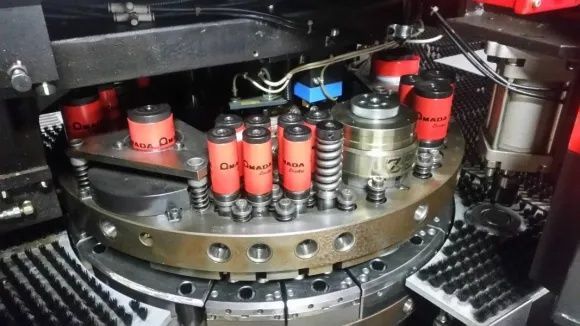
Turret Punch Press Facts: Working Process, Advantages & Industry Applications
A turret punch press is a machine tool designed to create holes, shapes, slots, and other features in sheet metal. It uses a punching tool and die combination to remove or form material according to a programmed pattern. Modern CNC turret punch presses combine mechanical systems, computer numerical control, tooling, and automated material movement to produce repeatable sheet metal components.
The technology exists because manufacturers need a controlled way to process large numbers of metal sheets with consistent dimensions. Instead of manually positioning a sheet for every hole, a CNC system can coordinate the movement of the sheet and the selection of different tools.
A typical turret punch press contains several important components:
- CNC control system for programming and machine coordination
- Turret containing multiple punching tools
- Punch and die assemblies for forming or removing material
- Sheet-clamping and positioning mechanism
- Drive system that produces the punching movement
- Worktable for supporting the sheet
- Sensors and safety equipment
- Software for preparing and managing machining programs
The machine can process materials such as mild steel, stainless steel, aluminum, and other sheet-metal grades when the material thickness and tooling are appropriate.
The basic process begins with a digital drawing or machining program. The CNC controller interprets the programmed coordinates and determines where each operation should occur. The sheet is then positioned while the turret selects the appropriate tool.
During punching, the punch moves through the sheet toward the die. The force separates or forms the material. The sheet then moves to the next programmed location, and the sequence continues until the required features are completed.
Why Turret Punch Presses Matter in Modern Manufacturing
Sheet metal components are used across many industries, including electrical equipment, automotive systems, electronics, HVAC equipment, industrial enclosures, appliances, and general fabrication. These applications often require numerous holes and accurately positioned openings.
A turret punch press addresses several manufacturing challenges at the same time. It can combine multiple tooling operations within one machine, reduce repeated manual positioning, and support different component designs without requiring a completely different production setup.
One important advantage is flexibility. A turret can hold multiple tools, allowing the machine to switch between different punching operations according to the CNC program.
Another advantage is repeatability. Once a suitable program has been prepared and verified, the same sequence can be repeated across multiple sheets. This helps maintain consistent hole locations and component dimensions.
Turret punch presses are also useful for parts with many holes or repeated geometric features. Nibbling, punching, forming, embossing, and other operations may be performed depending on the machine and tooling configuration.
Key Advantages
- Precision: CNC positioning helps maintain programmed coordinates.
- Flexibility: Multiple tools can handle different operations.
- Productivity: Automated movement reduces repetitive manual positioning.
- Repeatability: Programmed operations can be reproduced across batches.
- Material utilization: Nesting software can arrange components efficiently on sheets.
- Complex shapes: Different tooling patterns can create varied geometries.
- Automation potential: Loading, unloading, inspection, and production monitoring can be integrated.
However, performance depends on machine specifications, material properties, tooling condition, programming quality, and operator practices. A turret punch press is not automatically suitable for every sheet-metal application.
Working Process of a Turret Punch Press
The working process normally follows several connected stages.
1. Design and Programming
The component begins as a CAD drawing or digital design. The required holes, slots, contours, and forming features are converted into machine instructions.
2. Tool Selection
The required punch and die combinations are selected. A turret can contain several tool stations, allowing the CNC controller to choose different tools during production.
3. Sheet Positioning
The metal sheet is placed on the worktable and secured using the machine's clamping and positioning system. Accurate positioning is essential because every subsequent operation depends on the programmed coordinates.
4. Punching Operation
The selected punch moves downward through the sheet toward the die. Depending on the programmed operation, the machine can create circular holes, rectangular openings, slots, notches, or formed features.
5. Sheet Movement
The CNC system controls movement along the machine's working axes. The sheet is positioned for the next operation while the appropriate tool is selected.
6. Inspection
Finished components can be checked for dimensional accuracy, hole position, burr formation, deformation, and other quality characteristics.
For larger production systems, automated loading and unloading can connect the turret punch press with material storage and other sheet-metal equipment. Recent industry discussions have increasingly focused on automation, digital monitoring, intelligent tooling, and servo-electric drive technology.
Recent Developments and Technology Trends
During 2025 and into 2026, turret punch press development has increasingly focused on automation, digital connectivity, precision, energy efficiency, and intelligent production.
Servo-electric systems are receiving attention because they can provide controlled motion and support energy-conscious manufacturing. CNC technology is also becoming more closely integrated with production software and automated material handling.
Another important trend is predictive maintenance. Sensors and machine-monitoring systems can collect information about operating conditions, tool wear, vibration, and machine status. This information can help maintenance teams identify potential problems earlier.
Industry discussions published during 2025 also highlighted automatic tool management, online quality monitoring, remote diagnostics, and automated loading and unloading as areas of continued development.
The broader sheet-metal sector is also moving toward Industry 4.0 practices. Machines may increasingly exchange production information with planning, quality, maintenance, and inventory systems.
Technology Trend Overview
| Trend | Purpose |
|---|---|
| CNC automation | Controls positioning and punching sequences |
| Servo-electric drives | Provides controlled and efficient machine motion |
| Tool monitoring | Helps identify tool wear and maintenance needs |
| Automated handling | Moves sheets with reduced manual intervention |
| Digital production data | Supports monitoring and process analysis |
| Intelligent diagnostics | Helps identify operating problems |
| Nesting software | Improves sheet layout planning and material utilization |
These developments do not eliminate the need for proper setup, inspection, maintenance, and trained machine operation.
Laws, Safety Rules, and Policies in India
For Indian manufacturing facilities, machinery safety is an important consideration when operating metalworking equipment.
The Ministry of Heavy Industries issued the Machinery and Electrical Equipment Safety (Omnibus Technical Regulation) Amendment Order, 2025. The government announcement states that the regulation is scheduled to apply from 1 September 2026 to machines and electrical equipment listed in the applicable First Schedule, with conformity to corresponding Indian Standards where applicable.
This is particularly relevant to organizations planning machinery installation, importation, manufacturing, or compliance activities. The exact applicability should be checked against the machine classification and current government notifications rather than assumed solely from the machine's name.
Workplace safety is also connected with India's Occupational Safety, Health and Working Conditions Code, 2020 and related rules. The Ministry of Labour and Employment currently provides the Code, 2026 Central Rules, implementation materials, and FAQs covering occupational safety and workplace conditions.
For turret punch press operations, practical safety measures generally include:
- Machine guarding and appropriate protective systems
- Emergency-stop arrangements
- Safe tooling procedures
- Operator training
- Lockout and isolation procedures during maintenance
- Regular inspection of machine components
- Appropriate personal protective equipment
- Safe handling of sharp sheet-metal components
- Clear operating and maintenance instructions
Organizations should verify applicable central and state requirements, Indian Standards, electrical rules, and workplace-specific obligations before operating or modifying industrial machinery.
Tools and Resources for Learning and Planning
Several general-purpose tools can help people understand or plan turret punch press operations.
CAD software can be used to prepare accurate component drawings and define hole patterns, slots, and profiles.
CAM and nesting software can convert digital designs into machining instructions while arranging multiple components on a sheet.
Machine simulation tools can help review tool paths and identify potential collisions or programming problems before production.
Measurement equipment such as vernier calipers, micrometers, height gauges, and coordinate measurement systems can support dimensional inspection.
Maintenance checklists can track lubrication, tooling condition, electrical inspections, machine cleanliness, and safety-system checks.
Production calculators can help estimate material utilization, cycle time, sheet requirements, and basic production parameters. These calculations should always be checked against the machine manufacturer's specifications and actual process conditions.
Training resources from technical institutions, engineering libraries, standards organizations, and industrial safety authorities can provide additional learning material.
Frequently Asked Questions
What is a turret punch press?
A turret punch press is a sheet-metal machine that uses punches and dies to create holes, slots, shapes, and formed features. CNC controls coordinate tool selection and sheet positioning.
What materials can a turret punch press process?
Depending on machine capacity and tooling, turret punch presses can process materials such as mild steel, stainless steel, and aluminum. The suitable material thickness depends on the machine and specific tooling.
What is the difference between a CNC turret punch press and a conventional punch press?
A CNC turret punch press uses computer-controlled positioning and multiple tool stations to perform programmed operations. A conventional punch press generally relies more heavily on dedicated tooling and manual or mechanical positioning arrangements.
Is a turret punch press suitable for small production batches?
It can be suitable for varied production because CNC programming and multiple tool stations allow different component designs to be processed without creating an entirely new dedicated machine setup for every part. Actual suitability depends on part geometry, material, tooling, and production requirements.
What safety precautions are important?
Operators should follow the machine's operating instructions, use appropriate guards and safety systems, keep hands away from active tooling, use proper procedures during maintenance, and receive suitable training. Sharp sheet edges should also be handled carefully.
Conclusion
A turret punch press is an important technology in modern sheet-metal manufacturing because it combines punching, forming, CNC positioning, and multi-tool flexibility in one production system. Its ability to process repeated patterns and complex hole arrangements makes it useful across electrical, automotive, electronics, HVAC, appliance, and general fabrication applications.