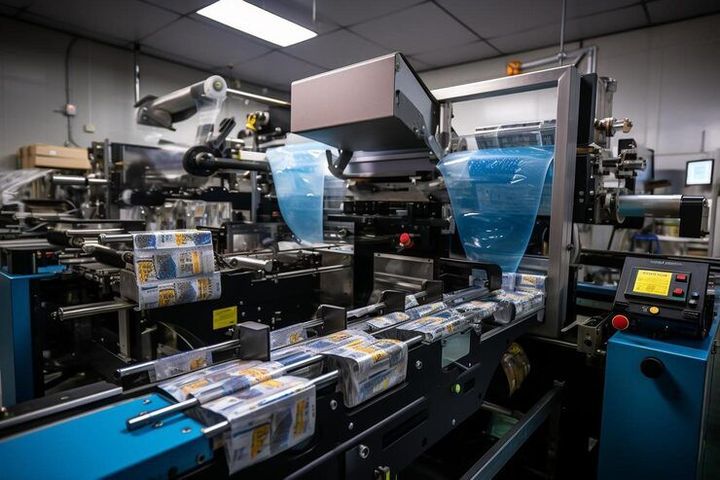
Label Printing Machines Basics: Technology, Components and Applications
Label printing machines create clear, readable labels for products, packages, containers, and industrial items. Modern systems combine printing technology, digital controls, sensors, and material handling to support accurate identification and traceability.
Label printing machines are equipment systems designed to print text, numbers, symbols, barcodes, QR codes, graphics, and other identification information onto label materials. They are used across manufacturing, packaging, logistics, retail, healthcare, electronics, food processing, and other industries.
The basic purpose is simple: place consistent information on a label and make that label available for application to a product, package, container, or component.
Depending on the application, a label printing machine may work with paper, synthetic materials, adhesive labels, thermal media, or other specialized substrates. Some systems print individual labels, while integrated production lines can print and apply labels automatically.
Common information printed on labels includes:
- Product names and descriptions
- Batch or lot numbers
- Serial numbers
- Barcodes and QR codes
- Manufacturing dates
- Expiry or best-before information
- Net quantity
- Product identification codes
- Handling instructions
- Regulatory information
Label printing technology exists because manual writing or inconsistent identification can create errors in packaging, inventory management, and traceability.
How Label Printing Technology Works
The printing process varies according to the machine type, but most systems follow a similar sequence.
First, label material is loaded into the machine. The printing system receives information from software, a production database, or a connected control system. The printhead then transfers the required information onto the label.
Sensors can detect label position, material movement, and printing conditions. A control system coordinates the printing process and helps maintain consistent positioning.
Some machines also include cutting, rewinding, dispensing, or application functions.
The main printing technologies include:
| Technology | Typical Characteristics | Common Applications |
|---|---|---|
| Thermal transfer | Uses a ribbon to transfer ink | Durable industrial labels |
| Direct thermal | Uses heat-sensitive material | Receipts, logistics, temporary labels |
| Inkjet | Sprays tiny ink droplets | Variable information and coding |
| Laser | Uses a laser-based marking process | Detailed identification |
| Digital printing | Computer-controlled image reproduction | Flexible label production |
| Flexographic printing | Uses flexible printing plates | High-volume label production |
The most suitable technology depends on label material, print durability, information requirements, production environment, and expected print volume.
Key Components of Label Printing Machines
A label printing machine contains several components that work together.
Printhead
The printhead is responsible for transferring the image, text, barcode, or other information onto the label material. Printhead design varies according to the printing technology.
Label Material Holder
This section holds the label roll or sheet and allows the material to move through the printing path.
Feed Mechanism
The feeding system controls how labels move through the machine. Accurate feeding is important because even small positioning errors can affect barcode readability or label alignment.
Sensors
Sensors detect label gaps, edges, material position, and movement. These signals help the controller determine when and where printing should occur.
Control Panel
Modern machines often use digital displays or touch interfaces. Operators can select print settings, monitor machine status, and identify warnings.
Controller and Software
Software determines what information should appear on each label. More advanced systems can connect with databases and production-management platforms to generate variable information.
Cutter or Rewinder
Depending on the machine design, labels may be cut into individual pieces or rewound into rolls for later application.
Why Label Printing Machines Matter Today
Accurate labeling is important because products move through increasingly complex supply chains. A single item may pass through manufacturing, storage, transportation, distribution, and retail stages.
Clear identification helps organizations track products through these stages.
Label printing machines can support:
- Product identification
- Inventory tracking
- Batch traceability
- Barcode scanning
- Warehouse organization
- Packaging consistency
- Regulatory information
- Production documentation
They are particularly important where large numbers of products require different identification information.
For example, a manufacturing facility may need a different serial number on every unit. Digital printing and variable-data systems can generate these identifiers without requiring each label to be prepared manually.
Applications Across Different Industries
Label printing machines have broad applications.
Manufacturing
Manufacturers use labels for components, finished products, containers, and production batches. Industrial labels may need resistance to moisture, abrasion, chemicals, or temperature changes.
Food and Beverage
Labels can communicate product identity, quantity, dates, ingredients, storage information, and other required information, depending on applicable regulations.
Healthcare
Healthcare-related products can require detailed identification, batch information, serial numbers, and other controlled information. Label specifications can vary depending on the product and regulatory framework.
Logistics and Warehousing
Barcodes and QR codes help identify packages and support inventory and shipment tracking. Labels can be generated according to product, location, order, or shipment data.
Electronics
Small components often require compact labels containing serial numbers, barcodes, or manufacturing information.
Retail and Consumer Packaging
Labels can provide product information and machine-readable identification for packaged goods.
Recent Trends in Label Printing Technology
The label printing sector has increasingly moved toward digital control, variable-data printing, automation, and better traceability.
One important development is the growing use of digital workflows. Instead of preparing separate fixed printing plates or manually changing information, digital systems can receive variable data electronically.
Another trend is greater integration with production and warehouse systems. Printing equipment can be connected with databases and manufacturing software so that information is generated from existing records.
QR codes and other two-dimensional codes are also becoming more important because they can store more information than traditional linear barcodes.
Sustainability is another area of attention. Businesses and packaging designers are examining recyclable label materials, reduced material consumption, and printing processes that can support more efficient packaging workflows.
In India, regulatory developments have also continued. On 29 October 2025, the Department of Consumer Affairs announced amendments to the Legal Metrology (Packaged Commodities) framework concerning packages containing medical devices.
In 2026, the Legal Metrology framework continued to see amendments. The Department of Consumer Affairs lists packaged-commodity amendments dated 13 February, 27 April, 29 May, and 21 September 2026, showing that labeling compliance remains an evolving area.
On 29 June 2026, the government also introduced an Improvement Notice mechanism under the Legal Metrology Act for specified first-time procedural or regulatory non-compliances, allowing eligible deficiencies to be corrected before penalty proceedings.
These developments make accurate digital labeling and compliance workflows increasingly relevant for organizations handling packaged products.
Laws and Labeling Policies in India
For businesses operating in India, label printing can be connected with requirements under the Legal Metrology Act, 2009 and the Legal Metrology (Packaged Commodities) Rules, 2011, along with subsequent amendments.
The Department of Consumer Affairs identifies several declarations that may be required on applicable pre-packaged commodities, including:
- Manufacturer, packer, or importer details
- Country of origin for imported products
- Common or generic product name
- Net quantity
- Manufacturing information
- Best-before or use-by information where applicable
- Maximum Retail Price
- Consumer-care details
- Unit sale price where applicable
The exact requirements depend on the product category and applicable rules.
The government also announced in January 2025 that amendments to labeling provisions would follow a structured implementation timeline, with enforcement dates planned around 1 January or 1 July and advance notice requirements.
Organizations should therefore review the latest applicable requirements rather than relying only on older label templates.
Choosing the Right Label Printing Technology
The right machine depends on the application rather than simply the highest printing speed.
Important factors include:
- Required print resolution
- Label size and shape
- Printing material
- Information that must be printed
- Barcode or QR-code requirements
- Required durability
- Production volume
- Variable-data requirements
- Available production-line space
- Environmental conditions
For temporary logistics identification, direct thermal printing may be suitable. For labels that need greater resistance, thermal transfer technology may be more appropriate.
Digital printing can be useful when designs or variable information change frequently.
Tools and Resources for Label Printing
Several general tools can help with label planning and production.
Barcode Generators
Barcode-generation software can create machine-readable identification patterns based on product or inventory information.
QR Code Tools
QR-code creation tools can convert selected information into two-dimensional codes.
Label Design Software
Design applications help create layouts containing text, graphics, barcodes, and variable information.
Measurement Calculators
Label-size and material calculators can help determine dimensions, roll requirements, and spacing.
Compliance Checklists
A labeling checklist can help review required declarations before production.
Print Quality Checklists
Quality-control templates can cover alignment, readability, barcode scanning, print contrast, material condition, and variable-data accuracy.
A simple digital workflow can connect product data, label design, printing, inspection, and application into one controlled process.
Frequently Asked Questions
What is a label printing machine?
A label printing machine is equipment used to print information such as text, barcodes, QR codes, numbers, symbols, and graphics onto label materials.
Which printing technology is commonly used for industrial labels?
Thermal transfer is widely used for applications where labels need durable printed information. However, the appropriate technology depends on the material and operating environment.
Can label printers print QR codes?
Yes. Many modern label printing systems can produce QR codes and other two-dimensional or linear barcodes when the appropriate software and print resolution are available.
Are label printing machines used for product traceability?
Yes. Labels can contain batch numbers, serial numbers, barcodes, and other identifiers that help organizations trace products through manufacturing and distribution processes.
What should be checked before printing regulatory labels?
The required declarations, product category, label dimensions, print readability, barcode accuracy, and current applicable regulations should be reviewed before production. Requirements can change, so current government rules should be checked.
Conclusion
Label printing machines have become an important part of modern manufacturing, packaging, logistics, and product identification. Their role goes beyond putting text on a package. Modern systems can handle variable information, machine-readable codes, automated data input, and quality checks.