Torque Testing Machines Guide: Complete Overview of Uses, Types, and Benefits
Torque testing machines are specialized devices used to measure the rotational force, or torque, applied to an object. Torque is a critical parameter in mechanical engineering, manufacturing, automotive systems, and product design because it directly affects the performance, safety, and durability of components.
Torque testing machines are designed to measure how much twisting force a product can withstand before it fails or deforms. These machines are widely used for testing components such as screws, bolts, bottle caps, medical devices, and automotive parts.
Modern industries rely on precise torque measurements to ensure product reliability and performance. Even minor variations in torque can lead to product failure, safety risks, or reduced lifespan.
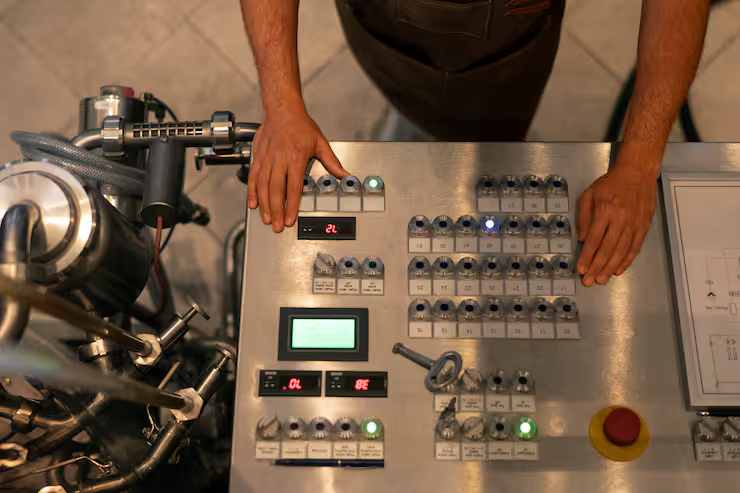
Importance: Why Torque Testing Matters Today
Torque testing machines play a critical role in maintaining quality and safety across industries such as automotive, aerospace, electronics, packaging, and healthcare. As products become more complex, accurate torque measurement becomes increasingly important.
They ensure product reliability by verifying that components perform consistently under stress. In safety-critical industries, improper torque can cause mechanical failures, making testing essential for preventing accidents.
Key Problems Torque Testing Solves
- Loose or over-tightened fasteners
- Product failure under rotational stress
- Inconsistent assembly processes
- Compliance issues with industry standards
- Reduced product lifespan
Torque testing also improves quality control by identifying defects early, reducing waste, and enhancing manufacturing efficiency.
Types of Torque Testing Machines
Torque testing machines vary based on their functionality, automation level, and application. Each type is suited for specific testing environments and requirements.
Manual Torque Testing Machines
Manual machines require human operation and are used for basic testing tasks. They are suitable for low-volume environments where simple quality checks are needed.
Digital Torque Testing Machines
Digital machines use electronic sensors to provide accurate readings. They are commonly used in laboratories and production lines where precision is critical.
Automatic Torque Testing Systems
Automatic systems are fully integrated into production lines. They are ideal for high-volume manufacturing and provide consistent, repeatable results.
Static Torque Testers
Static testers measure torque without movement. They are typically used for testing fasteners and closures.
Dynamic Torque Testers
Dynamic testers measure torque during motion. These are widely used in automotive and industrial machinery applications.
Comparison of Torque Testing Machine Types
| Type | Key Feature | Application Area | Accuracy Level |
|---|---|---|---|
| Manual | Human-operated | Basic testing | Moderate |
| Digital | Electronic measurement | Labs and production lines | High |
| Automatic | Fully automated | High-volume manufacturing | Very High |
| Static | Measures fixed torque | Fasteners and closures | High |
| Dynamic | Measures moving torque | Automotive and machinery | Very High |
Benefits of Torque Testing Machines
Torque testing machines offer several advantages that support modern manufacturing and engineering processes. They help ensure that products meet required torque specifications, reducing defects and improving customer satisfaction.
They also enhance safety by identifying potential failures before products reach end users. This is especially important in high-risk industries like aerospace and healthcare.
Key Benefits
- Consistent product performance
- Reduced manufacturing errors
- Improved compliance with standards
- Enhanced safety and reliability
- Better quality control processes
Additionally, modern torque testing systems support data-driven decision-making by storing and analyzing test data for continuous improvement.
Recent Updates: Trends and Developments in 2025
Torque testing technology has evolved significantly with advancements in automation and digital transformation. In 2025, smart sensors and IoT-enabled systems are becoming more common, allowing real-time monitoring and improved accuracy.
Artificial intelligence is also being used to predict failures and optimize torque settings based on historical data. This helps manufacturers improve efficiency and reduce downtime.
Portable torque testing devices are gaining popularity for on-site testing and maintenance tasks. Cloud-connected platforms now enable remote monitoring and centralized data management, improving collaboration across teams.
Laws or Policies: Standards and Regulations
Torque testing machines must comply with various industry standards to ensure accuracy and safety. These standards are set by recognized organizations and are critical for maintaining product quality.
Key Regulatory Bodies
- Bureau of Indian Standards (BIS)
- International Organization for Standardization (ISO)
- ASTM International
ISO standards, such as ISO 6789, define guidelines for torque measurement and calibration. Compliance is mandatory in regulated industries like automotive and medical devices.
Failure to meet these standards can result in penalties, product recalls, or restricted market access. Therefore, torque testing machines are essential for regulatory compliance.
Tools and Resources for Torque Testing
Various tools and resources support torque testing processes and improve efficiency. These tools help maintain accuracy, analyze data, and optimize product performance.
Common Tools and Resources
- Torque calculators for engineering applications
- Data logging software for recording results
- Calibration equipment for maintaining accuracy
- Industry standards documentation (ISO, ASTM)
- Simulation software for torque analysis
These resources enable engineers to enhance testing accuracy and streamline workflows.
FAQs: Common Questions About Torque Testing Machines
What is a torque testing machine used for?
A torque testing machine measures the rotational force applied to an object. It ensures that components meet required performance and safety standards.
Which industries use torque testing machines?
They are used in automotive, aerospace, electronics, packaging, and healthcare industries where precision and reliability are essential.
What is the difference between static and dynamic torque testing?
Static testing measures torque without movement, while dynamic testing measures torque during motion or rotation.
How often should torque testing machines be calibrated?
Calibration frequency depends on usage and industry requirements, but regular calibration is necessary to maintain accuracy.
Are digital torque testing machines more accurate than manual ones?
Yes, digital machines generally offer higher accuracy and better data recording capabilities compared to manual systems.
Conclusion
Torque testing machines are essential tools in modern manufacturing and engineering. They ensure accurate measurement of rotational force, helping products meet safety and quality standards.
With advancements in automation, IoT, and AI, torque testing is becoming more efficient and reliable. These machines play a key role in improving product durability, ensuring compliance, and supporting high-quality production processes.