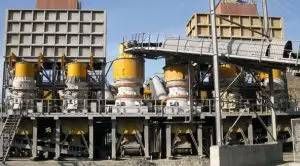
Industrial Crushers: Explore Advanced Crushing Equipment & Systems
Industrial crushers are mechanical machines designed to reduce large and irregular materials into smaller, more manageable pieces. They are widely used in mining, quarrying, construction, recycling, aggregates production, and several manufacturing processes.
The basic purpose is simple: size reduction. Large rocks or other materials enter the crushing equipment, where mechanical force breaks them into smaller particles. The resulting material can then move to screening, conveying, grinding, recycling, or other processing stages.
Different crusher designs use different methods of applying force. Common examples include compression, impact, and controlled mechanical pressure.
Some widely used crusher categories include:
- Jaw crushers
- Cone crushers
- Impact crushers
- Gyratory crushers
- Hammer crushers
- Roll crushers
- Mobile crushing plants
- Portable crushing equipment
The choice depends on factors such as material hardness, feed size, required output size, production capacity, and the intended application.
Industrial crushing systems can also include feeders, conveyors, screens, dust-control equipment, sensors, and automated controls. Together, these components create a complete material-processing circuit.
How Industrial Crushing Systems Work
A typical crushing process involves several stages rather than one machine doing everything.
Primary crushing reduces very large pieces of material into a smaller size. Jaw and gyratory crushers are commonly associated with this stage.
Secondary crushing further reduces the material. Cone and impact crushers are often used depending on the material and desired product.
Tertiary and quaternary crushing can provide additional size reduction when finer or more closely controlled particles are required.
Screening equipment separates particles according to size. Oversized material may return to a crusher for additional processing, creating a closed crushing circuit.
| Crushing Stage | Main Purpose | Common Equipment |
|---|---|---|
| Primary | Initial size reduction | Jaw, gyratory |
| Secondary | Further reduction | Cone, impact |
| Tertiary | Finer size control | Cone, impact |
| Screening | Particle separation | Vibrating screens |
| Conveying | Material movement | Belt conveyors |
Why Industrial Crushers Matter Today
Industrial crushers play an important role in modern infrastructure and resource processing. Roads, bridges, buildings, concrete products, rail projects, and other applications depend on properly sized aggregate and processed materials.
Mining operations also use crushing equipment to prepare ores for subsequent processing. Recycling facilities can use crushers to reduce concrete, asphalt, bricks, and other recovered materials into reusable aggregate.
The topic affects several industries, including:
- Mining and mineral processing
- Quarrying and aggregates
- Construction
- Road infrastructure
- Concrete production
- Demolition and recycling
- Material recovery
- Industrial manufacturing
One important challenge is energy consumption. Crushing and grinding are major parts of mineral-processing operations, so improving the efficiency of size reduction can have a meaningful effect on overall energy use. A March 2026 industry analysis noted that comminution accounts for around 2% of global energy consumption.
Modern crushing technology therefore increasingly focuses on efficient material processing, better particle-size control, automation, electrification, and improved monitoring.
Improving Material and Process Control
Consistent output is important because different applications require different particle sizes and shapes.
For example, aggregate used in concrete may require specific grading and particle characteristics. Mineral processing may require carefully controlled particle sizes before grinding or separation.
Modern systems can use sensors and automation to monitor operating conditions such as:
- Feed rate
- Crusher load
- Motor power
- Pressure
- Product size
- Temperature
- Vibration
- Material flow
This information can help operators identify unusual conditions and make adjustments during operation.
Automation is also becoming more significant. Digital monitoring can provide information about equipment performance and process conditions, while automated controls can adjust selected operating parameters.
Recent Developments in Crushing Technology
Several developments during 2025 and 2026 show the direction of modern crushing equipment.
In March 2025, Metso announced next-generation HPe cone crusher models featuring updated crushing chambers and automation platforms for monitoring and controlling the crushing process. The company reported that the models were designed for applications ranging from aggregates to mining.
In April 2025, the same product family was expanded to six models, covering secondary through quaternary crushing applications. The announcement also highlighted automation and energy-efficiency trends in crushing technology.
Electrification is another important development. A February 2026 industry update described future mobile crushing concepts around electric power, automation, machine vision, digital monitoring, and autonomous operation.
A November 2025 case study also described electric-driven crushing and screening equipment being used for aggregate production, with automation and remote control features included in the operating setup.
These developments indicate several continuing trends:
- Greater equipment electrification
- Automated process control
- Remote monitoring
- Data-based maintenance
- Improved particle-size control
- Energy-efficient crushing circuits
- Mobile and modular equipment
- Increased attention to dust and noise management
These are technology trends rather than guarantees of performance. Actual results depend on material characteristics, plant design, operating conditions, and equipment configuration.
Environmental Rules and Policies in India
In India, industrial crushing activities can be affected by environmental, air-quality, noise, land-use, and state pollution-control requirements.
The Central Pollution Control Board (CPCB) has published environmental guidelines specifically addressing stone-crushing units. The guidelines identify fugitive dust as a major environmental concern and describe measures intended to control emissions from crushing activities.
The CPCB document also reports information from 27 State Pollution Control Boards and Pollution Control Committees and identifies stone-crushing units according to production capacity. It lists small-scale units as up to 25 tonnes per hour, medium-scale units as 26–100 tonnes per hour, and large-scale units as above 100 tonnes per hour.
Environmental compliance can involve measures such as:
- Dust suppression
- Enclosed or controlled material-transfer points
- Appropriate air-pollution-control equipment
- Regular equipment maintenance
- Controlled material handling
- Road-dust management
- Monitoring of environmental conditions
Local requirements can differ by state and site. Therefore, operators should check the applicable State Pollution Control Board or Pollution Control Committee requirements in addition to national frameworks.
Noise can also be relevant. India's Noise Pollution (Regulation and Control) Rules, 2000 address noise generated by industrial activities and other sources. CPCB's current rules page was updated in December 2025.
The regulatory environment also continues to evolve. CPCB's rules page records updates to India's Construction and Demolition Waste Management framework in 2025, which can be relevant when crushing equipment is used in construction-material recovery.
Tools and Resources for Understanding Crusher Systems
Several general tools can help users study, plan, or evaluate crushing processes.
Equipment specification sheets can provide information about feed size, capacity ranges, power requirements, discharge settings, and operating limitations.
Particle-size analysis tools help determine the distribution of material before and after crushing.
Energy-consumption calculators can be used to estimate electricity requirements based on throughput and equipment characteristics.
Process-flow diagrams help users understand how crushers, screens, feeders, and conveyors interact.
Maintenance checklists can help track inspections of wear components, bearings, lubrication systems, belts, electrical systems, and safety equipment.
Dust-monitoring instruments can help assess particulate conditions around material-processing areas.
Simulation and modeling software can help evaluate different crushing and screening arrangements before physical implementation.
When comparing equipment, users should consider the complete process rather than focusing on a single machine specification.
Frequently Asked Questions
What are industrial crushers used for?
Industrial crushers are used to reduce large materials into smaller and controlled sizes. Common applications include mining, quarrying, construction aggregates, concrete recycling, road materials, and mineral processing.
What are the main types of industrial crushers?
Common types include jaw, cone, impact, gyratory, hammer, and roll crushers. Mobile and portable crushing plants can combine crushing and screening equipment for applications where material processing needs to be moved between locations.
How do I choose a crusher type?
Selection depends on factors such as material hardness, feed size, required product size, throughput, moisture, abrasiveness, and the number of crushing stages required. A complete process evaluation is generally more useful than selecting equipment based only on capacity.
Why is automation becoming important in crushing?
Automation can provide continuous information about equipment and process conditions. Depending on the system, it can assist with process adjustments, monitoring, overload protection, diagnostics, and data collection.
Are stone crushers subject to environmental requirements in India?
Yes. Stone-crushing operations can be subject to environmental requirements covering issues such as particulate emissions, dust control, noise, and operating conditions. Applicable requirements can vary by location, so relevant national and state regulations should be checked.
Conclusion
Industrial crushers are an important part of modern material-processing systems. Their basic function is straightforward: reducing large materials into controlled sizes. However, modern crushing plants have developed into integrated systems involving feeders, screens, conveyors, sensors, automation, and environmental controls.